
By COREY WILLIAMS
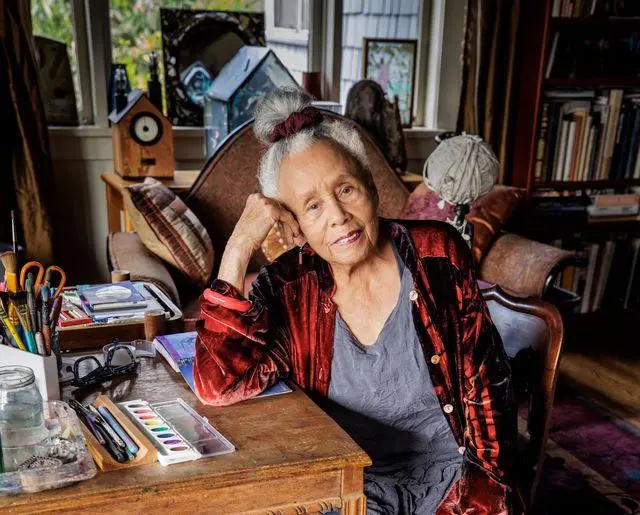
Artist Betye Saar, whose work reflected Black identity, culture and spirituality, died Sunday morning in Los Angeles at 99.
Read more Major Oregon interstate closed for 70 miles due to wildfire
Saar’s death was confirmed Monday by relatives. She would have turned 100 this week.
A central figure of the 1960’s Black Art Movement, Saar pioneered assemblage, or sculptures made of found objects, and reclaimed Jim Crow-era memorabilia as powerful totems of Black liberation.
“Her symbolically rich body of work has evolved over time to demonstrate the environmental, cultural, political, racial, technological, economic, and historical context in which it exists,” according to Roberts Project, the Los Angeles gallery that represented her.
Saar began her career in design and shifted to art at age 35 and continued to make art into her 90s. She grew up in Pasadena and was part of a community of Black artists in nearby Altadena; she often cited Simon Rodia’s Watts Towers as an early source of inspiration.
“Her appropriation of black collectibles, heirlooms, and utilitarian objects are transformed through subversion,” the gallery said. “Among the older generation of Black American artists, Saar is without reproach.”
Saar’s practice incorporated painting, printmaking, sculpture and found objects including dolls, washboards and other antiques.
Made in 1969, “Black Girl’s Window,” wasn’t exhibited widely until many decades later, when it was acquired by the Museum of Modern Art in New York. “There weren’t that many galleries in Los Angeles at the time and there certainly weren’t any for Black artists,” she once said in an interview.
“The Liberation of Aunt Jemima,” made several years later in 1972, is another one of her most important works. It features memorabilia she collected that denigrated Black people, included a “mammy,” or 19th century minstrel character who smiled while serving white slave owners.
Read more Nvidia’s $750 billion deals revive fear of AI circular financing
In Saar’s hands though, the figure is reclaimed: She smiles, but holds a rifle and a hand grenade.
“That was done as an answer to the killing of Dr. King,” said Angela Robinson Witherspoon, in reference to the 1968 assassination of the Rev. Martin Luther King Jr. in Memphis, Tennessee. “She was raising her three young daughters and she wanted to be part of the Civil Rights Movement.”
The Aunt Jemima brand was part of Quaker Oats for more than 130 years. The company announced in 2020 that it would retire the brand, recognizing the logo’s origins were “based on a racial stereotype.”
“I think that she had boundless energy for making art. I think she had a lot to say and was tired of the art world being dominated by white males,” said Robinson Witherspoon, who produced and directed a documentary in 2023 on her. “Betye Saar: Ready to Be A Warrior” features interviews with John Legend, Tina Knowles and other prominent voices.
Though Saar’s work was exhibited in a 1975 solo show at the Whitney Museum, large institutions have exhibited her work only sporadically over the decades. In 2019 though, the Los Angeles County Museum of Art and MoMA mounted concurrent solo shows.
Saar taught and mentored a generation of Black artists, including painter Kerry James Marshall. She’s long been considered a central figure of the West Coast arts landscape.
In spring 2026, Saar was inducted to the American Academy of Arts and Letters.
“Let’s Get It On: The Wearable Art of Betye Saar,” which focuses on costume design, is currently on view at Robert Projects, a gallery in Los Angeles.
Read more Defensive stalwart Vita Vea requests trade from the Bucs
Associated Press Writer Anna Furman contributed reporting from Los Angeles.