
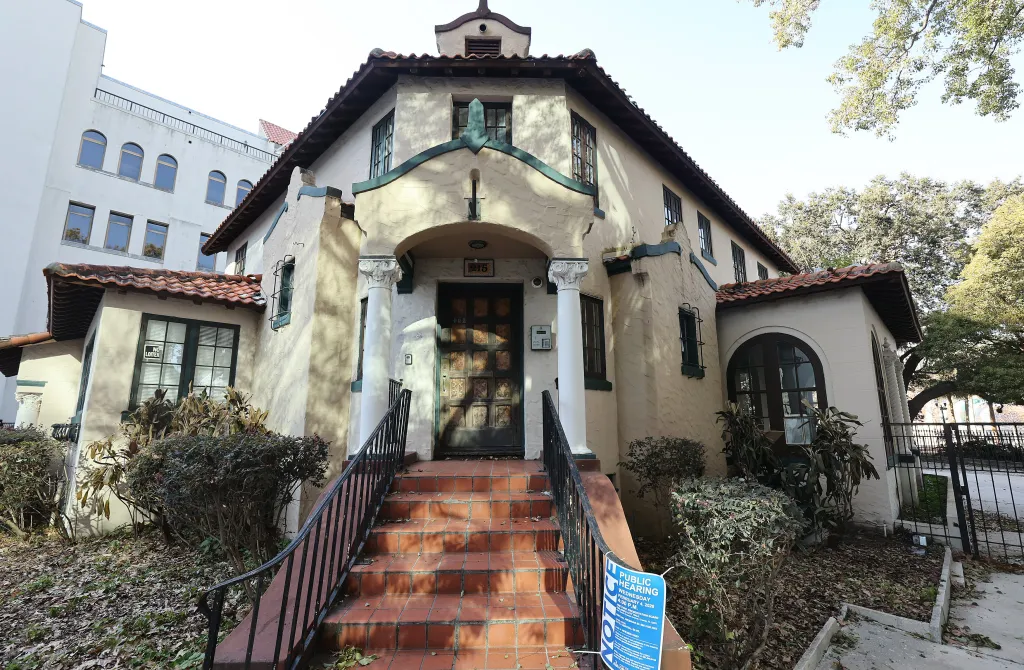
The nearly 100-year-old Lubbe House near Lake Eola has received new support for its preservation, weeks after the Orlando City Commission voted against designating it as a historic landmark.
Read more Venezuela says it deported a close ally of Maduro to face criminal proceedings in US
The Florida Trust for Historic Preservation has placed the Lubbe House on its 2026 “Florida’s 11 to Save,” a list of threatened historic places in the state. The move came at the Preserve Florida conference in St. Petersburg last week and “is designed to increase the public’s awareness of the urgent need to save Florida’s historic resources,” the group said in a news release.
“Being added to this list reinforces our view that it is worthy … and it’s an honor — so it should help save the house,” said Tana Porter, a historian and the co-secretary of the Orange Preservation Trust. “These are expert people … so it’s like validation and one better and louder voice saying, ‘Do not tear this down.’”
The Lubbe House, a Mediterranean-style property built in 1927, sits on the southwest corner of Lake Eola in downtown Orlando. Last year, the city acquired it as part of a plan to expand Lake Eola Park and create a new park entrance near the corner of Central Boulevard and Rosalind Avenue.
The city’s specific plans for the house are still unclear. Orlando Mayor Buddy Dyer said in late February that the home wouldn’t be demolished, but concerned local residents were hoping the landmark designation would provide an extra level of protection for the home.
City commissioners voted 6-1 against the landmark request in mid-March, citing concerns of extra costs for the city if the home received the designation. Officials said repairs and renovations of historic landmarks can be more expensive because of rules governing materials that can be used, among other issues.
David Martens, who sits on the board of the Orange Preservation Trust, said he is “thrilled” the house has been added to the list because it gives the threatened house “good exposure.”
“When you consider the entire state of Florida and how they scrutinize their selections, it’s a very big deal to be part of the 11,” Martens said. “We feel it’ll bring a lot of important attention to the house and further encourage its protection and value to the Orlando landscape.”
The fight to earn landmark status for the house is not over yet, Martens said.
“Landmark status does not only mean you can’t just rip it down,” Martens said. “It means that there’s other provisions that come with landmark status, like grants, so the Orange Preservation Trust will continue to pursue landmark status.”
Commissioner Patty Sheehan, whose district includes Lake Eola, was the lone vote in favor of landmark status for the home.
Read more Evans falls apart after great start at Lakeland; Oak Ridge wins, ties
After the vote, Dyer said officials would seek local input on what’s next for the Lubbe House. “Probably not a restaurant, probably not a wine bar, but we will figure out a good use and help us to upgrade the building itself,” he said.
According to the Florida Trust group, the Lubbe House is remarkable for being “a rare surviving example of Mediterranean Revival, or Moorish-style, residential architecture.”
“Located within Lake Eola Park, the house retains much of its original exterior character, including historic windows, doors and ornamentation,” the group added. “The Lubbe House is especially significant as the last remaining residence originally constructed along the shores of Lake Eola.”
Porter said the house was built by German immigrants for the purpose of overlooking Lake Eola and cannot be moved.
“It has stood very, very well, through hurricanes and time,” Porter said. “It was designed for that exact place and the place would be lost without it.”
Betsy Owens is the executive director of the Friends of Casa Feliz, a historic home in nearby Winter Park, and the granddaughter of the home’s original architect. She is “hopeful” Lubbe House’s designation will help other preservation efforts region-wide.
“Any historic preservation successes in Central Florida, an area which is not known for valuing its architectural heritage, can only help,” Owens said in a text message. “Rising tide lift all ships.”
The other properties making the Florida’s Trust’s “11 to Save” list are: the Ace Theater, built in 1930, and the Villa Serena home, built in 1913, both in Miami; the Capt. Francis A. Hendry House in Hendry County, built in 1914; Interlachen’s Lincoln Lane Schoolhouse, built in 1938; Egmont Key State Park in Hillsborough County, established in 1974; the Flagler-era railway depots in St. Augustine, built in 1906 and 1930; the Hamilton County Old Jail & Museum in Jasper, built in 1893; Pasadena Community Church in St. Petersburg, built in 1961; the Police Memorial Building in Jacksonville, built in 1974; and Stuart High School in Martin County, built in 1922-23.
“Inclusion in Florida’s ’11 to Save’ is a starting point for the Florida’s Trust’s advocacy and education efforts and is intended to be part of a collaborative effort to identify custom solutions for each property,” the trust said.
Read more Senate parliamentarian deals blow to $1 billion security proposal for White House