
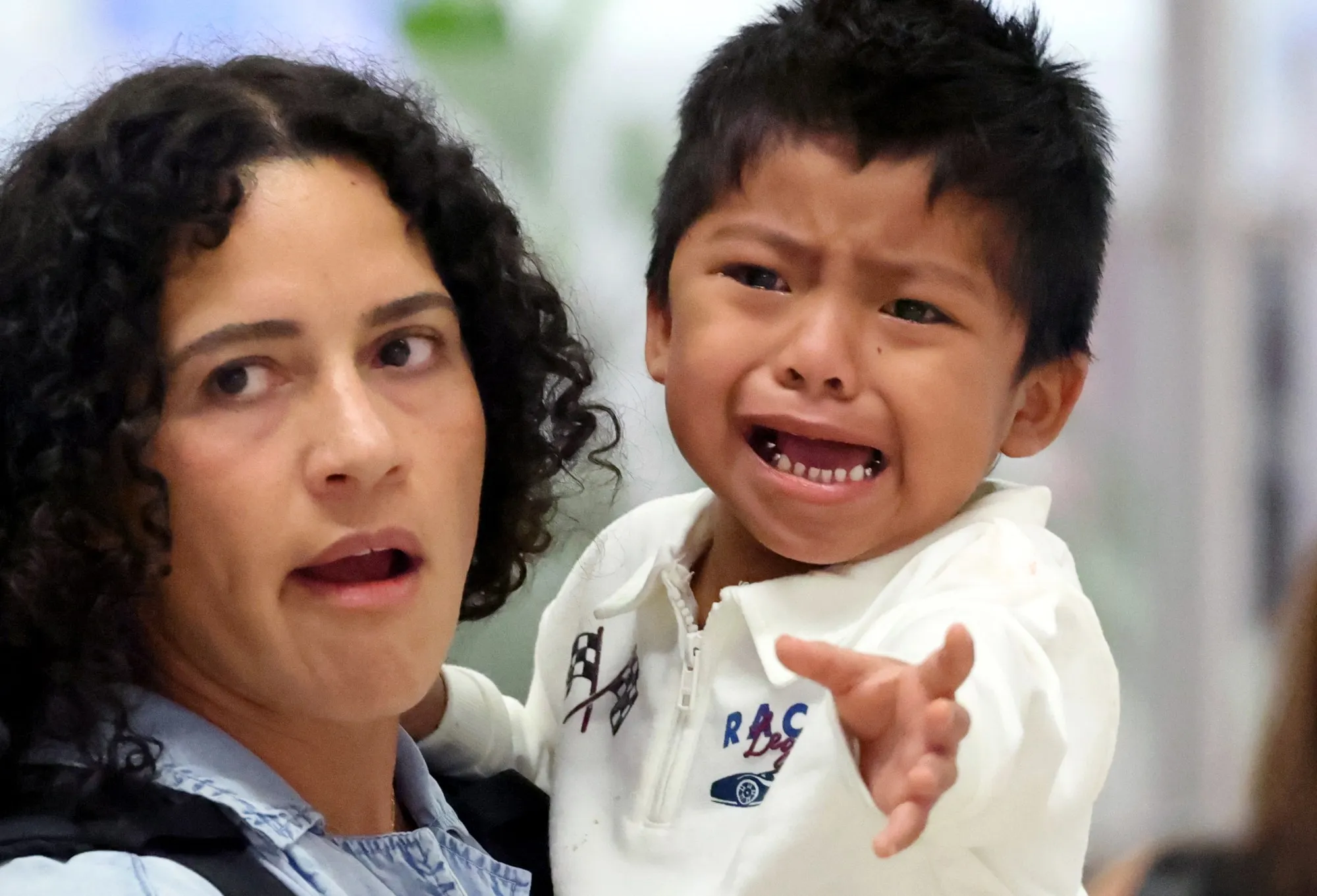
The unrelenting shrieks from a 3-year-old boy pierced the early morning air Friday around a TSA checkpoint at Miami International Airport.
Read more Proposal calls for permanent ‘U.S. Presidential Golf Course’ in Palm Beach County
From behind a barrier, as other travelers flashed startled looks, siblings burst into tears, knowing it would be a long time before they would again see their little brother, who was bound for Guatemala City with eight other children. All had been separated from their families by the deportations of their undocumented parents. Up until a few weeks ago, they had all lived in Palm Beach County.
Altogether, nine children from four families boarded an American Airlines flight Friday from Miami to Guatemala City on a trip that was arranged by the Guatemalan-Maya Center of Lake Worth Beach in another of a growing number of episodes where family separations are the byproduct of the Trump administration’s burgeoning campaign of immigration law enforcement. Eight of the young travelers are U.S. citizens, center officials said. The other is a Guatemalan citizen. The South Florida Sun Sentinel is withholding the full names of the families at the center’s request.
Jessica, one of the boy’s teen-aged sisters, said the airport departure was a second blow the family had absorbed in a month. Their mother and father, both undocumented residents after living in the U.S. for nearly 20 years, were arrested by U.S. Customs and Border Protection in early August and sent back to Central America. Except for the boy, Aiden, the couple’s U.S.-citizen children remain in South Florida, where their 18-year-old daughter, Wendy, now oversees their care.
“They took us from our parents, and now this is taking us from our brother,” Jessica said.
Wendy said she will be the main breadwinner, working two jobs while she contemplates studying at a local college.
They knew what was coming, said Mayra Cardenas, a program coordinator at the center.
“For them this was really sad,” Cardenas told reporters. “They are really attached to the baby, as you guys can see, and it was hard for them to let them go.”
As for the parents now in Guatemala, Cardenas added, “they’re devastated. They know how hard it is. [Wendy] is only 18 and now she’s overseeing four siblings.”
Given the circumstances, she said, “she realized sending the baby to the mom was the best decision.”
“It’s hard for us at the center that we see this daily,” Cardenas added, tears welling up in her eyes. “We are helping to make it easier on the parents. We handle all the paperwork, provide transportation and serve as a little bit of a therapist as well. When you live in a country when they are constantly being targeted and constantly being called criminals, it’s hard.”
Read more Best back scratcher
For months, the arrests of undocumented immigrants and the separation of families who have lived in South Florida for years have been on the rise as the Trump administration fortifies federal immigration enforcement agencies with more money and more agents.
The consequences of family separations
But some on the front lines of the nation’s growing clash on immigration wonder who will pay for the safety and care of children left without parents.
“There is a growing number of people who are being deported who have U.S. citizen children or lawful permanent resident children here,” said Evelyn Alexandra Batista, an immigration lawyer in West Palm Beach. “No one is asking or disclosing how many of those children are being left here or who actually is leaving with their parents. This is a very serious problem the government is not talking about and is going to have to be paid for through taxpayer dollars.”
In Florida, there are 332,100 U.S. citizen children living with at least one undocumented family member, according to survey data cited by the Washington, D.C.-based American Immigration Council. There are 249,700 U.S. citizen children living with at least one undocumented parent.
Nationally, there are 5,211,000 U.S. citizen children living with at least one undocumented family member. And there are 4,153,900 U.S. citizen children living with at least one undocumented parent.
Batista, who is not involved in any of the families’ case, said she has two clients — one from Guatemala and one from El Salvador — with similar situations.
“Salvadorans are going to be losing their [Temporary Protection Status] within the next week,” she noted. “What happens when their children are left here in the custody of the states? They are financially dependent on the welfare system and foster care system here.”
As for the parents of the children who flew out of South Florida on Friday, Cardenas of the Guatemalan-Maya Center said she was not certain whether they will get a chance to regain a foothold in the United States so they can be with their children.
“We don’t know, honestly,” she said. “With this administration everything is uncertain. We’re not sure if they can have a chance.”
Read more Extreme sports, quilts, the Beatles, Tupperware and José Andrés: A lot to learn this season