
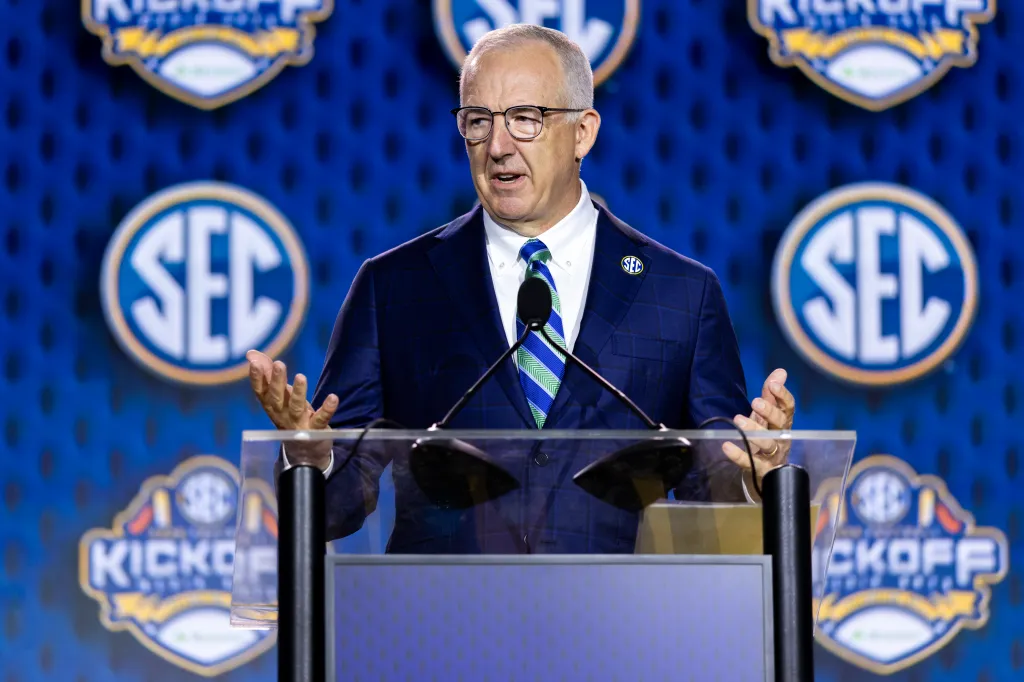
Greg Sankey insists the Southeastern Conference isn’t trying to use the threat of a breakaway as leverage.
Read more Central Florida trending hotter through the week as heat continues climb
Maybe not.
But when the commissioner of college football’s most powerful conference publicly acknowledged Monday at SEC Media Days in Tampa that league presidents are having “real” conversations about leaving the rest of college athletics if Congress doesn’t fix the Protect College Sports Act to their liking, it’s hard to hear anything else.
Whether Sankey intended it or not, the message landed loud and clear: Give us what we want, or we’re outta here.
That’s not leadership. That’s hostage-taking.
For years, college athletics has marched to Washington, begging Congress to save it from itself. Conference commissioners, university presidents and NCAA executives insisted only Congress could create national standards, rein in NIL chaos, protect schools from endless lawsuits and bring stability to an industry that has spent the last four years eating itself alive.
Now Congress is finally trying.
And suddenly the SEC has discovered government meddling might not be such a wonderful idea after all.
Funny how that works.
The SEC and Big Ten have submitted 10 proposed changes to the legislation, many dealing with lawsuits, state law preemption and NIL enforcement. Some may very well be reasonable. Sankey himself called them “commonsense suggestions.”
That’s not the problem.
The problem is the posture.
When the most powerful people in college football respond to a bipartisan effort by essentially saying, “If this doesn’t go our way, maybe we’ll just leave everybody else behind,” they aren’t acting like stewards of the sport. They’re acting like executives protecting market share.
“I do not believe that is a leverage point,” Sankey said of the SEC’s talk of breaking away. “I think that’s just honest communication.”
Whatever.
The fact of the matter is that real leaders don’t threaten to take their ball and go home. Real leaders ask what is best for everyone playing the game.
Imagine if Jerry Jones held a news conference tomorrow and declared the Dallas Cowboys deserved a larger share of the NFL’s television revenue because they’re America’s Team. He’d be laughed out of the room.
That’s because the NFL figured out long ago that competitive balance is good business. The Jacksonville Jaguars receive the same national television money as the Dallas Cowboys because the league understands something college football’s power brokers increasingly seem to forget: the Cowboys are worth billions precisely because the NFL as a whole is healthy.
College football increasingly operates under the opposite philosophy.
What’s good for the SEC and Big Ten is good for the SEC and the Big Ten. Everything else is negotiable.
That’s why Sankey’s comments were so revealing. He pointed to the SEC’s 13 national championships across all sports last year as evidence of the value his conference brings to the NCAA. Fair enough. Nobody disputes the SEC’s excellence.
But success shouldn’t entitle anyone to rewrite the rules (or potential laws) whenever they become inconvenient. Leadership requires rising above that.
Read more Universal: Multiday Horror Nights passes now on sale
Instead, college football has become an endless parade of conferences lobbying for whatever advantages benefit themselves.
The SEC wants protections from lawsuits. The Big Ten wants protections from lawsuits. Everybody wants federal help controlling athlete movement. Everybody wants uniform NIL rules. Everybody wants Congress involved — until Congress might produce a framework that doesn’t maximize their individual leverage.
Then suddenly the conversation changes.
Of course, it’s ridiculous that the government is involved in the first place. Think about how absurd this has become. What other multi-billion-dollar corporation would ask the federal government to meddle in its business? But that’s exactly what college football has done because its own executives have proven incapable of governing themselves. That alone should embarrass every university president in America.
Now imagine explaining to Congress that after years of begging for help, one of the nation’s wealthiest athletic conferences is threatening to leave because lawmakers won’t write exactly the bill it wants.
If you’re a senator, what message does that send?
It says this isn’t really about saving college sports.
It’s about protecting the SEC (and the Big Ten).
Sankey said there remains “meaning and value” in participating in a national organization but warned that “the national organization must function in a healthy manner.”
He’s right.
The NCAA has failed repeatedly. College athletics desperately needs better governance.
But healthier governance doesn’t begin with the richest conference reminding everyone it has an exit strategy. It begins with accepting that leadership sometimes requires compromise.
That’s what makes Sankey’s comments so disappointing.
The SEC occupies a position unlike any conference in college athletics. It has the resources, influence and credibility to help build the next era of college sports. Instead, its public posture increasingly resembles a corporation reminding regulators how much economic damage it could cause if it doesn’t get its preferred deal.
That’s not how you build trust. It’s certainly not how you build consensus.
The saddest part is that none of this should surprise us anymore.
College football no longer has leaders focused on protecting the sport. It has executives focused on protecting their conferences. Every major decision is filtered through one question: What’s in it for us?
Not for college football. Not for student-athletes. Not for fans.
For us.
And that’s precisely why the sport keeps finding itself in crisis. Every conference claims to be acting in the best interest of college athletics while simultaneously fighting for a larger slice of the pie.
The SEC didn’t become college football’s gold standard by threatening to leave everyone else behind. It became the gold standard by building the strongest football product in America.
Imagine how much stronger the sport could become if its most powerful conference devoted as much energy to protecting college football as it does protecting its own advantages.
Email me at [email protected]. Hit me up on social media @BianchiWrites and listen to my radio show “Game On” every weekday from 3 to 6 p.m. on FM 96.9, AM 740 and 969TheGame.com/listen.
Read more Asking Eric: I made a mistake at self-checkout, and a clerk tailed me to my car