
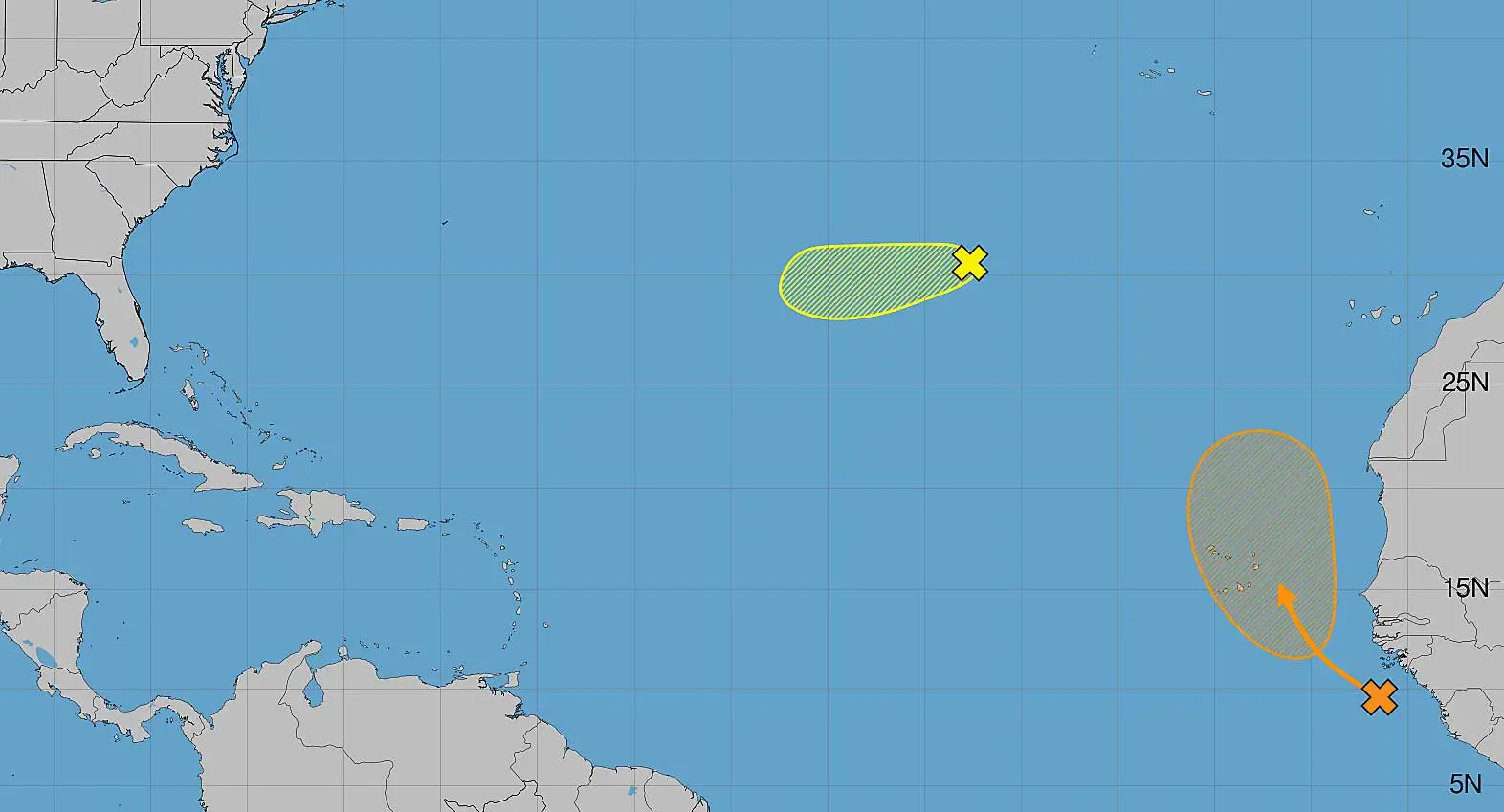
A short-lived tropical depression could develop this week from a tropical wave off the coast of Africa and the remnants of what had been Tropical Storm Fay could redevelop, according to the National Hurricane Center.
Read more Orlando Ballet, Philharmonic take top Dr. Phillips Impact Awards
In its 8 a.m. tropical advisory Wednesday, the NHC said chances had grown for development for an area of low pressure associated with the tropical wave now located about 600 miles southeast of the Cape Verde Islands.
“This system could become a short-lived tropical depression on Thursday or Friday while it moves northwestward to northward. However, strong upper-level winds should end the opportunity for development by the weekend,” forecasters said. “Interests in the Cape Verde Islands should monitor the progress of this system as gusty winds and areas of heavy rain are possible there by the end of the week.”
The NHC gave it a 30% chance to develop in the next two days and 40% in the next seven.
If it were to become strong enough, it could become Tropical Storm Gonzalo.
Meanwhile, what had diminished into a post-tropical cyclone on Tuesday, the remnants of Fay, now a low pressure system located about 800 miles southwest of the Azores in the central subtropical Atlantic, could find a way back into development.
“Shower activity associated with the low has increased this morning. However, significant re-development of this system is unlikely while it
moves generally westward over the next couple of days. By the weekend, increasingly strong upper-level winds should inhibit
re-development,” forecasters said.
The NHC gave it a 20% chance to redevelop in the next two to seven days.
Fay became the sixth named storm of this slow Atlantic hurricane season. So far the hurricane season has yet to produce an actual hurricane, though, but has seen the formation of tropical storms Arthur, Bertha, Cristobal, Dolly and Edouard.
Read more From transfer portal to starting quarterback: UCF’s Keyone Jenkins embraces new role
Edouard made landfall in Louisiana with the NHC’s last advisory coming on Sept. 3 as it moved inland over Texas.
It’s been quiet in the tropics since then.
Hurricane season began June 1 and runs through Nov. 30, but the height of hurricane season runs from mid-August through mid-October.
The National Oceanic and Atmospheric Administration last month updated its seasonal forecast and now expects between seven and 13 named storms this year. Of those, two to six would become hurricanes. It also predicted that there might not be any major hurricanes this year, or at most two.
Already, 2026 was forecast to have lower-than-average storm generation, and that has been reduced even further with the latest forecasts from the NOAA and other weather groups.
An average year would see 14 named storms and seven hurricanes, with three of those growing to Category 3 strength or higher.
Read more Best auto-follow drone