
Every vote counts. But not everyone wants every vote to count.
Heading into the fall elections, Americans face a widespread, coordinated and sustained assault on the bedrock of democracy. From state capitals to the White House, schemes to keep people from registering, voting or having their ballot counted are already in law, or in progress.
Read more Brewing El Niño and roasting oceans push planet into ‘uncharted territory’ for heat
We can’t yet know how these efforts will impact voting results, and for good reason: This has never happened before.
Some hurdles are deliberate and calculated to keep Americans from the ballot box or to secure one-party dominance. Others grew out of unrelated laws. To voters, though, it does not matter. Whether the hurdle is by accident or by design, suppression is still the end result.
Anticipation needed
Though voters face new challenges, they are not powerless. In the first of a series of editorials, the South Florida Sun Sentinel and Orlando Sentinel are highlighting hurdles to voting, how obstructions can keep people from the ballot box, and, most importantly, how voters can proactively anticipate barriers to voting, counteract them, and make sure their voices are heard.
Some efforts are national and intentional. The Trump administration last month threatened to withhold federal homeland security money to states unless they surrendered to a scheme interfering with how state and local elections are run.
By contrast, nothing suggests that a Florida law passed in 2022 and implemented in 2024 affecting driver’s licenses was intended to cause confusion over voter identification or disrupt voting by mail. But the law (SB 914), which had from Republicans and Democrats alike, threatens to do so, all the same.
Florida driver’s licenses and state ID cards issued, renewed or replaced after July 31, 2024, now include at least four randomly generated numbers. It fixed a security loophole: New licenses are less likely to be compromised.
Because the same state-issued identifications are also used to verify a voter’s identity, drivers are asked if they want to update their voter registration when they get a license or ID card. Saying yes will stop a future voting problem.
Reminders to voters
Election supervisors are reminding affected voters that they have to update their voter information, but the question is easily overlooked. If voters who want mail ballots haven’t yet chosen to update their information online, the Florida voter database might not recognize them.
These potential glitches will not prevent people from voting in person and voters who used their Social Security numbers to register are not affected. Even so, a small glitch can have a very big impact.
Read more Publix fruit at center of E. coli outbreak investigations, FDA and CDC say
Florida has more than 17 million licensed drivers. Those who are age 79 or younger renew their licenses every eight years. Voters 80 and over must renew every six years, and older voters are much more likely to vote by mail.
According by Florida State University’s Leroy Collins Institute, the older the voters, the more likely they are to vote by mail.
The risk to older Florida voters comes into sharper focus given the state Legislature’s crackdown on voting following Donald Trump’s loss in the 2020 election.
Voters can request vote-by-mail ballots online, by phone or in person, but the requests expire after every general election. That means Florida voters who most frequently renew their licenses are often the same ones expected to request mail ballots in large numbers this year.
The answer is ‘Yes’
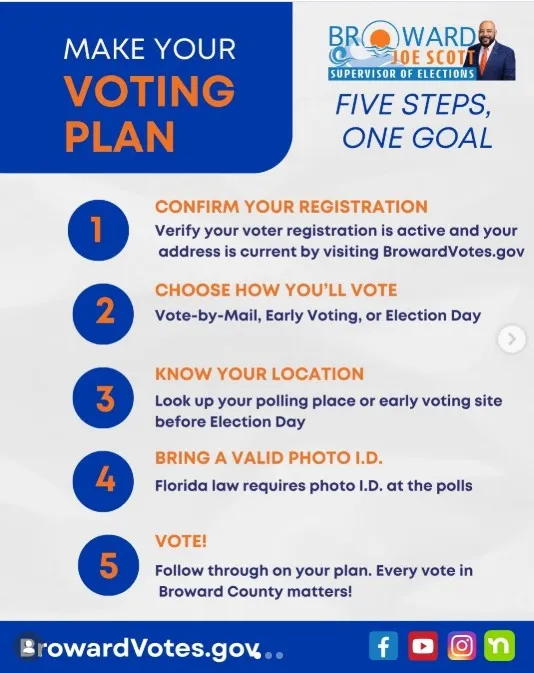
There are simple fixes. If you plan on renewing, replacing or updating your driver’s license or state ID number, you should answer “Yes” when asked if you want to also update your voter registration.
If you did not opt to update when you obtained your license or ID, you can easily update your voter registration using the Florida Online Voter Registration website.
If you do not want to use the online option, or are not sure whether you updated your registration, you can contact your local supervisor of election. Do it now, to make sure you are able to cast your ballots in August and November.
The Orlando Sentinel Editorial Board includes Executive Editor Roger Simmons, Opinion Editor Krys Fluker and Viewpoints Editor Jay Reddick. The Sun Sentinel Editorial Board consists of Executive Editor Gretchen Day-Bryant, Editorial Page Editor Steve Bousquet, Deputy Editorial Page Editor Dan Sweeney and editorial writers Pat Beall and Martin Dyckman. Send letters to [email protected].
Read more A disappointing World Cup for Christian Pulisic as US star is scoreless and hobbled by injuries