
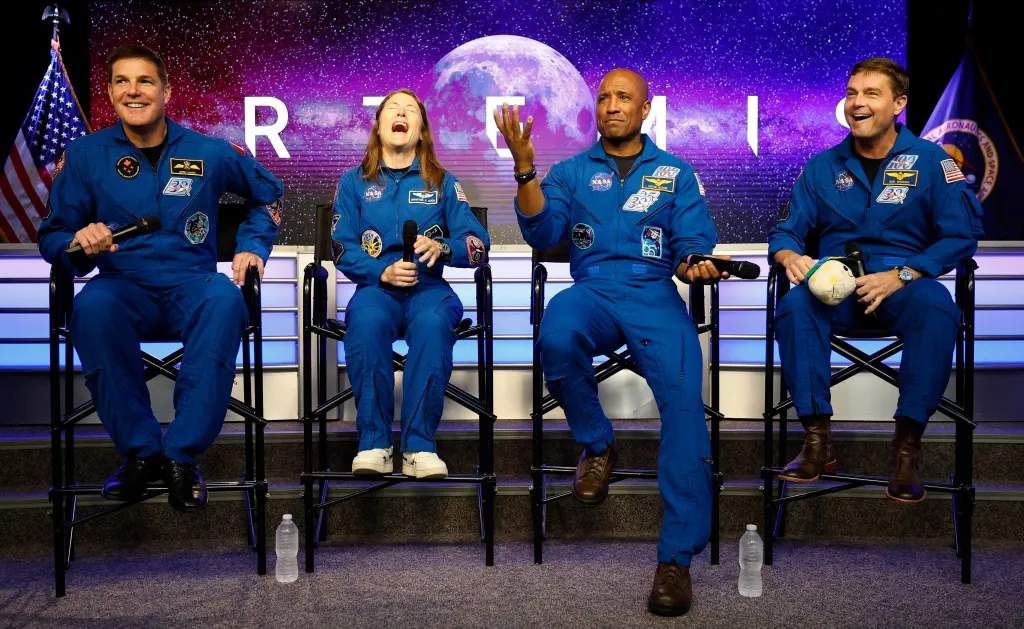
KENNEDY SPACE CENTER — The last time the four astronauts of Artemis II were together in Florida, they were taking a ride on the most powerful rocket to ever launch humans into space.
Read more Judge orders E. Jean Carroll be paid $5.8M after jury found Trump sexually abused and defamed her
The quartet of NASA’s Reid Wiseman, Victor Glover and Christina Koch, as well as the Canadian Space Agency’s Jeremy Hansen, returned to the launch site Wednesday, where they offered an engaging, descriptive recap of their singular experience of being hurtled out of Earth’s atmosphere for a 10-day mission that ventured around the moon.
“We all drove up to the pad last night. It’s a lonely place without that rocket on it,” Wiseman said.
Just over three months ago they were atop that Space Launch System rocket, strapped into the Orion capsule seats and blasted off KSC’s Launch Pad 39-B with 8.8 million pounds of thrust.
The world’s eyes were on the crew as they set other records, including the farthest distance traveled from Earth by humans — 252,756 miles — surpassing the distance flown by Apollo 13 in 1970. But it started with what was the first crewed launch of SLS and Orion, besting the power of Apollo’s Saturn V rockets and the space shuttle missions.
“I almost asked for my money back,” Koch said of the liftoff. “There was no shaking, no vibrating, no teeth shattering.”
She said there were no issues reading the displays, and that the ride up was “silky smooth.”
As pilot Glover and commander Wiseman were reading off telemetry during launch, she said she and Hansen were looking at one another thinking “this is so cool.”
“I was watching out the hatch window, watching the blue sky go all the way to black through steely blue. It was phenomenal. It was a great ride,” she said.
Glover said the key to them doing their job well was “getting comfortable being uncomfortable.”
“We knew we were going to step out into this place that people had never been before, and you just have to be OK, sometimes, not being OK, not being prepared for everything,” he said.
Hansen, who recently announced he was retiring from the Canadian Space Agency, was the only one of the four who had not traveled to space previously. He said the crew had a lot of faith in the vehicle, but were realistic about the mission.
“We just acknowledge the risk,” he said, noting they were “extremely optimistic that we were going to come back, but also knew that this was 10 days that there was a significant risk throughout the entire thing.”
Psychological preparation was key to setting aside those things they could not control.
“By getting to that mental state, I found, all four of us were very Zen-like, and really able to just observe and take in the experience,” he said.
Commander Wiseman said no one was more surprised than the four of them when the solid rocket boosters finally lit and the rocket took off. But as the mission unfolded, which featured a series of orbit-raising burns before committing to a trip to the moon, he was ready for it to come to an early end.
Read more Transgender teen drops out of Irish Dance meet in Orlando
“I was always thinking, ‘This mission is going to end after this burn,’” he said. “And then we would do the burn, and now it’s like, ‘Okay, well, shockingly, now we’re gonna head off to 38,000 miles and do another one of these, and then be ready to go home there.’”
Once they finally began orbiting the moon, “I was like, well, we’re not going home for eight days now, so let’s get comfortable.”
In the end, the mission sent them nearly 700,000 miles, flying back into Earth’s atmosphere at 24,664 mph and landing safely in the Pacific.
The crew also got to get a look at the capsule they had named Integrity, which made its way back from San Diego after its ocean recovery and is now at KSC’s Multi-Processing Payload Facility.
“We were just right outside Integrity a few hours ago, very emotional to see our spacecraft there,” Wiseman said.
The four are finishing up U.S.-based media appearances since landing, but still have more set for Europe.
While they tout the Artemis II experience, they also continue to cheer NASA’s Artemis III crew, whose members were named last month.
That mission aiming to launch from KSC in mid 2027 won’t be flying to the moon, but instead will make a low-Earth orbit trip that aims to test out Orion’s ability to dock with one or both of the two lunar landers being developed by Blue Origin and SpaceX.
Koch said that while Artemis II paved the way for their launch, one thing she wants to be mindful of “is not to be advice monsters.”
“This is their mission, and they are going to take it farther than we took it,” she said. “They are going to innovate, they are going to take it with their frame of mind, and I can’t wait to see what they do.”
It won’t be until Artemis IV that NASA seeks to return humans to the lunar surface for the first time since Apollo 17 in 1972.
Wiseman said that even with Orion 3,000 miles from the moon during their mission, it was easy to think about going all the way.
“I really felt like if we had a lander, we could hop in and go down to the surface of the moon,” he said.
With Hansen retiring and the three NASA astronauts’ future beyond their public relations appearances uncertain, Wiseman would not say whether any of them would throw their boots in the ring to get back to the moon.
“I’m going to tell you unequivocally, I wish I could walk on the moon, but I’m also going to tell you that I can’t wait to watch my friends walk on the moon,” he said. “I’ve never been alive when that has happened, and I’m going to be cheering the loudest out of 9 billion people. You will hear me.”
Read more First look: Epic Universe blasts out new nighttime show