
Millions of dollars in coastal infrastructure and a booming fishing industry are at risk in South Florida as the region’s coral reefs continue to die off at a rate scientists call alarming.
Read more Harvest to Table at 4Roots Farm returns with a focus on family
The threat has become more visible in recent weeks as South Florida endures a string of heat advisories and ocean temperatures keep climbing. The state’s coral reefs once covered roughly 50% of the sea floor; today, that figure is under 5%.
“Corals cannot tolerate that increase in heat,” said Joana Figueiredo, a marine biology professor and director of Nova Southeastern University’s National Coral Reef Institute. “They’ve evolved for millions of years in a very narrow temperature range, so whenever they go outside of that, they just get stressed, and then a lot of them die.”
Reefs are the first line of defense against coastal flooding, absorbing up to 97% of incoming wave energy before it ever reaches the shore. Without this buffer, storm surge and coastal erosion hit harder, which can threaten homes, roads and other infrastructure — and in worse cases, can force communities to relocate.
“The reef is really important because it breaks the wave action,” Figueiredo said. “So when the waves hit the reef, they break the wave and that means they’re going to have less coastal erosion.”
Florida’s flatness, Figueiredo added, makes the flooding risk especially acute.
“Even a minor storm, you’re going to get water going in, not just a big storm,” she said.
Researchers estimate that coastal erosion in the U.S. causes about $500 million in property loss and damage annually.
The U.S. already spends heavily on beach nourishment — pumping in new sand to replace what storms wash away — a method that has cost more than $10 billion nationwide over the past century.
Researchers say investing in coral restoration now can lower future costs.
“Every year we put sand on our beach and then the storms come in and take the sand away,” Figueiredo said. “All this money we put on the beach just goes away, so imagine having to do that so often.”
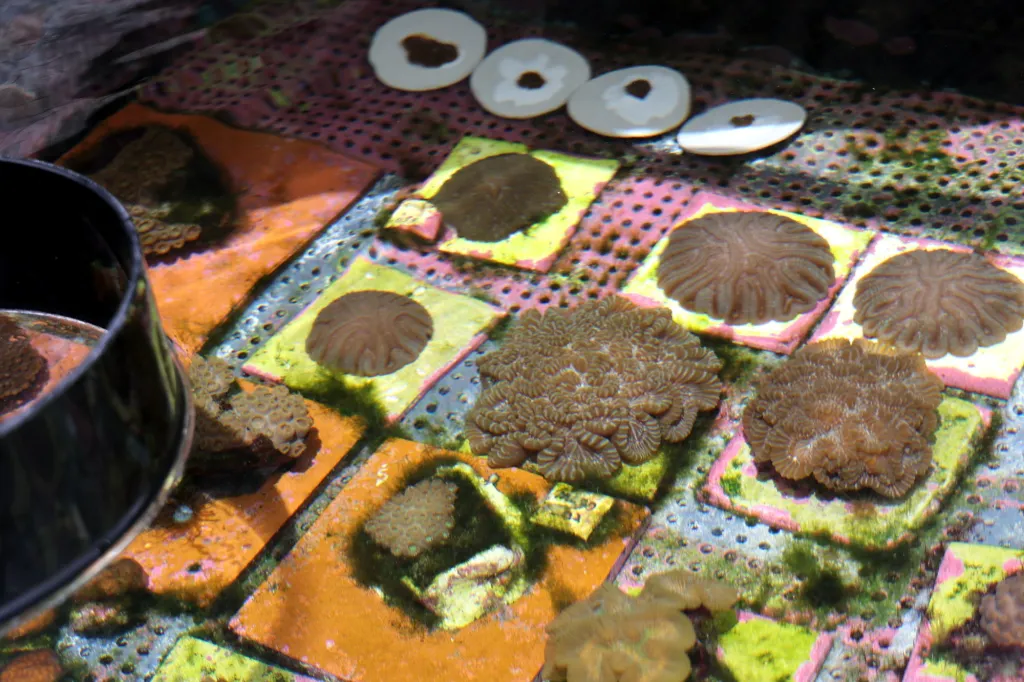
NSU researchers are working to slow this decline by growing coral to a suitable size for planting on Broward County’s reefs; their goal is to reconnect a population that has become too sparse to sustain itself.
“They’re [the corals] are too far away from each other to make babies,” Figueiredo said, explaining that corals killed off by heat and disease leave survivors too isolated to reproduce.
Read more Heat advisory for all of Central Florida lasts from 11 a.m. to 8 p.m.
The University of Miami is taking a different approach: Building “hybrid reefs” in Miami-Dade County that pair manmade structures a couple hundred meters offshore with living coral.
The UM project, funded by the Defense Advanced Research Projects Agency, aims to grow corals that can better survive warmer water.
To do that, scientists are crossbreeding native Florida coral with coral sourced from Honduras, where reefs run about 2 degrees warmer.
“They’re [the oceans] are warming faster than ever before,” said Andrew Baker, a UM marine biology professor and the school’s director of the Coral Reef Futures Lab. He noted that not every year is warmer than the last, but that “if you plot a line through the last few decades, there’s an inescapable trend upwards, and that rate of change is accelerating really fast.”
In fact, a NOAA analysis found it “very likely” that 2026 will rank in the top five warmest years.
“Every single year, we’ve entered a new normal, where the kinds of temperatures we see every summer are the kinds of temperatures that would have been unheard of even in the year 2000,” Baker said.
But the new hybrid corals aren’t just built for heat. Despite 2025 delivering some of the warmest summer months on record, January brought some of the coldest winter temperatures in years, and Baker said the coral are being bred to handle both extremes, not just abnormal warmth.
“Climate change isn’t just about the warming trend, it also tends to increase the variability along with that trend,” he said.
A 2022 study by NOAA and the University of Miami found that 70% of Florida’s coral reefs are currently experiencing net habitat loss — meaning they’re eroding faster than they’re growing.
“I think the impact is much higher than people are thinking,” Figueiredo said. “We don’t want to be doing restoration forever.”
Read more Asking Eric: He’ll give his grandkid $10,000 but won’t use their new name