
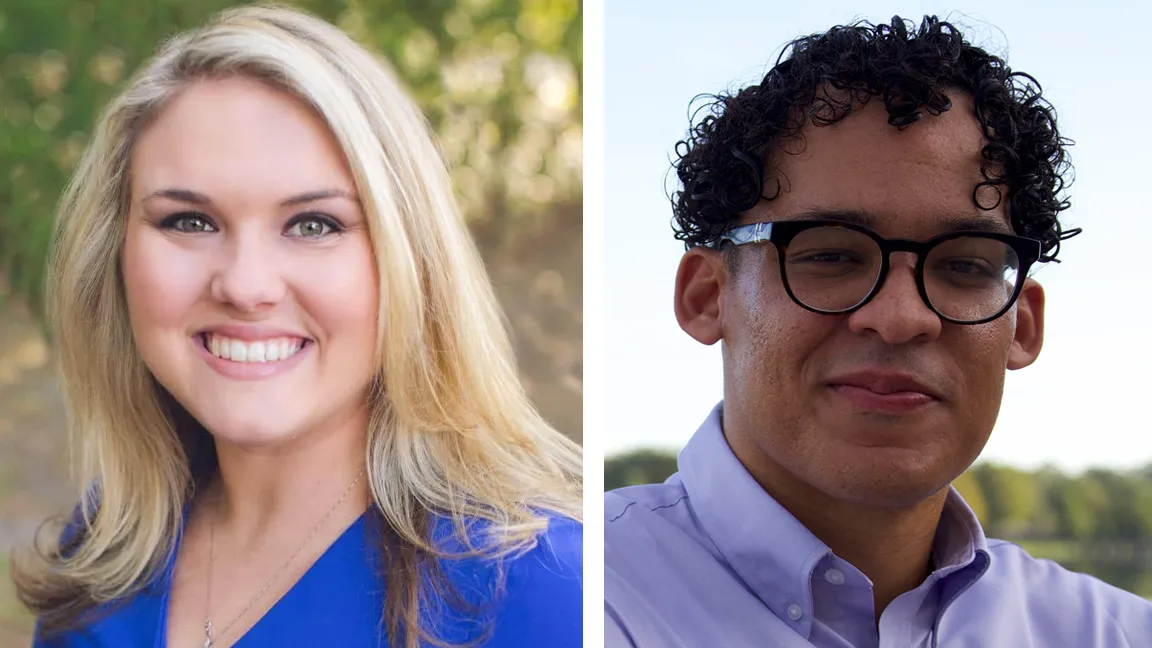
Residents in central Seminole County will have a new representative in the Florida House next session after GOP state Rep. David Smith was term limited after eight years in office.
Read more Scammers posing as FBI stole 18K from elderly Windermere resident, cops say
Now Republican Emily Duda Buckley and Democrat Nik Dean, both political newcomers, are vying for the District 38 seat, which covers portions of Altamonte Springs, Casselberry, Fern Park, Oviedo and Winter Springs.
Buckley, 34, is a descendant of the Duda family, which first settled in Oviedo in the early 20th century and have long farmed celery and citrus. Today, A. Duda & Sons is a large agricultural and real estate corporation with farming and real estate operations around the country.
Neither Buckley nor her campaign returned calls for comment. According to a Sentinel candidate questionnaire, Buckley said her campaign is focused on “kitchen table” issues.
“Issues like lowering insurance rates, reducing burdensome taxes, increasing affordable housing options, fixing our deeply flawed child and elder care systems and making our state more affordable for the families that call Florida home,” she responded.
Buckley defeated Marcus Hyatt in last August’s GOP primary by garnering nearly 57% of the votes.
Dean, 31, is a medical malpractice attorney who lives in unincorporated Seminole near Maitland. He grew up in Central Florida before heading to Tufts University in Medford, Mass., where he played football and earned degrees in philosophy and political science.
Dean qualified as a candidate in late August after Democrat nominee Michelle DeJesus dropped out of the race, citing family issues.
“Affordability is always top of mind for me,” said Dean, in explaining his top campaign issues.
“Young people today are so worried about having to work their entire lives — struggling to make ends meet — and then they wonder: Am I ever going to have a meaningful pathway to retirement?” he said.
He proposes providing state tax incentives to companies that offer profit sharing for its employees as part of compensation, or that provide employees with equity in their company. In turn, that would incentivize employees to contribute to the success of a company and also “increase the wealth of working families,” Dean said.
To tackle affordability and rising cost of living, Buckley wrote that she would “pursue residential property tax relief, build on the insurance reforms that are bringing carriers back and lowering premiums and fix the ‘cliff effect’ in childcare and [Florida] KidCare so families aren’t penalized for earning more.”
Both candidates said they would preserve rural areas. However, they offered differing opinions on protecting Seminole’s development-restricted rural boundary if future state legislation would attempt to demolish it.
In 2004, Seminole voters approved placing the county’s rural boundary in the county charter. The rural boundary covers nearly the entire eastern third of Seminole — mostly east of the Econlockhatchee River — and residential development is restricted to either one home per five acres or one home to 10 acres. It’s an effort to prevent urban sprawl in an environmentally-sensitive area that lacks water and sewer lines.
Read more Seniors face higher Medicare prescription costs in 2027
Two years ago, Seminole voters overwhelmingly approved a referendum that would require at least four of the five county commissioners to vote in favor of removing property from the rural area.
But during this year’s legislative session, an amendment was added into a land-use bill that would have allowed property owners within or adjacent to rural boundaries, including Seminole’s, to seek compensation if the county didn’t give them permission to remove the development restrictions. The amendment — which would’ve gutted Seminole’s rural boundary restrictions — failed in the Senate, but the issue is likely to return in next year’s Legislature.
Supporters of the amendment said restrictions in rural areas, such as in Seminole, could be a violation of property rights. But opponents said developers can still build within rural areas, but not at high densities. Or they can request to remove property from the rural area.
“I respect both sides of this,” Buckley wrote in the questionnaire. “I understand why residents value the rural boundary; it protects the character and natural resources that make this area special. And I also take landowners’ property rights seriously.”
Dean said he’s “all for protecting the rural boundary,” calling it a local issue decided by Seminole voters and not the Legislature.
The rural boundary “is one of the rare bipartisan issues that people in Seminole County have strongly voted for and local elected officials support,” Dean said. “I’m not against development. But we have to be smart with development. …There is a way to increase housing and affordability in the urban areas without disturbing the [development restrictions in] rural areas.”
To control health care costs for working families, Dean proposes increasing Medicaid reimbursement rates and funding for community healthcare clinics.
Buckley is a licensed foster parent and has long worked as a guardian ad litem. She also has worked with the Florida Association of Foster and Adoptive Parents and the 4Roots Foundation.
Her residency, though, is unclear.
According to Leon County property records, Buckley is the co-owner of a home just north of Tallahassee with a homestead exemption. But according to state financial records, a corporation tied to her, Mikler Estates LLC, owns a house on Mikler Road in Oviedo. Florida law requires legislators to live within their district on election day.
Dean listed a net worth of $88,371, in state financial disclosure forms. He earns $176,669 in annual income from the Winter Park law firm where he is employed. As of Oct. 2, Dean’s campaign has raised nearly $37,000, which includes $23,000 from the Florida House Democratic Campaign.
Buckley listed her net worth at $869,540, including the Tallahassee home valued at $534,100 as an asset. Her annual salary is $145,483 from A. Duda & Sons, and $9,540 in stock dividends from the company, according to the financial disclosure form.
Her campaign has raised $309,140 in contributions as of Oct. 2, including $49,500 from the Florida House Republican Campaign and various donations from political committees tied to mining, oil, gas, agriculture and insurance industries.
Read more Orlando police: Michelle Parker’s ex-fiancé charged with murder 15 years after disappearance