
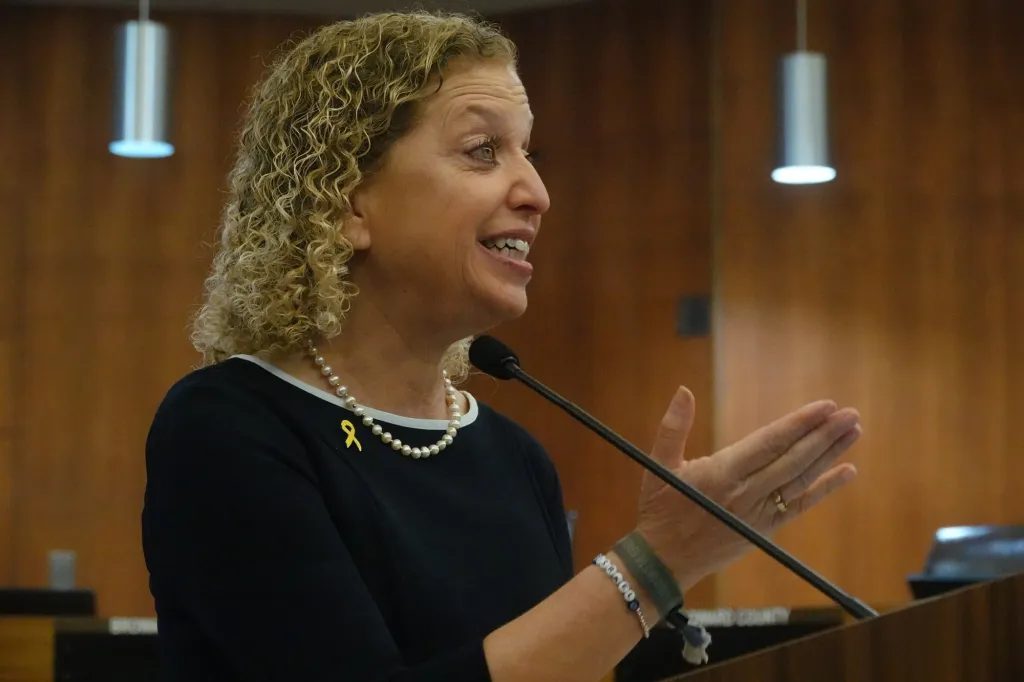
Polling conducted for Congresswoman Debbie Wasserman Schultz’s campaign shows she is viewed favorably by Black voters in the district where she’s seeking reelection — despite strenuous objection to her candidacy from Black candidates running for the same seat and some community leaders.
The poll found that Wasserman Schultz, who is white, has higher favorability among African American and Caribbean American Democrats in the 20th Congressional District than she has among white voters. Black voters’ views increase her overall favorability among Democrats to 80%.
Among the poll’s other findings: Wasserman Schultz would win the Democratic primary with a majority of the vote and not, as some of her primary foes and community activists have warned, by finishing in first place — but not with a majority — in a crowded primary field.
Wasserman Schultz had 52% of the primary vote in the survey. Seven other candidates had a combined total of 43% of the vote. Another 5% of voters were undecided.
“It was a gratifying result,” Wasserman Schultz said. “It’s demonstrative of the fact that I have been immersed in the African American and Caribbean American communities in Broward for years. I have shown up. I have been at events and organizations and church services and festivals and marched in Souls to the Polls every single election cycle in the primary and general (election) even when it wasn’t in my district. … I have shown up. And showing up matters.”
The poll was conducted by EMC Research for Wasserman Schultz’s campaign, which provided results of several questions to the South Florida Sun Sentinel. The campaign didn’t release the individual percentage for each of the other candidates.
The poll reported she is known by 93% of likely Democratic primary voters in the district.
Redistricting
The issue of where Wasserman Schultz should run has been the subject of furious debate in Broward Democratic Party circles for several weeks. On Friday, she announced she would seek another term in the 20th Congressional District.
Her decision, and the criticism of it, stem from Florida’s unusual move to change congressional districts in the middle of the decade. The Republican-controlled Florida Legislature ratified the redistricting plan, which came from Gov. Ron DeSantis, who signed it into law.
That happened after President Donald Trump told Republican-controlled states he wanted them to change congressional district boundaries in ways that would get more Republicans and fewer Democrats elected in November.
One element of the plan was to chop up Wasserman Schultz’s current district in southern and western Broward. Pieces were divided among five new congressional districts, four of which include parts of other counties and four of which lean Republican.
Black community
The newly configured 20th Congressional District, where Wasserman Schultz is running, includes some territory she’s long represented, and also includes most of the African American and Caribbean American communities in Broward County.
An estimated 42% of the district’s voting age population is Black. Democratic data analyst Matthew Isbell has estimated that in 2024, Democratic primary voters in the district were 51% Black, 35% white and 7% Hispanic.
Candidates who’d previously announced they were running in that territory attempted to ward off her candidacy, and criticized her decision to run there. Also opposing her run were the president of the Broward Black Democratic caucus, the president of the Fort Lauderdale/Broward branch of the NAACP and the state Legislature’s Black caucus.
Much of the territory has been represented since 1993 by the late U.S. Rep. Alcee Hastings, who died in 2021, and former U.S. Rep. Sheila Cherfilus-McCormick, who resigned in April just before the House Ethics Committee met to consider sanctions for violations of ethics rules. Some of the Black candidates and community leaders said the district should be represented by a Black lawmaker.
On Tuesday, 10 Florida members of the Democratic National Committee — which Wasserman Schultz led as national chair during part of Barack Obama’s presidency — issued a statement to “condemn” Wasserman Schultz’s decision to run in the 20th District.
“Representation matters. Lived experience matters,” they said. “We cannot claim to defend voting rights, racial justice, and representation while undermining Black political power when it becomes politically convenient.”
The poll suggests Democratic primary voters in the 20th District may weigh other considerations.
Voters were read this statement: “Debbie Wasserman Schultz has had a long, productive career representing South Florida and getting results for us. Some people are saying that since this district has been represented by a Black member of Congress for decades, she should step aside so we can elect someone who more closely reflects the makeup of our community.”
Voters were asked if it would make them more or less likely to vote for her, or if it makes no difference.
Read more Lightning risk is about to ramp up in Florida. Here’s how to stay safe.
The poll reported that 41% of voters said it would make them more likely to vote for her, 41% said it would make no difference, and 16% said it would make them less likely to vote for her.
Among primary voters who that would make them less likely to vote for her, 83% were already planning to vote for another candidate.
The campaign said there weren’t any previous questions that preceded that question that could influence how people answered, other than the wording of that particular question.
Favorability
Wasserman Schultz’s overall rating among Democratic voters in the district, with 80% favorable and 13% unfavorable, is a net positive of 67 percentage points.
White voters: 79% favorable; 17% unfavorable.
Hispanic voters: 73% favorable; 14% unfavorable.
African American voters: 84% favorable; 8% unfavorable.
Caribbean American voters: 85% favorable; 8% unfavorable.
She fared best among voters age 50 and older: at least 85% favorable. Her favorability was lower, at 65%, among voters younger than 50.
The poll was started the day after DeSantis signed the new districts into law, and was conducted from May 5-10. It used phone interviews to landlines and mobile phones and email and text messages asking people to take an online survey.
The pollster said the 400-respondent survey had a margin of error of plus or minus 5 percentage points.
Political landscape
The DeSantis staffer who drafted the new districts crammed as many Democrats as possible in the 20th District, a move that made the neighboring congressional districts more Republican.
The 20th District is so Democratic that the winner of the Aug. 18 primary is virtually guaranteed to win the November election.
The pollster asked primary voters who they’d vote for and offered eight possibilities, including Wasserman Schultz and other candidates who were running or considering candidacies.
That was the hypothetical matchup that the pollster said Wasserman Schultz won with 52% of the Democratic primary vote, with 43% divided among seven other candidates, and 5% undecided.
The campaign declined to name the other candidates it tested or to provide the polling percentage for each.
Other candidates still in the race include Luther Campbell, the rap music icon, free-speech advocate and youth football coach; Cherfilus-McCormick, who faces a federal criminal trial next year on charges that include some of the issues the House Ethics Committee examined; Dale Holness, a former Broward County commissioner who has run for Congress twice before; Elijah Manley, an activist who has run for office several times before.
The field is rapidly evolving, and it isn’t clear how many candidates will remain in the race or jump in by June 12, the deadline for the candidates to qualify to run in the Aug. 18 primary.
On Monday evening, physician, lawyer and retired Air Force colonel Rudolph Moise said he was dropping out. In 2010 and 2012 Moise had unsuccessfully sought the Democratic nomination in a different congressional district, based in Miami-Dade County and including part of South Broward.
He said in a statement that the 20th District “seat should never become a political fallback plan or a vehicle for political survival while the very communities it was created to empower risk being pushed aside.”
State Sen. Rosalind Osgood, D-Fort Lauderdale, had been considering a candidacy, but said Tuesday she would not run. “I have to think about protecting minority representation at every level,” Osgood said, including the state seat she’d have to relinquish in order to run for Congress.
“I don’t want more division. I don’t want more communities split. So the best way not to have that is to stay where I am now and continue to lead and support,” Osgood said.
Political writer Anthony Man can be reached at [email protected] and can be found @browardpolitics on Bluesky, Threads, Facebook and Mastodon.
Read more Gary Grimes retires from business, but he’ll still be making music
Read more UCF received nearly $20 million of revenue from Big 12 in second season