
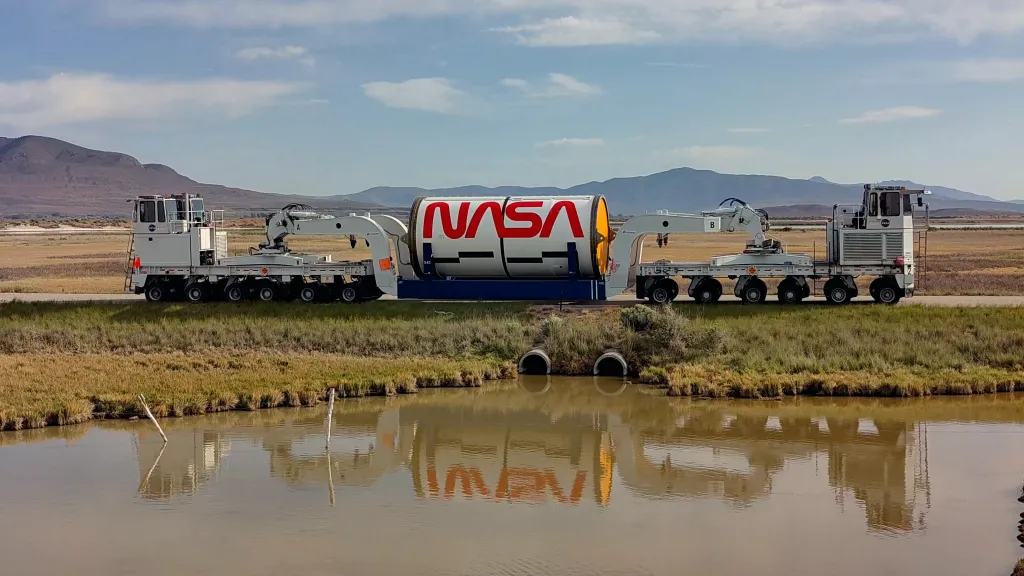
The stacking together of the powerful rocket to launch next year’s Artemis III mission can soon begin after the final segments of the twin boosters that power the Space Launch System rocket began their cross-country trek to Kennedy Space Center this week.
Read more Ned Jarrett, NASCAR Hall of Famer, 2-time Cup Series champion and longtime broadcaster, dies at 93
Northrop Grumman packed up and shipped the the final booster motor segments from their Utah manufacturing facilities, sticking them on a special Union Pacific Railroad train named 4547 in deference to President Trump.
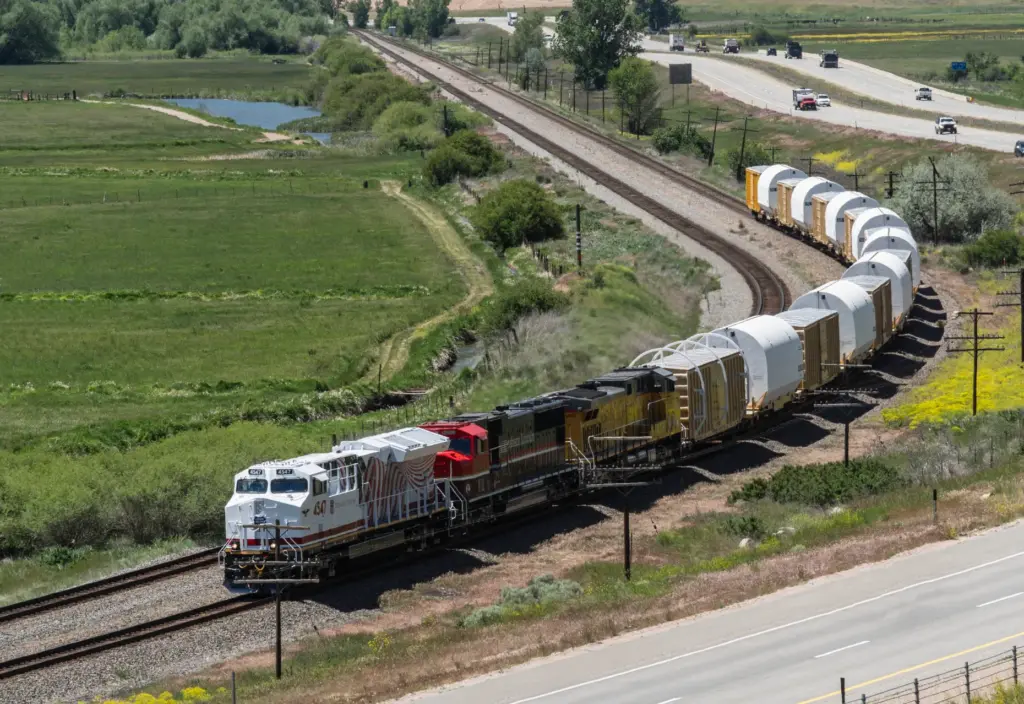 Northrop Grumman’s twin solid rocket booster segments to be stacked as part of the Space Launch System rocket for NASA’s Artemis III mission travel by train from Utah on June 3, 2026 headed to Florida’s Kennedy Space Center. (Courtesy/Northrop Grumman)
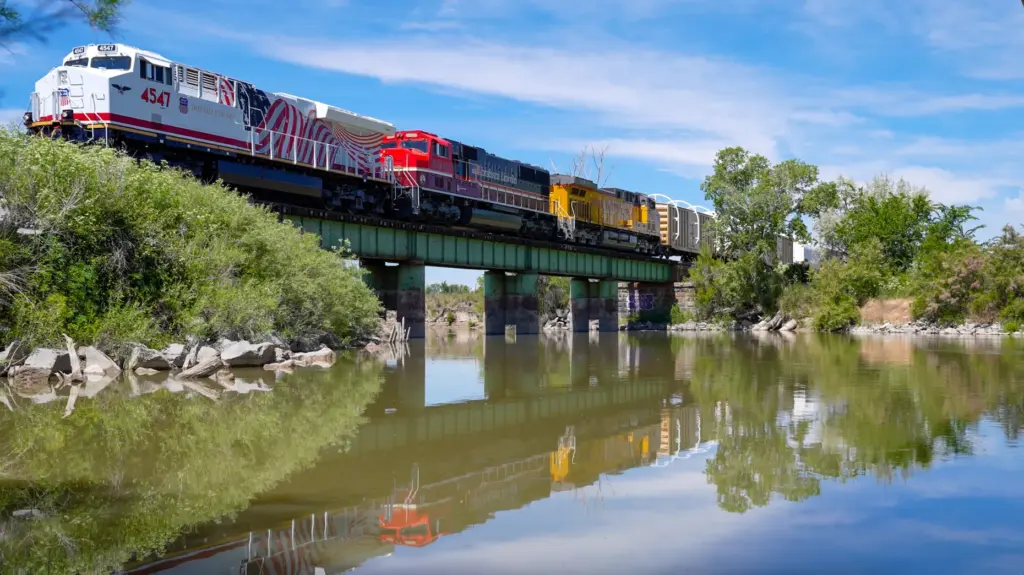 The final booster motor segments for NASA’s Artemis III mission depart Northrop Grumman’s Railyard Shipping Facility in Corinne, Utah on June 2, 2026. The eight segments will form the twin five-segment solid rocket boosters for the agency’s Space Launch System rocket, providing more than 75% of the vehicle’s total thrust at liftoff. The boosters are traveling on Union Pacific Railroad’s newest commemorative locomotive, No. 4547. Marking its inaugural mission, the locomotive will deliver the flight hardware to NASA’s Kennedy Space Center in Florida, where stacking operations for Artemis III are set to begin later this year. (Brandon Hancock/NASA)
The eight segments will join two segments delivered in April at KSC ready to be stacked to form the twin solid rocket boosters atop the mobile launcher 1 as the SLS rocket begins to take shape this summer. They will then be mated with the core stage, built by Boeing, which arrived earlier this year to Florida.
Combined, they provide 8.8 million pounds of thrust on liftoff, which remains the most powerful rocket to ever make it into orbit. SpaceX’s Starship will eventually double that power, but has to date only performed suborbital test missions.
Artemis III won’t be headed to the moon like the first two Artemis missions, though. Instead, the SLS will send four astronauts riding the Orion spacecraft on a low-Earth orbit mission targeting launch in mid 2027. Its goal is to test out Orion’s docking capability with one or both of the two lunar landers being developed by SpaceX and Blue Origin.
Pathfinder versions of SpaceX’s Starship and Blue Origin’s Blue Moon MK2 landers will need to be ready for the mission, though, and both companies face hurdles in getting ready. Blue Origin’s path forward may be the most precarious, since the rocket on which the lander was supposed to launch, the New Glenn, does not have a working launch pad after last week’s explosion during a tanking test at Cape Canaveral Space Force Station’s Launch Complex 36.
SpaceX’s Starship also has to complete its latest “mishap” investigation as it remains grounded by the Federal Aviation Administration following last month’s latest suborbital test flight from Texas.
Read more Florida, Duke set for top-5 showdown in O’Dome during SEC-ACC Challenge
Blue Origin, meanwhile, has shifted into rebuild mode on the Space Coast.
One week later, incredible progress. It’s a 24/7 operation with a solid path forward to launch this year, helped by a lot of luck. @NASA and @USSpaceForce have both been extremely helpful.
This team. Never tell them the odds. pic.twitter.com/rmMSQ9Xgxq
— Jeff Bezos (@JeffBezos) June 4, 2026
Founder Jeff Bezos posted images of teams at the pad Thursday on X.
“One week later, incredible progress. It’s a 24/7 operation with a solid path forward to launch this year, helped by a lot of luck. @NASA and @USSpaceForce have both been extremely helpful. This team. Never tell them the odds,” he posted.
NASA Administrator Jared Isaacman promised Thursday to update the Artemis III timeline on Tuesday, the same day the agency plans to announce the four astronauts to fly on the mission.
“This is a whole government response,” Isaacman told Fox News. “NASA is going to deploy subject matter experts to help with the investigation, to get to root cause of the problem, help them rebuild the pad.”
He also said NASA will be moving forward with development of the lander as if New Glenn were ready. That could mean trying to figure out a different rocket to launch it if needed.
“We’re also decoupling the lander from the launch vehicle and the pad itself. What does that mean? That means NASA is laser-focused on the lander, because we’re laser-focused on our mission to return astronauts to the surface of the moon before 2028,” he said. “We’re going to be able to keep that lander in development, progressing, so it’s available for our test mission in 2027, which is Artemis III, and potentially available to meet our landing objectives in 2028.”
Read more Baseball All-Area: Tripp Rosenberger of Winter Springs is Player of Year