
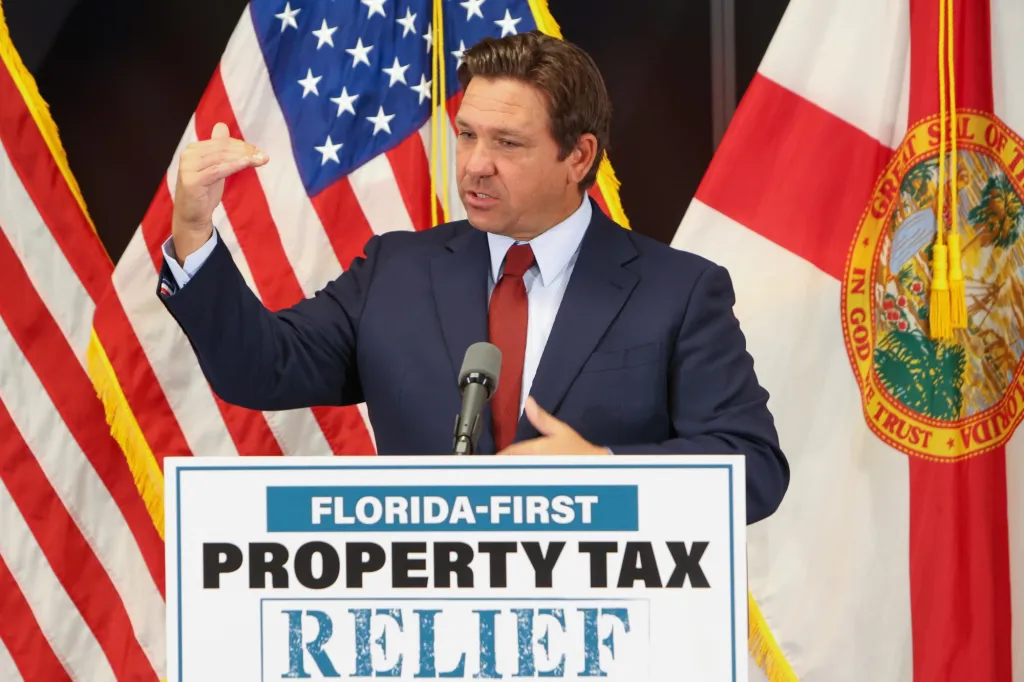
Now that Floridians will decide in November whether to approve a historic property tax overhaul that would provide property tax relief at the expense of many essential local government services, expect an intense campaign for their votes.
Read more Plant Doctor: What’s going on with my bougainvillea shrubs?
In just the last few days, the rhetoric has already taken on a new level of specificity — and an air of desperation.
Counties, cities and towns putting together their budgets for next year say if the property tax amendment passes, all manner of government services, from police and fire to park development, from mosquito control to annual Fourth of July celebrations could be curtailed.
They are scrambling to come up with contingency plans, and began posting the potential impacts on their websites this week for their residents to study.
“I’m not opposed to it being on the ballot,” Winter Springs Mayor Kevin McCann said. “But it’s going to be a challenge for every city. It will be survival mode.”
Even if the moderately upscale, family-oriented Seminole County city were to close “every single park,” cut all youth recreational programs, eliminate funding for the Scottish Highland Games and fireworks shows, McCann said, it still wouldn’t be enough to balance the budget without that tax money. Because it is heavily residential, Winter Springs is among the Central Florida cities most dependent on homestead property taxes, the target of the planned cuts.
The ballot amendment, proposed by Gov. Ron DeSantis and approved by the Legislature on Tuesday, would expand the current $50,000 homestead exemption on non-school taxes that residents have on their primary residences.
If the measure is approved by voters, the exemption would go up to the first $150,000 of their home’s assessed value starting January 1. That exemption would then increase again, to $250,000 in 2028. But school tax revenue would be shielded from the new exemptions.
Proponents say if the amendment passes, the average homeowner will save $2,000 on their property taxes — a figure that an Orlando Sentinel analysis shows would range from $2,300 in Orlando to about $1,500 in unincorporated Lake County. That could be tempting during the current affordability crisis that’s struck Florida and the rest of the nation.
“Dangling that carrot of $2,000 cash makes you feel good, but it doesn’t address what services you are willing to give up for that, or wind up paying some other way,” said Sen. LaVon Bracy Davis, D-Orlando, who voted against putting the measure on the ballot.
“The responsibility is now with local elected officials to educate the public,” she said.
DeSantis has been pushing for property tax relief for more than a year. He and his allies have painted local governments as irresponsibly spending more than they need to on nonessential, even frivolous services, instead of giving surplus revenues back to the homeowners each year.
“When people say ‘You can’t do it, you’re not going to have any services,’ just ask them: ‘Did we not have schools and police in 2019 when they were taking in $32 billion? Of course we did,” DeSantis said during a recent press conference, where he said local revenues have doubled since he took office in 2019.
Blaise Ingoglia, a former state senator DeSantis appointed as Chief Financial Officer in July, has been his staunchest ally, calling the messaging from local governments “scare tactics” from “apologists for big government.”
DeSantis and other amendment supporters have a high bar to get the ballot measure approved – 60% of the vote.
And homestead exemptions have a checkered track record with voters.
They enthusiastically approved raising the original homestead exemption of $5,000 to $25,000 in 1980. And in 2008, Floridians overwhelmingly voted in favor of doubling the homestead exemption to $50,000.
But a 2018 amendment to raise the homestead exemption again, to $75,000, fell short with 58% of the vote, and a 2022 amendment to provide an additional $50,000 exemption to public servants like teachers, police and firefighters also did not get the 60% need for passage.
Still, recent polls show a majority of voters support property tax relief — at least until it is explained to them that those tax cuts could jeopardize essential services like public safety and libraries. That last finding gives local governments hope.
Read more Orlando Sentinel turns 150 years old today. This is our story.
If the 2026 measure passes, cities and counties will lose billions of dollars that currently pay for libraries, parks, healthcare, veterans services, senior centers, and child care, all services that are left unprotected by the language of the measure. Smaller cities and fiscally constrained counties would be hit even harder, because they lack the alternative resources and large-scale commercial property base that would help larger governments absorb the blow from losing homesteaded property tax revenues, according to reports from city and county analysts.
The cuts will also impact their ability to pay off massive municipal bonds that were issued for public works projects.
The three west Orange County cities of Apopka, Ocoee and Winter Garden are hatching plans to consolidate services among them if the measure passes. They’ve produced an 11-page white paper that outlines the impact of the tax cuts and what measures they could take to soften the blow.
Homestead revenue accounts for 30% to 40% of their budgets, they said. That revenue provides the cornerstone for essential services like police and fire protection, road maintenance, parks and recreation, code enforcement and basic government functions “that have no significant alternative revenue streams.”
Orange County sent out an email that explains the basics of the county budget, and breaks down what passing the ballot amendment will cost and what services it will impact.
The county says the amendment would slash revenue by $160 million when the $150,000 exemption takes effect, cutting countywide tax revenue by $85 million, a separate fire protection tax by $46 million and the sheriff’s budget by $29 million. In the following year, when the $250,000 exemption kicks in, the county would be out $270 million — a loss of $154 million in countywide revenue, $71 million in fire protection and $45 million to the sheriff’s budget.
Services for families, the elderly and the homeless, tenant assistance, mosquito control, and economic development are among those that could be cut, the email says.
Osceola County is estimated to lose approximately $250 million in annual property tax revenue—or roughly 15% of its total county levy— by 2028, if the amendment is approved.
Officials in the Osceola city of St. Cloud also have created a website to educate residents about how the city spends money generated through property taxes.
During the 2025-26 fiscal year, St. Cloud collected $32.3 million in revenue from property taxes, or 37% of its general fund, according to the Florida Auditor General. Each year, more money is spent on public safety than the amount collected from property taxes, the web site shows.
If voters approve the measure, the city estimates it will lose $7.99 million in revenue from property taxes during the 2027-2028 fiscal year and $13.73 million the following year.
The site says funding could be jeopardized for economic development initiatives, parks and recreation programs, community events and social services.
The amendment would cut Seminole County revenues by more than $188 million, impacting long-term planning, county spokesman Chris Patton said. The cuts could impact the planned transformation of two golf course into county parks, Patton noted.
About 41% of all property tax revenue goes toward law enforcement, 31% toward fire and emergency operations, 11% for transportation and roads, and 5% for parks and libraries, officials said.
Whatever voters decide, government officials will make it work, Winter Spring’s McCann said. “But I don’t think folks understand the change that will take. It will be a different city.”
Staff writers Martin E. Comas, Ryan Gillespie, Stephen Hudak, and Natalia Jaramillo contributed to this report.
Read more History center exhibit showcases Orlando Sentinel’s story, community connection