
Ten years ago, Orlando, best known for its medley of theme parks, was rebranded as the site of America’s deadliest mass shooting when a lone gunman burst into the Pulse nightclub on “Latin Night” and opened fire with a semi-automatic rifle.
Read more How much would Florida homeowners save under proposed tax cut?
Forty-nine patrons of the South Orange Avenue venue, long considered a safe space for the region’s LGBTQ+ community, died in a hail of bullets on June 12, 2016. Dozens of others were wounded.
Orlando pledged it would not let hate win and would never forget. But remembering is hard, too.
“For me, these ten years have not passed,” said Carmen Capo, who spoke to the Orlando Sentinel about the tragic death that night of her son, Luis Omar Ocasio Capo, 20, an aspiring dancer. “I’m just trying to survive. You have to learn to live like a clown. Even though your heart is shattered, you have to smile.”
Not all the memories are as devastating. “We challenged our community to respond with love and compassion and unity,” said Orlando Mayor Buddy Dyer of the emotional outpouring that marked the aftermath of the massacre. “And I think we’re still that same community.”
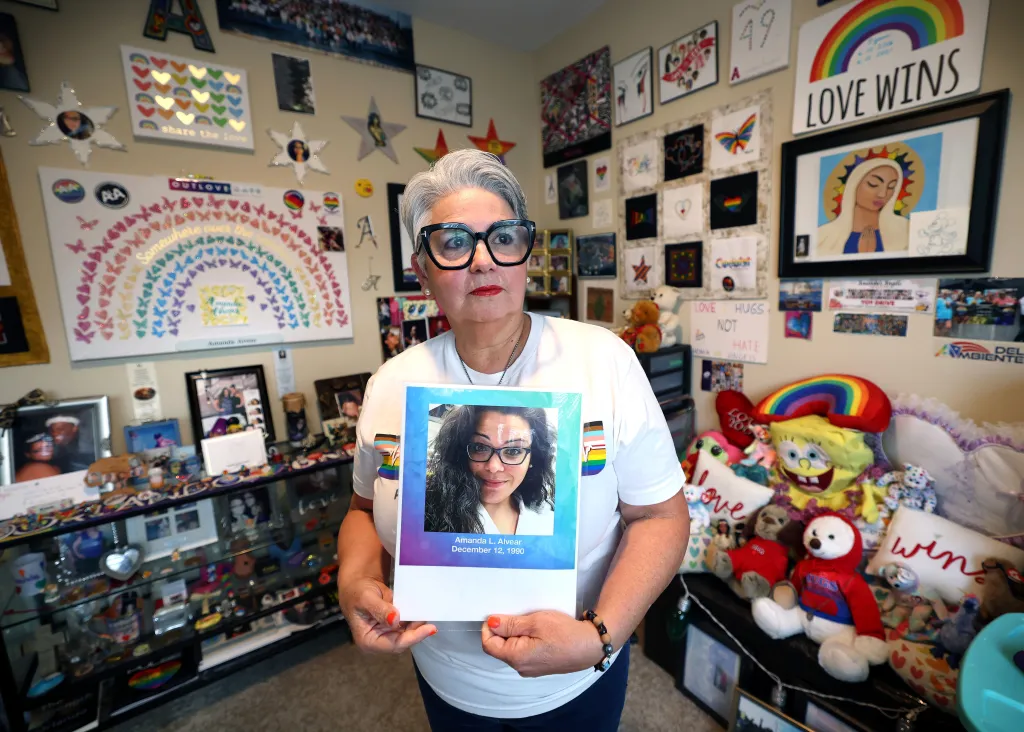
But the community is not the same as it was before Pulse became a worldwide symbol of both intolerance and common cause. And for at least as long as its survivors endure, the collective memory will last too, said Mayra Alvear, whose daughter Amanda, 25, a Valencia College student, was another victim.
“This is something that always stays with you until God calls you back home.”
These are some survivors’ stories.
Olga Disla: “My son is with me in my mind.”
Every year as the month of June approaches, Olga Disla struggles with crippling anxiety.
“My cardiologist told me, ‘We are in May. You have to try to calm yourself down’,” Disla said in Spanish. “As the day where my life changed forever gets closer … it feels like the music in horror movies when the protagonist is about to encounter the killer.”
She recalls that day ten years ago, when she was at home in Puerto Rico studying for her masters degree in education. Disla got a call from a close friend who had heard news of a shooting attack at a Central Florida nightclub and asked if she knew where her son Anthony was.
“When my friend told me the name of the club my life left me,” Disla said. “Because when I spoke to him the previous day he told me he would be there.”
Immediately she called her eldest son Marcos, who told her he was at the scene of the massacre.
“I think he was trying to protect me because he didn’t call me right away,” Disla said. “He couldn’t even find the words to tell me that he couldn’t find Anthony.”
She raced to the airport and took the first flight to Orlando at 4 p.m. without a suitcase or any clothes. Her sister picked her up from the airport.
“I felt it in my heart,” Disla said through tears. “When I saw her I just looked her in the eyes and I said, ‘He is dead isn’t he?’ She shook her head yes and I just screamed and screamed.”
The day before, Disla said she had felt a powerful instinct to protect her son and told him not to drive to the club because she was concerned about car accidents. Anthony, hearing his mother’s concerns, got a ride instead.
Anthony Luis Laureano Disla died there of multiple gunshot wounds at the age of 25.
“Even to this day I think about how I could have prevented this if I could have had that power,” Disla said with a shaky voice. “But obviously I didn’t get that chance. You think about a car accident, not the reality of what happened.”
Ten years later Disla said her health has declined, exacerbated by the grief of losing her child. She had open heart surgery four years ago, suffers from hypertension and lost vision in her right eye after the retina detached.
Disla is now retired in Poinciana, where she moved to be closer to her eldest son and her youngest’s grave.
“The numbers mark time but they don’t finalize the pain,” Disla said. “I can’t tell you that I’m happy in my life but I have learned to live with that. My son is with me in my mind every day.”
Juan José Cufiño Rodriguez: “Groggy all the time.”
Juan José Cufiño Rodriguez was at Pulse celebrating one of his last nights in the United States. He’d been traveling around the country for three months, with his final weeks in Florida, and was slated to return soon to his home in Colombia. At the nightclub, he danced with friends and a new boyfriend, Jean Carlos Nieves Rodriguez.
Then gunshots rang out in the nearly pitch black night club, he said, the only flashes of light coming from the shooter’s gun every time he fired. One bullet hit Cufiño Rodriguez’s hand. Another his knee. Another his leg. The last strike to the former physical education teacher changed his life forever, hitting in the middle of his spine.
He spent about 100 days at Orlando Regional Medical Center, the longest hospitalization of any of the injured Pulse survivors. He was in a medically induced coma for months, he said, and woke to a difficult new life. He learned that Nieves Rodriguez perished in the massacre.
“I’ve tried to erase all those memories,” Cufiño Rodriguez said in Spanish during an interview from his home in Bogota. “But it’s complicated because I can’t forget everything. Every time I look down, I’m in a wheelchair, and it’s unyielding.”
Ten years after the shooting, Cufiño Rodriguez, 40, is still dealing with the injuries. He takes medication for the chronic pain, but its side effects are difficult to manage.
“I feel like I’m groggy all the time on this medication,” Cufiño Rodriguez said. “It’s a very ugly feeling.”
He works as a cashier at a restaurant in Bogota. But he doesn’t earn enough to have continuous physical therapy, so he saves for months to pay for the intermittent treatment that he hopes one day will allow him to walk again.
“Life continues,” Cufiño Rodriguez said. “Just because I’m in a wheelchair does not mean that my bills will stop coming, so you just have to continue.”
Managing in a wheelchair is exponentially harder in Bogota than the U.S. he said, as the city is not made with people with disabilities in mind. He barely leaves his apartment, and when he does he spends most of his time trying to find ramps to get in and out of places or bathrooms big enough to fit his wheelchair.
His parents and 19-year-old son live nearby but he doesn’t rely on them for much help, he said, though they were by his side when he recovered in Orlando.
“I don’t want to be a burden on them,” Cufiño Rodriguez said.
One day he hopes to go back to the U.S. to establish a life in a country that is more accessible.
But visiting Pulse memorials will not be on his to-do list, as he tries to shield himself from any news related to the nightclub.
Still, he did learn the city of Orlando had demolished the shuttered building in March. It was the only option, he said.
“I’m happy they tore it down,” Cufiño Rodriguez said. “What could you have done with a building where there was such a terrible massacre?”
Carmen Capo: “We have to celebrate life.”
Carmen Capo woke to loud banging on her window. It was 6 a.m., and her son’s friend was outside. There had been a shooting at a nightclub, the young woman said, and Capo’s 20-year-old son had been injured. Frantic, Capo raced to the hospital from her Orlando home, not stopping to brush her teeth or put on a bra.
When she arrived she learned what every mother most fears: Her son had died. “Even breathing hurts at that moment,” she said of absorbing the news that Luis Omar Ocasio Capo was gone.
“There is not a day that goes by that I and his four siblings don’t miss him because he left a huge hole in our family,” Capo said in Spanish from her home in Puerto Rico.
But if there is any bright side to the tragedy, Capo said it’s that Omar’s death has brought the rest of her family closer together. They call each other at least once a day and constantly text, sometimes 20 times a day, she said.
“Because we never know when the last ‘I love you’ will be,” Capo said.
Omar, the fourth of her five children, was born to be a star, she said.
He’d just received a callback to be a dancer at Disney World earlier that week. He was studying art at Valencia College and wanted to be an actor and celebrity, she said. He had been dancing with several teams across the country since he was 7 years old.
“I don’t want people to remember him as a victim,” Capo said. “I want people to remember him as a star, the brightest one in the sky.”
The night of June 11, Omar went to a party with a group of friends. Capo told her son, who still lived at home, to stay with her that night, but he told her he had already promised his friends he would go.
At 1:17 a.m. Capo said she sent her son a text, reminding him that he had to work at Starbucks later that day. He texted back saying he was getting ready to leave.
“I never heard back from him again,” Capo said.
After his death, Capo moved back to her native Puerto Rico, hoping to escape the constant reminders in Orlando that her son was gone. Moving has been therapeutic, she said. She has lost 72 pounds and benefits from being surrounded by her extended family.
Every three months, she visits her son’s grave in Orlando.
She will be in town for the 10th anniversary of the tragedy. Capo, her four children and six grandchildren have rented a house in Central Florida and will be together to remember Omar. She’s even made t-shirts to celebrate him.
“I know he will be there with us,” Capo said. “We have to celebrate life, which he loved to do.”
But there is still constant heartache.
“For me, these ten years have not passed,” Capo said, fighting back tears. “I’m just trying to survive. You have to learn to live like a clown, even though your heart is shattered, you have to smile.”
Brandon Wolf: “I learned what heartbreak is.”
Brandon Wolf crouched in the corner of the nightclub bathroom for what felt like forever as gunshots rang out. Finally, he and several others decided to run, arms linked, toward the glowing light coming from the crack of an emergency exit door. They escaped.
“I’ll never forget the looks on people’s faces, and the fog machine smoke still billowing and the music still radiating on the floor while gunshots were going off,” Wolf said.
Wolf survived but two friends he’d gone to the club with, Juan Ramon Guerrero and Christopher Andrew Leinonen, perished in the gunfire.
Hours later Wolf was able to reach Juan’s sister.
“She kept saying, ‘Please tell me he wasn’t there’,” Wolf said. “I remember trying so hard not to break down, there was a lump in my throat, and finally the only thing I could say to her was, ‘I’m so sorry’,” he said.
“I think that was the first moment I learned what heartbreak is,” Wolf said. “Time feels like it stood still. I remember sitting on the couch for hours and hours just staring at the floor.”
Pulse was a special place, Wolf said, where as a gay man he felt he could fully be himself.
“Pulse was probably the first place I ever held hands with someone that I had a crush on without looking over my shoulder,” Wolf said. “I think a lot of people come to Orlando to find better for themselves and I was one of those. Pulse really felt like the physical embodiment of that community that I was looking for.”
Devastated by the loss of Leinonen, his best friend, and so many others, Wolf has said he decided to channel his anger and anguish into advocacy, fighting for LGBTQ rights and gun control.
This month, he returns to Florida to work again for Equality Florida, the LGBTQ rights group where he began that work soon after the shooting.
One of the many calls he made after the shooting was to his father, who lived thousands of miles away in Oregon. His father, Wolf’s remaining parent after his mother passed away when he was young, had struggled with Wolf’s sexuality. It drove them apart, he said.
But over the last ten years, Pulse has helped that relationship heal.
“My dad has taken a long time to come to understand me,” Wolf said. “What he realized, in the wake of Pulse, is that bad things were still going to happen, he had just ensured that he would not be my first phone call and that really broke his heart.”
During his first visit to Orlando after the shooting, Wolf’s father asked to go to Pulse and pay his respects, he said. The experience opened up new avenues to talk, Wolf said.
“It’s one of the things that’s come out of the last ten years that’s been meaningful to me,” Wolf said. “Healing from that tragedy together has allowed my dad and I to get closer.”
But the massacre weighs on him.
“After that day, life has never been the same,” Wolf said. “There is no moment where there’s a bow on it, and it’s tidy, and you write the end and close the book. It’s just not that easy.”
Mayra Alvear: “It’s important that the story is told.”
Ten years later, Mayra Alvear said the worst night of her life remains hauntingly painful and the death of her daughter, Amanda, sometimes very fresh.
“This is something that always stays with you until God calls you back home. It’s a pain that you carry inside that you have to learn how to live with,” said the Haines City mother. “So it’s been like a roller coaster. Some days are good, some days are bad.”
Amanda Alvear, a 25-year-old Valencia College student and pharmacy tech, was a happy and outgoing young woman who in high school was an honors student, junior class president and prom queen.
On June 12, 2016, Amanda, who still lived at home, called her father to say she would be spending the night at a friend’s house, then went to a housewarming party with several friends before they decided to go to Pulse.
Early in the morning, Amanda’s best friend called the family to tell them about the attack and that Amanda had been at the club. Alvear, in her bedroom, pleaded to God for her daughter’s safety.
“I just remember screaming…going to my knees and asking God, ‘Please let her be alive, let her be injured, don’t take her from us yet,’” she recounted tearfully.
Read more My Sister’s House gives DIY music scene a new home in Orlando
Like many other family members who could not reach their loved ones in the hours after the massacre, Alvear went to the hospital to search for her daughter, only to find she had not survived.
“It was an awful nightmare,” she said. “My daughter decided to go out dancing. She was supposed to come home,” she said. “She was young, and she wanted to have fun.”
The week of June 12 was already a painful one for Alvear, as it was the birthday week of her son, Nelson, who died of cancer at the age of 12 in 2001.
Now her Christian faith, she said, helps her each year get through the tragic time, as she’s confident one day she will see her children again in the next life.
Alvear looks forward to the completion of the City of Orlando’s permanent memorial to those killed at Pulse. She sat on the advisory committee that helped draft the long-awaited memorial’s final design and firmly believes it will help keep alive the memory of what happened and honor the dead.
“It is important that the memorial is there, that the story is told, so people of future generations remember what hate can do, and what love can change,” she said.
Buddy Dyer: “A community that is welcoming to everybody.”
Just after 7 a.m. nearly 10 years ago, Orlando police recounted to the public the first details of the horror that unfolded overnight while much of the city slept, reporting that 20 people had been killed at Pulse nightclub.
Mayor Buddy Dyer, recounting his earliest memories of Orlando’s darkest day, said authorities knew at the time the number was far higher, but didn’t have a precise count. Minutes after the news conference ended, Dyer’s deputy chief of staff Heather Fagan approached him, looking pale. The real number was more than twice as large.
Later that morning, Dyer delivered the news to the nation.
“That was probably the toughest message I had to deliver, coming back out and not losing it and telling everybody that there weren’t 20 dead, there were 50 dead,” Dyer said recently, counting the 49 victims and the deceased shooter.
Looking back at him from seats on the asphalt along Orange Avenue, he said, dozens of seasoned reporters were shocked — audible gasps could be heard on televisions across the nation. “It was visible the pain on everybody’s face.”
Throughout the ordeal, Dyer, who had been awakened before 3 a.m. by a phone call from a deputy police chief as the tragedy unfolded, waited in the police department’s mobile command center positioned just south of the nightclub along with Orlando Police Chief John Mina and representatives from a slew of law enforcement agencies. Authorities received information from those trapped inside the club through text messages to 911 or to family members.
From inside the command hub, they could hear police set off explosive charges to force entry into the building.
After three long hours, the nightmare ended with a gun fight between the shooter and police, who killed him.
That night changed the city, painting it with rainbows on walls, light posts, utility boxes and crosswalks. Thousands mourned on the lawn outside of the Dr. Phillips Center for the Performing Arts a day later. Annually, church bells echo across downtown streets 49 times on the fateful anniversary.
Ten years after the massacre, the pain remains. Dyer said he thinks, at least in Orlando, compassion has endured too.
“We challenged our community to respond with love and compassion and unity. And I think we’re still that same community. The country has changed,” he said.
“I don’t think we have retreated from the concept that we’re a community that is very welcoming to everybody. And we need to continue to support the families of the 49 and everyone who was affected by Pulse.”
John Mina: “Wow, this is huge.”
Orlando Police Chief John Mina woke up early June 11 to a tragedy. Singer Christina Grimmie had been being fatally shot hours before while signing autographs outside The Plaza Live in the Milk District.
He looked forward to a proper night’s sleep after a long day of briefings and fielding reporters’ questions. Then came a call after 2 a.m. on June 12 — at least 20 people were dead at the Pulse nightclub.
“My first thought was that it must be some type of gang-related thing in the nightclub,” Mina, now Orange County sheriff, said. “Then it turned into a hostage situation.”
Mina worked from a mobile command center on scene. Officers outside the nightclub traded gunfire throughout a three-hour standoff with the shooter, Omar Mateen.
One officer, Michael Napolitano, was shot in the head, the round miraculously stopped by his ballistic helmet. But 49 partygoers lost their lives and 58 more were wounded as Mateen fired relentlessly using a military-style weapon.
Mina tried to remain stoic through it all. Then he made it home, and the enormity of what had happened set in.
“I remember after that first night just sitting on the couch taking a breath and watching all the national news coverage of our agency and our city, the people in our community that had been killed,” Mina said. “That’s when I was like, ‘Wow, this is huge.’”
It got even bigger. With Mateen pledging allegiance to the Islamic State, the FBI got involved. That led to a behind-the-scenes tussle between OPD and federal authorities about what to release to the public and when.
In the aftermath, resentment grew about how OPD responded to the shooting. There were accusations that officers delayed confronting Mateen, and that their failures were covered up, controversy that rages in some quarters to this day.
But many lives were saved that night. And Mina points to federal and state investigations that cleared officers accused of accidentally killing some victims from friendly fire. Records of the full FBI probe, however, still have not been released.
Nonetheless, Mina has sought to put the lessons of that night into practice.
Today, Mina said, OPD and the Orange County Sheriff’s Office conduct active shooter trainings annually, far more frequently than prior to Pulse. He also invested in rifle-rated ballistic armor for his subordinates while pushing to acquire military-style vehicles and upgraded breaching equipment for SWAT teams.
As for the Orlando community, he sees it today as being more protective of its LGBTQ and Hispanic residents. But 10-year-old scars remain.
“I think more people pay attention to their surroundings than before,” he said, “but I also saw this community come together with love instead of hate.”
Chadwick Smith: “This is not a drill.”
At 3:25 a.m. on June 12, with Orlando Health’s emergency department filled with Pulse’s wounded, the hospital activated a “Code Silver.”
The alert, warning of a possible imminent safety threat to patients, staff and visitors, heightened an already tense and perilously chaotic scene inside Central Florida’s busiest trauma center, where victims had arrived by fire/rescue squads, police cruisers and pickup trucks.
Forty-four people from the gay nightclub, all shot, most multiple times, had been brought in, dead or in danger of dying. Now this.
“We thought there was an active shooter on the premises of the hospital,” Dr. Chadwick Smith, the on-call surgeon in the ER when Pulse happened, said, detailing a vivid memory of the ordeal, little-mentioned at the time, during a recent interview marking the tenth anniversary of the tragedy.
The notion was not far-fetched. Pulse was no more than two blocks south of the hospital.
Smith called colleagues at home for help. “This is not a drill. This is not a joke. Twenty-plus gunshot wounds are coming in,” Smith said to trauma surgeons he had awakened. “I need you here as fast as you can. And every time, the answer I got was ‘I’ll be right there.’ ”
Dr. Joseph Ibrahim and Dr. Michael Cheatham, among those who answered the call, had heard about the Code Silver. Cheatham said they thought perhaps the gunman fled from Pulse and was impersonating a victim.
“All of the people working in the trauma bays barricaded the doors but kept caring for patients,” Smith said of the staff response to the alert. “That’s pretty traumatic. You’re caring for people who have been shot and you’re now worried about being shot yourself.”
Smith said worried coworkers texted their own loved ones but never lost focus on saving lives.
Though a skilled surgeon, Smith didn’t perform a single surgery that night.
“My role that night was to direct the flow of patients into operating rooms in order of urgency,” he said. “If somebody’s been shot, a surgeon really needs to make the determination of what’s needed — who needs to go into an operating room and in what order.”
As night turned to morning, Smith remembered, he walked the Emergency Department, visiting every patient who had been wounded or operated on, keeping tabs on each, making notes on small stickers that he, at first, stuck on the pant legs of his light blue scrubs.
Incredibly, every patient who made it alive to the operating room — 35 in all — survived. The staff performed a total of 76 operations on the Pulse victims.
“Code Silver,” a false alarm, was called off at 4:14 a.m.
For their heroic work, the trauma team was honored in 2017 as the Orlando Sentinel’s “Central Floridians of the Year.”
Now 50, Smith has grown accustomed to questions about the hospital’s response that night.
“I kind of expect it about this time of the year, every year, and I figured this year there would be even more [attention] because it’s been 10 years now,” said Smith, who sat for interviews in May not only with the Orlando Sentinel but also TV news stations and online publications.
Joshua Stephany: “We give what we can.”
As he prepared for the horrible, heart-wrenching task of documenting the 50 deaths from the Pulse massacre, acting medical examiner Joshua Stephany made a decision that resonated nationwide.
He insisted that the shooter be separated from his victims.
The body of Omar Mateen was transported from the scene alone, stored in a different building than his 49 victims and autopsied separately, too.
“I never wanted anyone to think of that individual in the same place ever again with those whose lives he took,” Stephany said in a recent Sentinel interview.
Stephany and a team of forensic investigators were summoned shortly after 2 a.m. June 12, 2016, to the crime scene they will never forget.
Bodies were everywhere inside Pulse, where the night club’s strobe lights were still flashing.
Stephany, hired as an associate medical examiner for Orange and Osceola Counties in 2007, had been serving as the acting chief for about a year. He stepped in for Dr. Jan Garavaglia, better known to reality TV audiences as the star of Discovery Channel’s “Dr. G: Medical Examiner,” who had retired.
Orange County commissioners removed Stephany’s interim label two days after Pulse as he was finishing the last of the autopsies.
The medical examiner’s role, spelled out in Florida statute, requires the dead be identified, injuries and wounds be documented and cause and manner of death be determined. It typically draws little notice — but Pulse was different, and Stephany’s decision-making distinguished it further.
“Special thanks for separating the evil one from the innocents,” wrote Constance O’Hanlon of Oviedo in a letter to the Medical Examiner’s office in the summer of 2016.
It was one of dozens of hand-written notes of praise, prayers and thanks to Stephany and his staff for their compassionate, professional and respectful work. Some writers recognized the team’s inconceivably heavy burden over a few short days.
The staff usually works five to seven cases a day.
But in addition to the usual work and Pulse, Stephany’s team in the same time frame also performed an autopsy of Grimmie, 22, the singer was shot to death June 10, 2016, by an obsessed fan during a post-concert meet-and-greet. Then, two days after Pulse, they handled the death of a Nebraska toddler, killed by an alligator that snatched him from the beach of Disney’s Grand Floridian Resort.
Some letters urged Stephany and his staff to take care of themselves, too.
“You are leading the way for so many who mourn,” a physician from Washington, D.C., wrote. “My sincerest condolences to all of you — for we, as providers, never go untouched by the ills of the world around us. We give what we can — time, energy, careful thought and above all compassion.”
The memorial: “A respectable place to honor our loved ones.”
The long-sought — and long overdue, some say — permanent memorial to the Pulse tragedy is expected to begin its year-long construction timetable this September, pursuing an ambitious goal set by Dyer to complete the project by the time he leaves office in late 2027.
The memorial, estimated to cost around $12 million, will contain a reflection pool where the club’s dance floor once stood and an elliptical walkway with 49 columns, one for each of the “49 angels,” as the victims are known. Light features – including the colors of the rainbow – abound.
The memorial effort dragged for years as the private onePulse Foundation, originally tasked to create it, stumbled and then collapsed amid excessive ambition that produced a plan for a $100 million memorial and museum the group had no ability to fund. The foundation’s demise left a trail of broken trust throughout the region, particularly among survivors and families.
The City of Orlando ultimately purchased the Pulse property last year for $2 million, as well as a neighboring property for $1 million, promising to complete the project. It set up a 18-member committee of survivors and victims’ families to help reach a consensus on what the memorial should look like.
The committee’s meetings were sometimes contentious, with one of the toughest debates being whether the nightclub would be demolished or preserved in part. But with a striking degree of unity, the panel in the end unanimously recommended a final design, although it left some design choices to the city.
Survivors and victims’ families were allowed to go inside the nightclub one final time on the week of the massacre’s ninth anniversary last year before it was torn down in March to make way for the memorial. Some items from the club have been preserved in a secret warehouse the city showed to reporters last week, and are expected to be put on display.
Although the Pulse massacre’s status as the country’s deadliest was supplanted the year after that June night, in Las Vegas in 2017, its resonance remains for the broad community that suffered through it or came to understand it, here and around the world.
“We will have a beautiful, respectable place to go visit, to honor our loved ones,” said Alvear, a member of the advisory committee.
Read more Space Coast launch schedule