
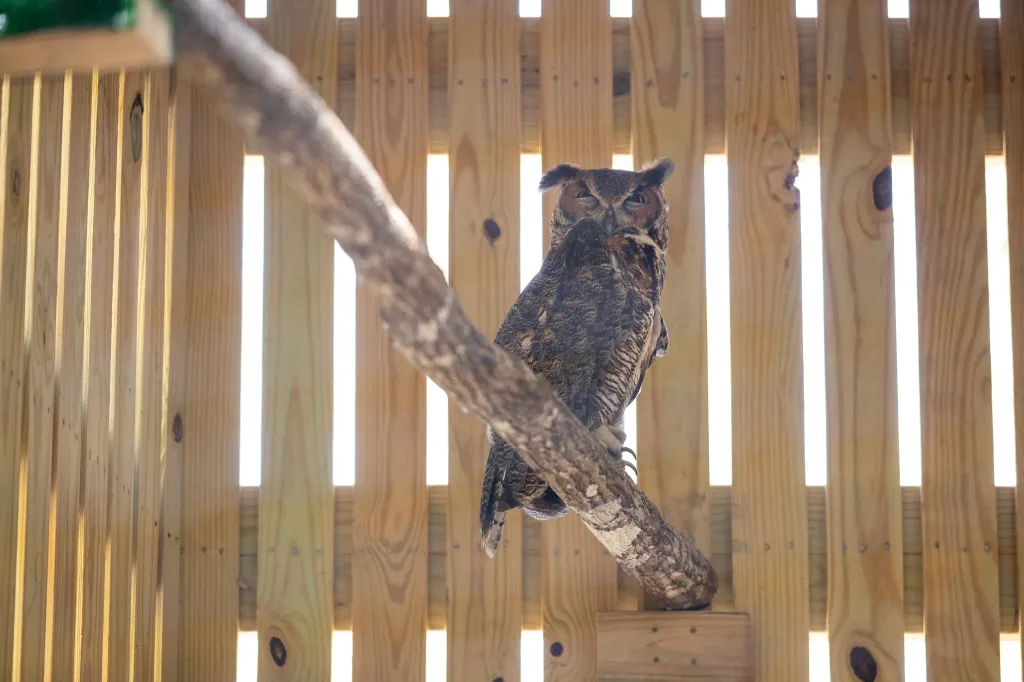
What happens when apex predators find themselves injured in the wild or in need of a helping hand? Some of them end up in the caring hands of the team at the Audubon Center for Birds of Prey.
Read more Editorial: In the aftermath of horror, Orlando chose love
The Maitland nonprofit cares for around 800 sick, injured and orphaned birds annually while inviting the public for educational programs and to visit with the center’s 30 resident raptors. Bald eagles, owls, hawks, falcons and vultures are all among the birds of prey visitors can see when visiting the 3-acre property on Lake Sybelia, which is one of 55 Audubon centers and sanctuaries nationwide.
The Central Florida center closed last summer for the construction of a new aviary to house great horned owls, barred owls and a black vulture. The $650,000 enhancement was two years in the making and replaced the center’s original aviary, built in 1979, which sustained damage from hurricanes in 2024.
The new aviary houses a pair of barred owls, Fil and Hitch, who have become foster parents to orphaned owls.
“They help raise orphaned barred owls during the season. They’ve raised 13 so far,” said Katie Gill Warner, the center’s director. “That’s the best chance of being raised by their species. We do a lot in the clinic when we have babies with camo and puppets, but nothing can replicate actual parents.”
In designing the space, the center worked with landscape architecture firm Coyle & Caron, whose past clients include the Smithsonian National Zoo, Bok Tower Gardens, Orlando Health and Zoo New England. The aviary mimics the species’ natural habitat and provides unobstructed views, as well as a covered viewing shelter.
A bird’s-eye view of history
In June of 1979, 53-year-old Doris Mager climbed into an inactive eagle’s nest for nearly a week to raise awareness of the then-declining bald eagle population and raise money for a raptor rehabilitation center.
More than four decades later, Mager’s legacy continues, especially as the Maitland center celebrated its 800th bald eagle released into the wild last year.
Florida Audubon also traces its roots back to Maitland. In March of 1900, 15 conservationists gathered at the lakeside home of Clara and Louis Dommerich to protect the hundreds of thousands of wading birds being killed to decorate women’s hats.
Read more Scenes from Southern Fried: Camaraderie, culture and competition
Rainbow Raptors
Audubon Center for Birds of Prey celebrates Pride Month on June 27 with a free-admission event that includes raptor chats, conservation-themed activities, storytime for young visitors, a bubble dance party and a day of fun outdoors at the center. Come Out With Pride Orlando and the Winter Park Veterinary Hospital sponsored the event. Reserved tickets are recommended.
The first Motus visitor
In January, the Audubon Center for Birds of Prey joined a global network for tracking bird migration by installing a “Motus station” on the property. The program, a partnership of Birds Canada and Audubon, uses radio telemetry to track the movement and behavior of birds.
The device can specifically pick up on tagged birds. An adult male kestrel was the first visitor pinged by the station on April 3. There’s something fortuitous about a bird of prey being the first one tracked by the Orlando location. Other Motus stations are located in Hobe Sound, the Florida Keys, Cuba, the Cayman Islands and Mexico.
Back to the wild for young owls
Following a visit to the Maitland facility to see the new owl enclosure, I was invited to help release three juvenile eastern screech owls back into the wild. Each one was orphaned earlier this spring and rehabbed by the center until they were ready to be released into the wild.
Each of the young owls was hesitant to leave their small transportation boxes at first. But one by one, they took flight into the woods near Shingle Creek, landing on trees where they perched for a long time and later took naps.
Nearby, a limpkin waded in the creek to forage, and a great blue heron flew by. It was awe-inspiring to see the birds take to their new home. I hope the owls are now safe, well-rested and finding plenty to eat in the wild.
Find me @PConnPie on Instagram or send me an email: [email protected]. Stay up to date with our latest travel, arts and events coverage by subscribing to our newsletters at orlandosentinel.com/newsletters.
If you go
Rainbow Raptors is from 10 a.m.-3 p.m. June 27 at 1101 Audubon Way in Maitland. Admission is free and open to all. The center is open from 10 a.m.-4 p.m. Tuesday-Sunday. Tickets for regular admission are $10 per visitor and free for children 3 and younger. More information: audubon.org
Read more The best portable ovens for camping