
INGLEWOOD — During December’s World Cup draw in Washington, D.C., Gianni Infantino, president of FIFA, soccer’s global governing body, presented President Trump with the organization’s first-ever FIFA Peace Prize.
Read more Gators star discus thrower Alida van Daalen eyes national record at NCAAs
The 18-carat gold trophy stands 14½ inches tall, and although hollow inside, still weighs 13.6 pounds.
It was at the draw at the Kennedy Center that Trump asked U.S. national team coach Mauricio Pochettino if he was ready for some truly heavy lifting?
“What do you think, coach. Can you win the World Cup?” Trump asked, recalled Pochettino.
“Of course, Mr. President,” Pochettino responded.
Three months later, Pochettino had a similar conversation with U.S. national team players at a training camp.
“Why not us? Why not us? Why not us?” he told the team. “We need to really believe that we can be there. We need to dream.”
Dreaming hasn’t been the problem.
Ever since the improbable run to USA ’94’s Round 16, upsetting Colombia, a pre-tournament favorite along the way, World Cup glory has been the ultimate American dream.
In their 2009 book “Soccernomics,” Simon Kuper and Stefan Szymanski wrote that because of their financial power and soccer infrastructure, the U.S. and Japan were “destined to become kings of the world’s most popular sport.”
When Kuper, a longtime Financial Times columnist, and Szymanski, a Michigan sports management professor, updated the book for the 2022 World Cup, they had to admit, “Well, we were wrong.”
The World Cup returns to the U.S. this week, 32 years, 30 Major League Soccer franchises, hundreds of millions of dollars in national team funding, eight Team USA head coaches after the Miracle On Grass with those dreams as glittering and empty as Trump’s trophy.
Team USA opens Group D first-round play against Paraguay at SoFi Stadium Friday (6 p.m. PT) as international soccer’s biggest underachiever.
The U.S. has 14 million participants in organized soccer, the most in the world, double Germany’s 7 million, the second most on the planet, yet the Americans haven’t been among the 20 nations who have reached the quarterfinals at the last five World Cups. South Korea reached the semifinals of the 2002 World Cup. Morocco made the 2022 tournament semis.
The U.S.?
Team USA has advanced to the World Cup quarterfinals just once, in 2002 when it knocked off regional rival Mexico in large part because of a tactical blunder by El Tri coach Javier Aguirre. The U.S. is 1-19 in its last 20 World Cup matches against European teams. Germany’s 2-1 victory in Chicago last Saturday was the Americans’ ninth straight loss to a European side in all competitions.
The 1994 World Cup was about laying the foundation for MLS. This World Cup for American soccer is about changing the narrative.
Read more Pictures: Pulse 10th anniversary commemorated with portraits at Orlando City Hall
“I think if we can do something special, if we can get that quarterfinal, that semifinal, I think we’ll no longer have that conversation,” said Marcelo Balboa, a former U.S. captain who played in three World Cups. “Because when we do go to Europe, you get that conversation of how the Americans don’t have any players that can change the world soccer, they don’t. They’re okay teams.
“So yeah, you know what, making a semifinal could shift a little bit the (view of) world soccer and look at the United States in a different way. Because right now they look at us, ‘Oh, they’ll get out of the group,’ and we get stuck there. So there could be a huge change, especially the way everybody sees us after this World Cup.”
American soccer has been reaching for the stars for more than a quarter-century.
U.S. Soccer, the sport’s national governing body, in 1998 launched Project 2010, a $50 million development initiative that was supposed to be the road map to take Team USA to the sport’s pinnacle.
“Winning the World Cup by 2010: Soccer’s Equivalent to the Apollo XI Moon Landing” was the title of the project’s 1998 report. The document’s cover featured an astronaut on the Moon, American flag in one hand, the World Cup trophy in the other, an image that, like the report’s title, is just as laughable now as it was then.
“I don’t have answers for that,” said Tim Ream, the current U.S. captain, referring to the Americans’ lack of World Cup success. “I haven’t gone into a deep analysis and looked at all the reasons. … There are any number of things that people can look at and analyze. For me, because I’m still playing, I haven’t.
“But it is something that I’m sure people are trying to understand. You look at the explosion on the youth level and how many kids are gravitating toward the sport and wanting to play the game, I think it bodes well for the future.
“But yeah, I don’t have an answer for your question, unfortunately.”
One of the answers is that out of all the millions of kids playing the game in the U.S. has yet to step a world-class field player. The U.S. has produced three world-class players, all of them goalkeepers: Kasey Keller, Brad Friedel and Tim Howard, whose World Cup record 16 saves against Belgium in the 2014 World Cup Round of 16 was not enough to advance the U.S. to the quarterfinals.
“We are USA and competing against Belgium, Portugal,” Pochettino, the former Argentina international who coached Tottenham Spurs to the UEFA Champions League final, said after losses to those European teams in March. “I think, for sure, Belgium and Portugal have a few or some players playing (who are) in that top 100 (I don’t think we have that).”
No U.S. player this year made the Guardian newspaper’s annual list of the world’s top 100 players. Forward Christian Pulisic was the highest rated American player at 116 in the paper’s survey of 219 former players, coaches, media and other experts.
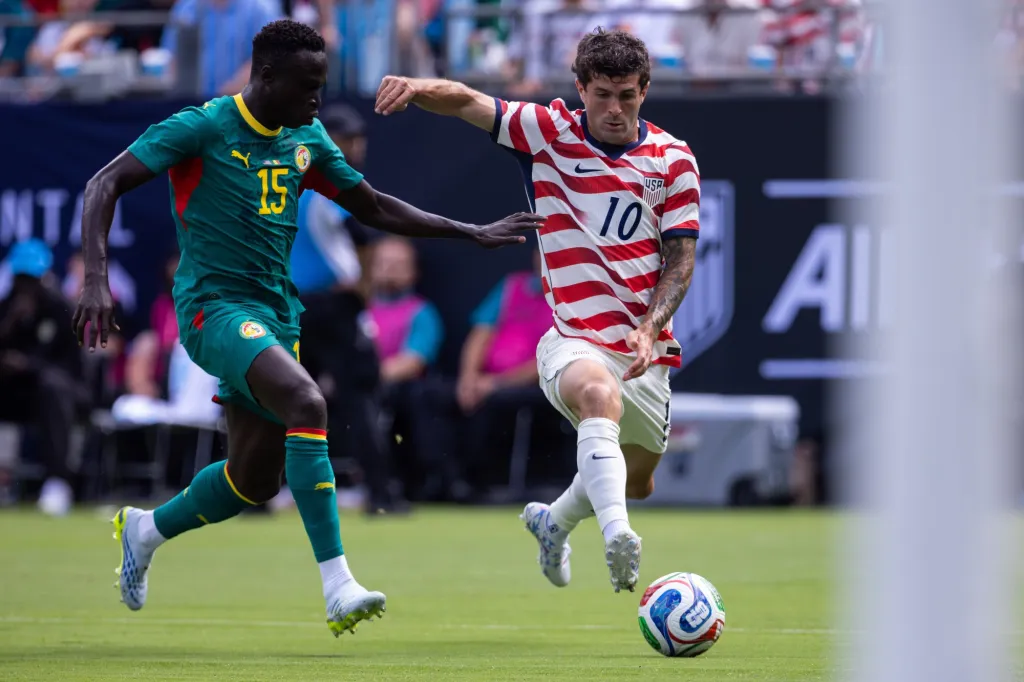
And Pulisic comes into the tournament hardly in top form. His goal in a friendly against Senegal last month was his first goal in this calendar year and his first for the U.S. national team since November 2024.
“We want to do this for ourselves. We want to do this for our own country. We don’t need to prove to anyone else,” Pulisic said. “We have good players, really good players playing in top clubs in the world. We have a good team and, yeah, we’re going to do the best we can to prove ourselves right more than anything.”
If not, at least one American has gotten his hands on the World Cup. In August, Infantino, a regular visitor to the White House, stopped by the Oval Office with a guest – the World Cup trophy. At one point Infantino placed the World Cup trophy in Trump’s hands.
Read more Mayor Demings will reconvene tourist-tax task force
“Can I keep it?” Trump asked.