
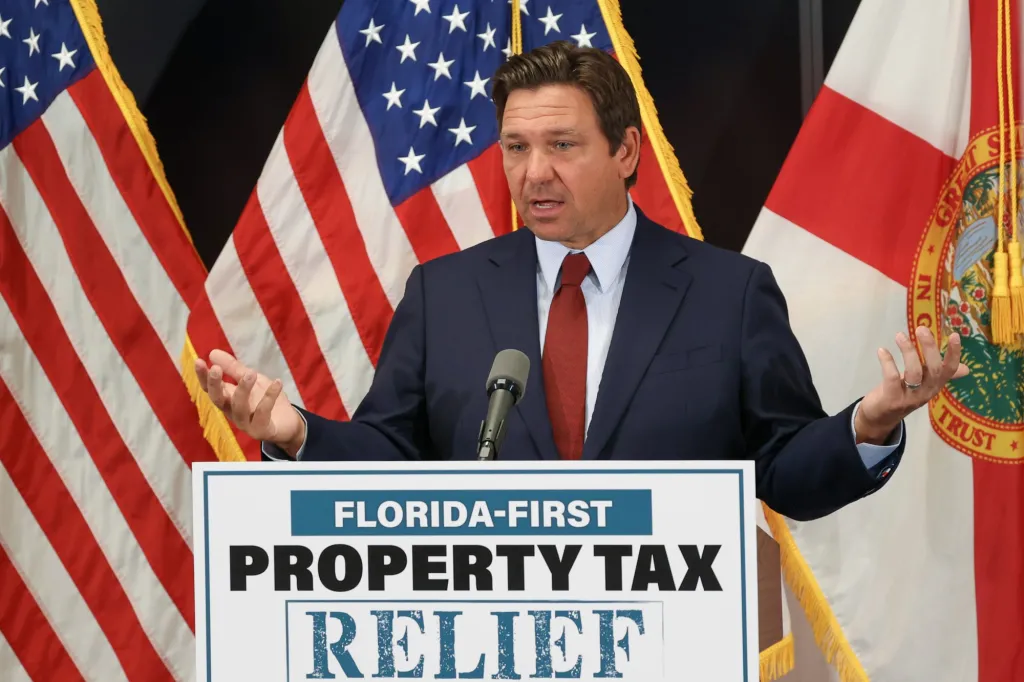
A massive overhaul of the state’s property tax structure being pushed by Gov. Ron DeSantis would have a sweeping impact on the financial stability of local governments across Florida and place devastating constraints on their ability to borrow money, according to three of the nation’s biggest credit rating agencies.
Read more Another rescue from Sloth World dies during rehabilitation, Central Florida Zoo says
If approved by 60% of voters in November, the property tax amendment would take effect Jan. 1. It would incrementally raise the tax exemption on homesteaded properties, adding $100,000 to the current $50,000 exemption next year, raising it to $250,000 in two years, and increasing it in line with inflation until homestead taxes are nearly eliminated.
Ultimately, the measure would slash a quarter of what local governments currently collect to pay for necessary services and pay off bond debt, an amount Florida’s Revenue Estimating Conference estimates could eventually total nearly $12 billion annually.
“If enacted, the expanded exemptions would constrain city and county revenue, increase taxpayer concentration, and reduce financial flexibility,” Moody’s Ratings, one of the largest government credit ratings agencies in the country, wrote in a report released Friday.
The three ratings agencies, which also include Standard & Poor’s and Fitch, reviewed the proposed tax plan as approved by the Republican-controlled legislature earlier this month.
That version is far less sweeping than DeSantis’ original plan, as it takes school taxes out of the mix and eliminates a proposed state trust fund to help cities and counties more dependent on property tax revenues which would be hit hardest by the cuts.
The rating agencies’ warnings echo a number of other criticisms of the plan, including a recent Wall Street Journal report saying it was “a shame that Gov. Ron DeSantis is using his final months in office to push a poorly designed measure on the November ballot that would put his state on the slippery slope of a progressive property tax regime.”
In response, DeSantis accused the conservative news outlet of “defending bloated local budgets and opposing property tax relief for Florida homeowners.”
The nonprofit group Florida TaxWatch called the plan poorly-thought out and rushed through the Legislature with little time for debate or analysis. The group also said any property tax cuts would be better suited to a state tax commission scheduled to meet next year.
Local governments have warned for months that the proposal would break their economies and force hard decisions to either cut services or raise other taxes and fees.
Former Republican state Sen. Jeff Brandes, a libertarian from St. Petersburg and founder of his own think tank who is critical of the governor’s plan, said he is not surprised by the dire reports issued by the credit ratings agencies.
“If you look at these local budgets… you realize they are playing a dangerous game,” Brandes said. “We’ve already seen local tax collectors come out and say they are going to have to adjust their millage upward just to cover existing debt.”
Millage is a term used to describe the tax rate local governments charge on properties. One mill equals $1 of tax for every $1,000 of assessed value, which is equivalent to .1%. Orange County’s current rate is 4.437 mills. State law would allow cities and counties to raise their millage rates all the way to 10 mills.
“The world will still go on, but it will just be taxed differently,” Brandes said.
Local governments would also be able to tag on other fees for services without approval from the Legislature.
Read more Orange expects no school closures next year, despite financial crisis
Cities and counties would lose about $5 billion the first year, more than $8 billion the second year, up to about $12 billion by the sixth year, state economists said in a report released Friday – more than a week after the resolution to place the amendment on the ballot was approved.
The ratings agencies placed particular focus on the likely erosion in local governments’ ability to issue bonded indebtedness, which is commonly used to finance infrastructure like roads and sewers. Those agencies are regularly called on to assess the stability of such debt and help set the interest rates that should be offered to attract purchasers.
“If it passes, local governments could face a substantial reduction in tax revenues without identifying a replacement source, limit annual growth in taxable assessed value, and restrict use of property tax revenue for core services” wrote Michael Parker, the chief analyst for Florida for Standard & Poors Global Ratings.
They could face other factors, as well, Standard & Poors said, “including uncertainty about the macroeconomic environment, declining enrollment for schools, and hurricane risks, compounded by cost-sharing ambiguity from the Federal Emergency Management Agency.”
Moody’s analysts said the impact of the tax cuts will depend on what policy choices city and county officials make to make up for the losses.
“An aggregate tax base decline of about 25% … would affect issuers differently depending on how reliant they are on property taxes,” Moody’s said.
About 43% of municipal funds on average come from property taxes, meaning they would lose an aggregate 11% of their revenue, Moody’s said.
Counties would lose about 7.2 % of the $70 billion in annual revenue collected, based on an estimated loss of $5 billion in the first year, as calculated by the Florida Association of Counties, Moody’s analysts reported.
That puts many Florida cities and counties “in a decent position to absorb a moderate shock to their tax bases because those bases have more than doubled over the past decade,” the Moody’s report said. “If this reform were to shrink tax bases by 25%, it would set taxable values back to where they were just three years ago.”
Fitch Ratings largely echoed the findings of the other two credit rating agencies, saying the tax exemptions “will increase fiscal uncertainty unless policymakers take offsetting action.” That would likely come in form of fees or shifting the tax burden on businesses, commercial properties, apartments and other non-homesteaded properties.
A lot of what local governments can do depends on how much flexibility they have in raising the tax rates. The closer they are to the maximum tax rate they are allowed to impose under state law, the more likely they will be able to absorb the loss, Fitch said.
Some governments “may offset lower recurring property tax revenues with expenditure cuts, service reductions, or reserve use,” the report from Fitch said. “A sustained decline in available reserves could lead to downward adjustment of an issuer’s financial resilience assessment, depending on the magnitude.”
“Increasing other revenue streams could increase exposure to economically sensitive revenue or concentrate the tax burden among certain non-homestead taxpayers, including commercial property owners,” the Fitch report said.
The governor’s office did not return a request for comment on the agencies’ reviews.
Read more Circus catch dooms Winter Park as Eau Gallie wins UCF 7-on-7 tournament