
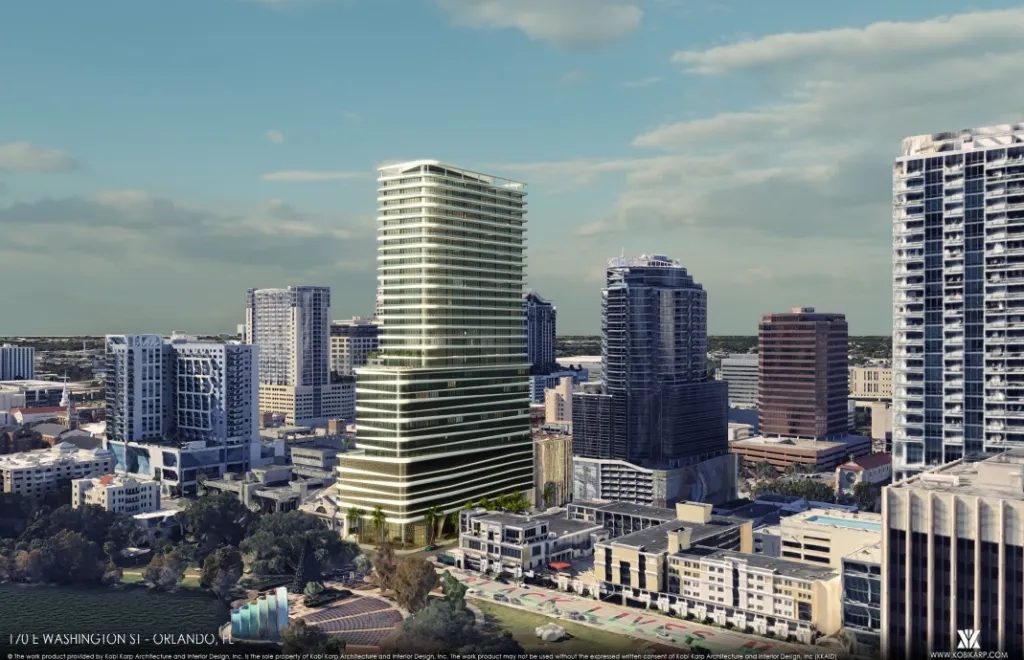
Members of Orlando’s Municipal Planning Board voted 6-1 Tuesday to approve a zoning amendment for a proposed 37-story tower that could bring a luxury hotel and the downtown’s first branded condo residences across from the Lake Eola bandshell.
Read more Father’s Day in Orlando: Events, deals and ways to celebrate dad
The vote overruled concerns raised by members of the historic St. George Orthodox Church and residents of the 60-year-old Metropolitan condominiums, which both abut the proposed tower. One opponent, Yari Auger, called the project a “monstracity,” but said her issue isn’t with the aesthetics.
“The issue is the real and documented risk of irreversible physical damage to a protected historic resource, which also happens to be a multi-generational, multi-racial and multi-ethnic beacon in the heart of the city,” she said, according to a report in GrowthSpotter. “Construction of a high-rise typically requires deep excavation, pile driving, dewatering, heavy vibrations, prolonged soil disturbances. Historic masonry structures were not designed to withstand these forces.”
The city’s planning staff recommended approval of the project with 30 conditions, including one intended to prevent damage to the 100-year-old church and its landmark stained-glass windows.
“One of the conditions in the staff report is that they have to do a different method than pile driving, which is a percussive way of pounding in the piles that support the structure into the bedrock, if you will,” Planning Director Jason Burton said. “So, they’re required to do an alternative method that’s more sensitive both from a noise and vibration perspective, whether it’s augering or other types of situations that would be more sensitive towards the church next door.”
The .63-acre lot at 170 E Washington St. was previously approved for a seven-story, 155-key Cambria Suites. Land use attorney Jason Searl, with Maynard Nexsen, is working with the same owners to entitle the site for a mixed-use tower with a three-story signature restaurant, a 221-room luxury hotel and 252 branded residences.
The revised PD increases the allowed height from 100 feet to 425 feet, which means the new tower would be approximately the same height as The VUE at Lake Eola (428 feet) and the Orange County Courthouse (416 feet).
The plan from Kobi Karp Architecture & Interior Design shows hotel amenities over the six-level parking garage and residential amenities on the 19th floor. There is a single restaurant on the ground floor, along with separate lobbies and elevators for the hotel guests and residents.
Father John Hamatie told the MPB he doesn’t consider the building attractive and finds its relationship to the church offensive. “We talk about proportional transition, the church becomes spatially and visually subservient to this building,” he said.
Read more Class of 2026: Lake County’s valedictorians & salutatorians
Orlando’s Appearance Review Board provided a courtesy review of the project on May 21, during which Hamatie and several church members spoke against the project’s scale and height. Still, ARB members complimented the overall design and praised the developer’s efforts to minimize the visual impact on the church building. Those steps included recessing the southeast corner of the building and four levels of the parking garage.
“We have gone above and beyond to accommodate their concerns,” Searl said, adding that the developer supports the staff condition to minimize vibrations during construction. He said the project team includes Sterling Project Development, a New York company that worked on a 50-story tower in New York’s Wall Street district, right across from the historic Trinity Church.
“So members of our project team have first-hand experience doing exactly what we’re requesting to do here,” Searl said.
Afredo Barrett, the only MBP member to vote against the zoning amendment, wasn’t convinced that the precautions and alternative construction methods would be enough to protect the church. “The examples you provided of high-rises being built next to historic churches are all in areas where the soil conditions are different from the soil’s conditions in Florida,” he said. “None of the examples relate to projects within Florida.”
But Board Member Eric Jackson said that to support the project, he needs to feel confident that the applicant has both the expertise and the intent to protect the surrounding properties. “I think at some point … you’ve just got to be the sort of company that stands behind what you do.”
The next steps in the development review process include City Council consideration of the MPB minutes, submittal and approval of an Administrative Master Plan, formal Appearance Review before the Appearance Review Board, and subsequent building permit applications.
Have a tip about Central Florida development? Contact me at [email protected] or (407) 420-6261. Follow GrowthSpotter on Facebook and LinkedIn.
Read more Rounding up and recapping the prime pizzas in your neighborhood, take 3 | Review