
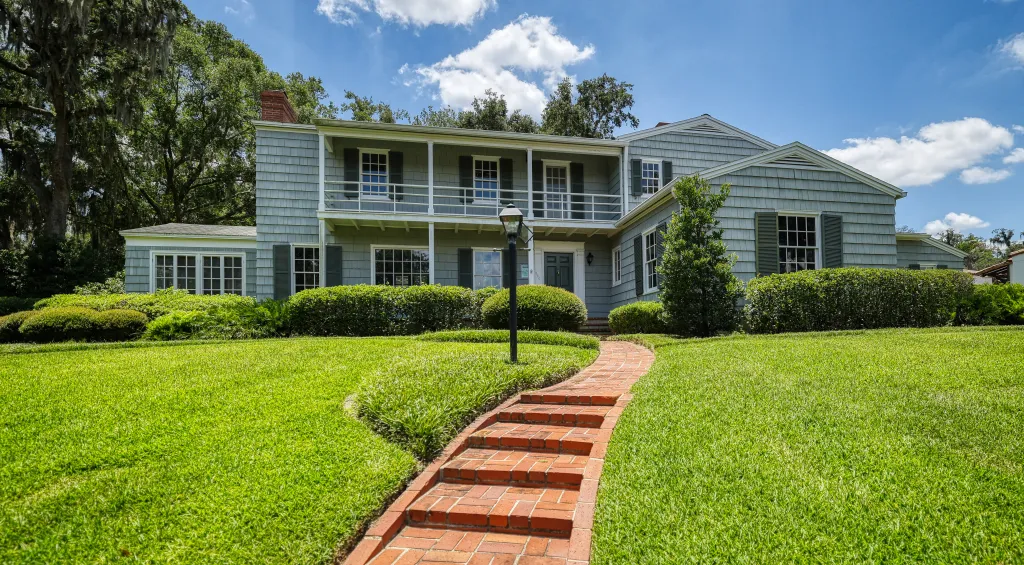
The city of Winter Park touts itself as a community with unique character, due in large part to its historic architecture. But some residents are worried builders and bulldozers are chipping away at its past, one home at a time.
Read more Orlando board OKs 37-story tower dwarfing neighboring church on Lake Eola
Among the endangered buildings are works by the city’s most-famous architect, James Gamble Rogers II. The owners of homes he designed at 1020 Palmer Avenue (the Merrywood House built in 1939) and 250 Virginia Drive (also 1939) have filed for city permits to demolish them, although it’s unclear when they would be razed.
In the wake of an outcry over the possible teardowns, city commissioners recently tasked their Historic Preservation Board with a new directive: How can Winter Park save more of its iconic houses in a town where property owners fiercely value their independence?
At the center of the controversy is the Winter Park Register of Historic Places, a list of properties with special protections because of their heritage value. But placement on the list comes only with the consent of the property owner, meaning many iconic buildings aren’t on the register.
“We can’t do like some cities and say, ‘I’m sorry, it’s a historic house, you’re not allowed to tear it down,’” board chair John Skolfield, owner of Skofield Homes, said last week during the preservation board’s first work session on the issue. “It’s a property rights thing, it’ll never happen here.”
Skolfield said one major challenge is that the value of bare land in the city can exceed that of a developed parcel. A property could be worth $1.2 million as “dirt,” he said, while a lot with a preserved home might only be worth three-quarters of that amount, creating a strong economic incentive to tear it down.”
Board member Rhett Delaney, who works in finance and mortgages, pointed to how some cities with successful preservation efforts — St. Augustine; Savannah, Ga.; and Charleston, S.C. — center their efforts around tourism. But Winter Park is more of a residential community, he said.
“Until we … decide whether we want to be a destination location or just another municipality, you’re going to have to give such a huge benefit to homeowners to want to put their stuff on the registry,” he said. “And every time we bring that up, all we hear is that we don’t have the money.”
Board member Margie Bridges, who works in real estate, said the city needs to better educate its residents.
“The homeowners are … petrified to offer up their homes for historic preservation because of the misinformation, misunderstanding and confusion,” Bridges said.
Allison McGillis, director of the city’s Planning & Zoning Department, noted that there are about 200 residential properties on the historic register now.
“The common misconception is that if you historically designate your home it freezes it in time,” she said. But, she said, “You can add onto it, you can change your windows, you can change your roof, you can change your siding.”
Property owners can also still add additional square footage to homes and request approval for variances or modifications to required setbacks.
Listing a home on the register, she added, also doesn’t restrict what owners can change on the inside.
“If someone’s interested in how a house looks but they don’t like the floorplan or the pink-and-blue bathroom tiles in there, none of that has to stay,” McGillis said.
Read more Father’s Day in Orlando: Events, deals and ways to celebrate dad
But it’s not enough to limit restrictions, some say. The city needs to give its property owners strong incentives to put their homes on its voluntary register. The existing incentives are modest.
The city typically sets aside $100,000 annually to encourage property owners to join the register, including up to $18,000 in matching grants for exterior renovations. Owners on the list can also build a secondary house with a separate address and utility meters on their land — something prohibited on other residential lots — that offers a potential source of rental income. In return, it’s more difficult to get approval to demolish homes on the register.
Skofield offered other ideas to make preservation more enticing, including faster permitting, priority inspections, waiving all or part of fees and a dedicated staff liaison to help homeowners through the process.
The fate of Merrywood, the largest home designed by Rogers, remains unsettled. A prospective buyer wants to split its almost 4-acre lot, build a home on half the property and sell other half with the building to someone who wants to preserve and restore it.
The Planning & Zoning Board voted earlier this month to recommend the city grant the lot split, even as the city’s comprehensive plan prohibits splitting lakefront lots.
Owners of a home at least 50 years old who want it to get on the city’s historic register can start by filling out the free one-page application on the city’s website. Staff would then confirm it meets one of several criteria, such as ties to significant events or people from the past. The city gets five to 10 applications each year.
But board member Kelsey Wolfe, a real estate investor, said no amount of education will alter the reality that property owners can find it hard to see beyond their own return on investment.
“I don’t know how much change in the ordinance would be accepted,” Wolfe said. “I think that people with a lot of money are the ones that are against it.”
She said “since we are going to lose things,” the city might fund a real estate photographer to document properties — inside and out, with photos and video to create a virtual tour — before they’re demolished.
Skolfield said while Wolfe’s idea might be practical, “There’s kind of a sadness to say we’ll just have a digital memory.”
While there are individual lots across the city on the register, Winter Park has four historic districts — two locally-created, College Quarter and East Virginia Heights, and two nationally-created, Downtown and Interlachen.
When the local districts were formed, the city designated homes as either “contributing” (they have historical value) or “non-contributing” (usually newer or heavily-altered homes). “Contributing” homes are subject to similar rules as properties on the register.
Betsy Rogers Owens, executive director of Friends of Casa Feliz, and granddaughter of James Gamble Rogers II, cited the successful movement to save his Casa Feliz mansion in 2001 and turn it into a museum. The past is now repeating itself, she said.
“It’s kind of death by a thousand cuts,” Owens said. “You lose one or two a year and everybody says, ‘What a shame, but we’ve still got these other places.’ But it is a measurable decline.”
Read more Class of 2026: Lake County’s valedictorians & salutatorians