
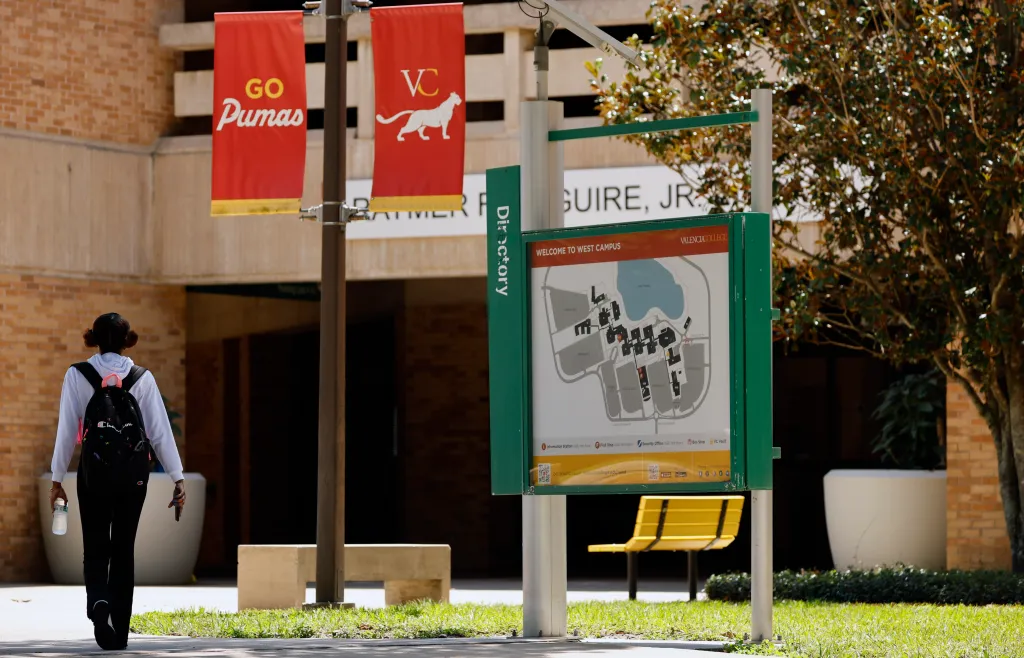
Florida could soon ban undocumented students from enrolling in state universities and colleges, moves that would make it the fourth state and by far the largest to shut these immigrants out of at least some publicly financed higher education options.
Read more Florida says AIDS drug program could need more money
The Florida Board of Governors, which oversees the state’s 12 universities, wants to amend admission rules so that students “not lawfully present in the United States” could not enroll in a university, unless the school already had admitted “all academically qualified applicants,” according to the newly released agenda for its June 24 meeting.
That would likely bar undocumented students from enrolling at Florida State University, the University of Florida, the University of Central Florida and other state universities that routinely deny admission to students who meet the state’s basic admission requirements because of lack of space and resources to accommodate them.
The State Board of Education, which oversees the state’s 28 state colleges, is to vote June 30 on a similar proposal to make both those colleges and Florida’s adult education programs off limits to immigrants without legal status.
If the rules are approved, Florida would join Alabama, Georgia and South Carolina in adopting “prohibitive enrollment” policies, in which students without legal status are barred from enrolling in some or all public institutions.
“It’s heartbreaking that there are other people that are in my shoes, wanting to pursue higher education and state college is a lot more affordable, that they’re wanting to strip away that opportunity from them,” said Jose Carrera, an undocumented student who attended Seminole State College is now majoring in biomedical sciences at the University of Central Florida.
The proposed board of governors rule looks unlikely to impact Carrera as it would not kick in until the 2027-28 school year, and it is aimed at initial enrollment. But the state board rule is less defined, making it unclear if students currently attending state colleges, including Lake-Sumter State College, Valencia College and Seminole State in Central Florida, would have to leave.
Carrera, 23, was brought to the United States from Mexico as a baby. The low-cost state college, and a later transfer to UCF, made higher education more affordable for his family and gave him a path toward his goal of becoming a physician’s assistant, one who is bilingual and can help close the language barrier between medical staff and Spanish-speaking patients. He hopes to graduate from UCF next year.
There is no exact data on how many students in the state colleges and universities lack legal status.
But in the 2024-25 academic year, there were at least 4,672 undocumented students enrolled in Florida’s state colleges and likely about 2,000 more at state universities, based on a count of who was using out-of-state tuition waivers. Those allowed undocumented students to pay in-state tuition, though they were not citizens.
National organizations, however, have estimated that thousands more undocumented students attend Florida colleges and universities.
The proposed rules come as the Republican administrations of both Gov. Ron DeSantis and President Donald Trump crack down on immigration.
Florida last year repealed a law — one once championed even by Florida Republicans — that allowed so-called Dreamers like Carrera, who’d arrived as children and graduated from Florida high schools, to pay in-state tuition. The repeal makes it far more expensive for them to take classes at public colleges and universities.
The new rules, if adopted, would make it impossible for many to even enroll.
State Sen. Randy Fine, a Brevard County Republican who proposed the repeal of in-state tuition, seemed to sum up the current views, saying then that it was time for the state to end “sweetheart deals for college degrees to those who should not even be here” and urging state leaders to follow Trump’s lead and “stop giving illegal immigrants rewards for breaking the law.”
Immigration and education advocates fear the humanitarian and economic impact.
Repealing in-state tuition is already effectively banning undocumented students from the state’s university system because they can’t afford it, said Gaby Pacheco, CEO of TheDream.US, a group that funds scholarships for undocumented students across the nation.
Read more Pictures: Orlando Magic introduce new coach Sean Sweeney
But Pacheco’s bigger worry is that Florida’s college and university board votes later this month will have ripple effects across the nation.
“Other states are going to think this is the right thing to do and they’re going to say Florida did it … and it’s going to spread across the country from leaders that are pushing forward anti-immigrant policies,” Pacheco said.
The proposal to ban undocumented students from state colleges became public in April, quickly alarming advocates.
“This is not just one policy or an isolated decision. It feels like a growing pattern, step-by-step of excluding, silencing and stripping away rights that should be protected for everybody. Education should be something that is not denied to anyone,” said Valeria Maldonado, a youth organizer and a student at Miami-Dade College who spoke at a press conference hosted by the Florida Immigrant Coalition to oppose the proposal on April 27.
The policy might contribute to Florida’s “brain drain” issue, said Jared Nordlund, the Florida State director at UnidosUS, the country’s biggest Hispanic advocacy and civil rights group, in an interview after the state college rules became public.
“We don’t want to push out kids who obviously want to stay here, build a business here, be part of Florida’s economy,” He said. “We should be doing everything which we do to retain those people.”
The rule that would impact Florida’s universities was posted more recently, though immigration advocates had feared it was coming.
Carrera can now only afford to take only one or two classes a semester after his in-state tuition was repealed. But Seminole State’s low costs, and the fact that he lived nearby and could take a bus to campus, made his first years of college affordable.
“I saved a lot of money,” he said.
Now he works as a landscaper to cover his higher UCF costs and to help pay his father’s immigration attorney. His father was arrested and detained by U.S. Immigration and Customs Enforcement earlier this year while on his way to work as a roofing contractor. He was released in May.
Carrera plans to look for private physician’s assistant programs in Florida that don’t care about his legal status and he may consider going to Mexico to study medicine, a move his parents support. But he is reluctant to leave them.
“For me helping my family is more important than higher education so if it doesn’t work out I’m just going to stick to landscaping in Florida to help my parents out,” Carrera said.
Florida’s immigrant population could suffer for generations and that will hurt the state’s economy in the long term, Pacheco said. If college is unattainable in Florida, she said, education may lose its value, and students may drop out before they finish high school.
“Because if a young person cannot see themselves having this opportunity to continue their education to fulfill their dreams they’re going to say ‘what for? Why should I graduate from high school anyway?’,” she said.
Read more Former UCF coach Shawn Clark’s legacy lives on in his wife’s mission