
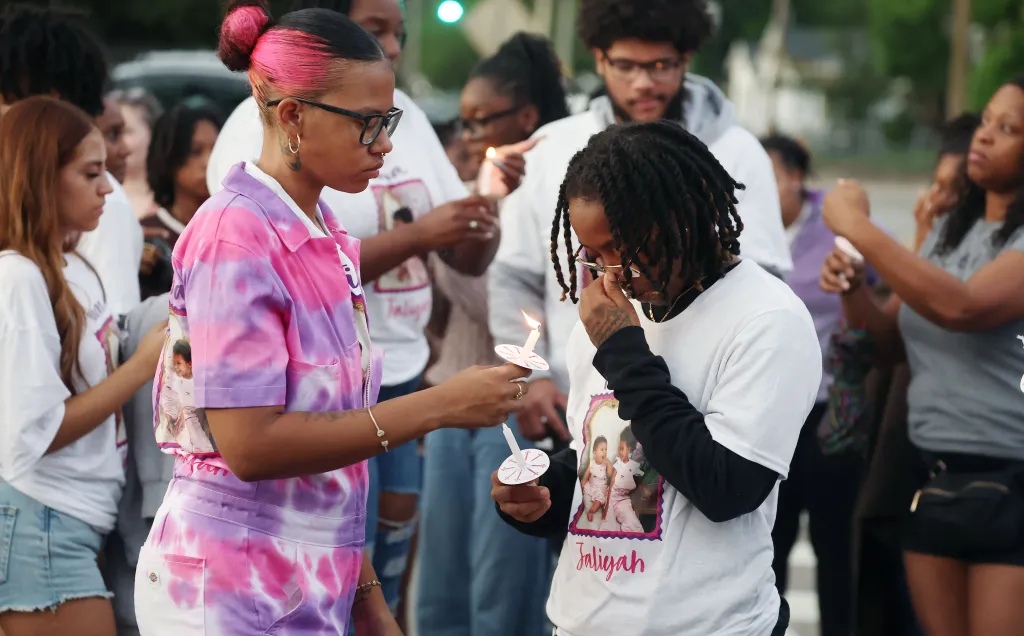
Over 100 mourners gathered last week around a memorial of flowers and photos to remember two young sisters slain by their father — another in a frustratingly long line of domestic violence tragedies.
Read more Man’s ear infection spread to his brain. His family claims it could’ve been caught before he died
Tiana Rae Watts was 2. Her sister, Jaliyah Katherine Watts, had not yet celebrated her first birthday. They were shot and killed inside their Orange County apartment by Bryant Darrell Watts, 33, a convicted felon, who then killed himself, according to the Orange County Sheriff’s Office. The little girls’ mother, Jasmine Jackson, 21, had been reportedly chased by Watts just before the shooting but was not injured.
At the June 11 vigil, held at the same complex where the girls were shot, Jackson was embraced by friends and family, too emotional to speak. Some in the crowd wore t-shirts printed with the girls’ photos. They held candles, the flames fizzling in the evening drizzle.
The deaths of Tiana and Jaliyah Watts represent a national statistical dichotomy.
Overall homicides in the United States have fallen for four consecutive years, according to FBI data analyzed by the Washington Post. Yet family and intimate-partner killings have moved in the opposite direction — accounting for roughly 1 in 5 U.S. homicides today, up from approximately 1 in 7 in 2020. The Post story, published June 6, noted three fathers in the U.S. killed their children that week, including a man in South Florida who police say stabbed his daughters and their mother to death before taking his own life.
Domestic violence experts say the cases, while shocking, are part of a known pattern, that children of abused mothers are often collateral damage. More needs to be done, they say, to recognize signs of domestic violence and act more quickly to prevent an escalation.
“Children are another weapon that is used by the abuser,” said Bethany Backes, a University of Central Florida professor and expert on intimate partner violence. “Whether they directly harm the children or threaten to harm the children – all of those things are tactics used by abusers to terrorize the victim.”
But criminal justice systems fail again and again to police domestic violence effectively, Backes and other experts say. Sometimes judges don’t have a full picture of the risks a victim faces, like an abuser’s access to weapons and prior threats to kill, and release men arrested on domestic violence charges quickly, with little to keep them away from the women they’re accused of hurting. And sometimes the victims make enforcement more challenging by refusing to detail the risks, because of emotional attachment to the abuser, dependency, or fear.
Watts, for example, was arrested in February, accused of hitting Jackson and making her face bleed. His arrest, first court appearance and release all happened on the same day. In court, a judge removed a provision noted in his arrest warrant for “no contact” with Jackson, saying he could have contact as long as it wasn’t “hostile or violent,” court records show.
Watts wasn’t present for his pre-trial hearing June 4, one day before the shooting. He had another hearing scheduled for June 23.
Backes is currently researching what happens in domestic violence cases in the 12 months after a defendant’s first court appearance – a period she describes as one of the most dangerous for victims. Early data shows that the judicial system’s response often doesn’t match the threat, or that protections for the victims listed in court documents aren’t enforced.
In November 2025, an arrest warrant was issued for Watts on a domestic violence battery charge after an employee at a walk-in medical clinic saw him hitting Jackson while the two were in a car and then saw Jackson inside the clinic bleeding from her head, court records show.
The witness saw Jackson try to leave the vehicle, only to be pulled back inside, the responding officer wrote in an affidavit. A few minutes later, Jackson got out of the car holding a baby. Watts got out, grabbed the baby from her and then drove off, the witness said.
The employee called the police, but Jackson told the responding officer her injuries weren’t caused by Watts and instead the result of a “stampede” at a downtown club the previous night. Jackson refused to answer any questions from a “lethality threat assessment,” the questionnaire used by law enforcement to assess whether a domestic violence incident is likely to turn fatal.
She also did not want to press charges, but the officer, citing the witness’ testimony, actively bleeding facial injuries and Watts’ “history of violence,” believed Watts caused her injuries and issued a warrant for his arrest.
Jackson was driven by ambulance from the clinic to Orlando Regional Medical Center. In addition to the wound at her temple, her “lips were swollen and bloody” and an ankle was bruised, the officer wrote.
Read more James Burrows, director of classic TV comedies including ‘Cheers’ and ‘Friends,’ dies at 85
Watts was a convicted felon, the document said, but while it noted a history of violence, it did not describe the past convictions.
At Watts’ first court appearance, the judge imposed a ban on Watts possessing a gun, but he obtained one anyway, as he’d done previously.
Watts was arrested in 2014 for possessing a Glock 9 mm handgun as a convicted felon and in 2017 for carrying a concealed Glock .45-caliber pistol without a permit, according to Orange County court records.
Backes said firearm restrictions in domestic violence cases are inconsistently enforced. Some police jurisdictions send officers to physically collect weapons. Others accept a signed statement they’ve been transferred to a family member.
“We don’t do a great job of taking away firearms,” she said.
Nationally, nearly 7 in 10 intimate partner homicides are committed with a firearm, according to CDC data analyzed by Everytown.
Abraham Salinas, director of the Harrell Center for the Study of Family Violence University of South Florida’s college of public health, said children killed in domestic violence homicides are not, in most cases, the primary target. But in up to 40% of domestic violence cases, they end up as victims, too.
In cases where a father kills his children and then dies by suicide, Salinas said the violence is rarely random or spontaneous. Screenings for domestic violence at places where families already go, including doctor’s offices, could help. But many victims are never asked if they face violence from partners or family members, he said.
Infants and toddlers face the highest risk of getting caught in violence at home, he said, as they cannot call for help or tell a neighbor, a teacher or doctor what is happening inside their home.
Children who attend daycare or are old enough to attend school have, at minimum, a set of adult eyes on them each day – teachers who might notice bruises, changes in behavior or signs of fear and are required to report suspected abuse to authorities.
“Community connectedness is a protective factor,” he said.
Better intervention programs for abusive men could help, too, Salinas said, but most of those arrested on domestic violence charges never complete such a program.
Whenever there is a domestic violence homicide in Orange County, Michelle Sperzel checks the Harbor House database. The CEO of Harbor House of Central Florida, the county’s domestic violence shelter, looks for a phone call, an intake, any record of contact. What she finds, consistently, is nothing, she said.
“What we find, unfortunately, is that it’s someone who has never reached out to Harbor House,” Sperzel said. “And that in itself is the missing piece. There are resources that are here and available for someone.”
The issues that keep abused women from coming forward have intensified since the COVID-19 pandemic, including financial pressure and online monitoring or harassment. Physical violence has also increased, she said.
Overall, Harbor House has been serving more people in recent years, but Sperzel said Harbor House has not yet solved how to help women who don’t know about its services, don’t trust outsiders or don’t believe, despite what they are facing, that they deserve help.
“Being a survivor myself… I think the biggest thing that I always think of is that it’s the shame that goes along with it,” she said. “That the person that you love and care about is treating you so poorly. In your mind, you’re like, ‘I deserve better than this’ but at the same point, it’s hard to get out of it.”
Read more Robo firefighters, holographic assistants and universal remotes: Inside the Augmented World Expo