
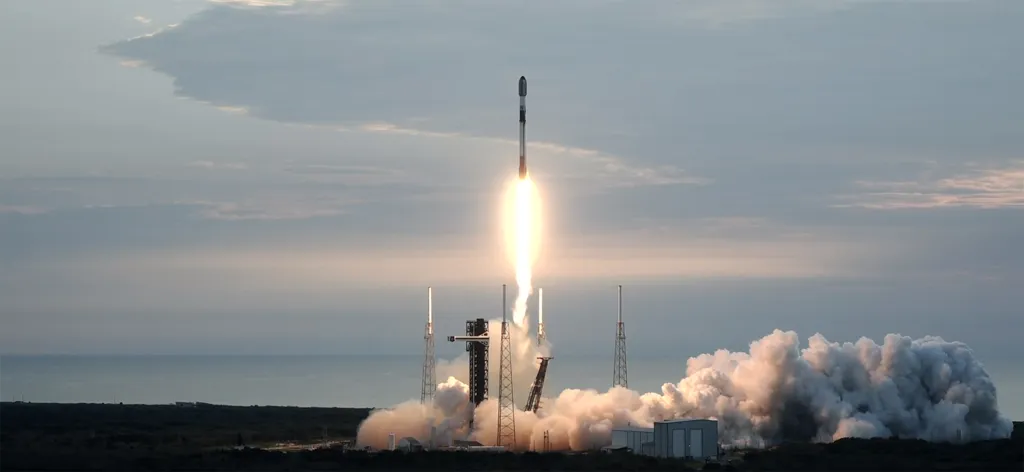
SpaceX sent to space a test version of a spacecraft called Starfall during a sunrise launch on the Space Coast on Tuesday.’
Read more ‘A strong message’: In a first, OCPS high schools combine for summer show
A Falcon 9 rocket lifted off from Cape Canaveral Space Force Station’s Space Launch Complex 40 at 6:43 a.m. carrying the disc-shaped Starfall vehicle, developed by SpaceX as a means to provide an affordable microgravity platform to the commercial market.
The system is also touted by SpaceX as a way to perform in-space manufacturing.
Starfall is designed to be able to orbit and make safe splashdown returns. The test flight sent this version on a suborbital trajectory with a landing targeted for the Pacific Ocean.
The first-stage booster for this mission flew for the 29th time and made a recovery landing downrange on the droneship A Shortfall of Gravitas stationed in the Atlantic.
This marked the 42nd launch on the Space Coast in 2026, with all but six coming from SpaceX.
With nearly six months of launches in the books, this year’s pace is likely to fall well short of the record 109 launches seen among all providers in 2025 from Florida.
SpaceX has dialed back its launch pace in Florida, limiting Falcon 9 missions to its Canaveral operations as it focuses on building out the new launch tower at Kennedy Space Center’s Space Launch Complex 39-A for its in-development Starship and Super Heavy rocket, which for now has only launched test missions from Texas.
Read more Rain chances are slightly lower while heat trend continues
It still uses the pad at 39-A for Falcon Heavy launches, but has only flown that heavy lift rocket once in 2026. The next Falcon Heavy launch, though, could come as early as Aug. 30 carrying NASA’s $4.3 billion Nancy Grace Roman Space Telescope, which arrived to KSC aboard NASA’s Pegasus barge on Sunday.
Today’s mission includes a demo of a new vehicle that will enable affordable, routine access to the microgravity environment for scientific research and in-space manufacturing. After demonstrating controlled flight, the spacecraft will splash down in the Pacific Ocean pic.twitter.com/NLwhigtSWC
— SpaceX (@SpaceX) June 23, 2026
United Launch Alliance has flown four of the rest, and has its next mission, an Atlas V rocket carrying Amazon Leo satellites, looking to fly on July 3.
Blue Origin’s New Glenn flew once, but plans for more launches this year are on hold until the company can repair its launch pad in Cape Canaveral, which was damaged during a massive rocket explosion during a static hot fire test.
The other launch this year was NASA’s Space Launch System rocket that sent the Orion spacecraft and its crew on the lunar fly-by Artemis II mission. SLS won’t fly again until at least mid 2027 on Artemis III.
Read more Sun Terra pulls application for Walmart within Minneola Marketplace