
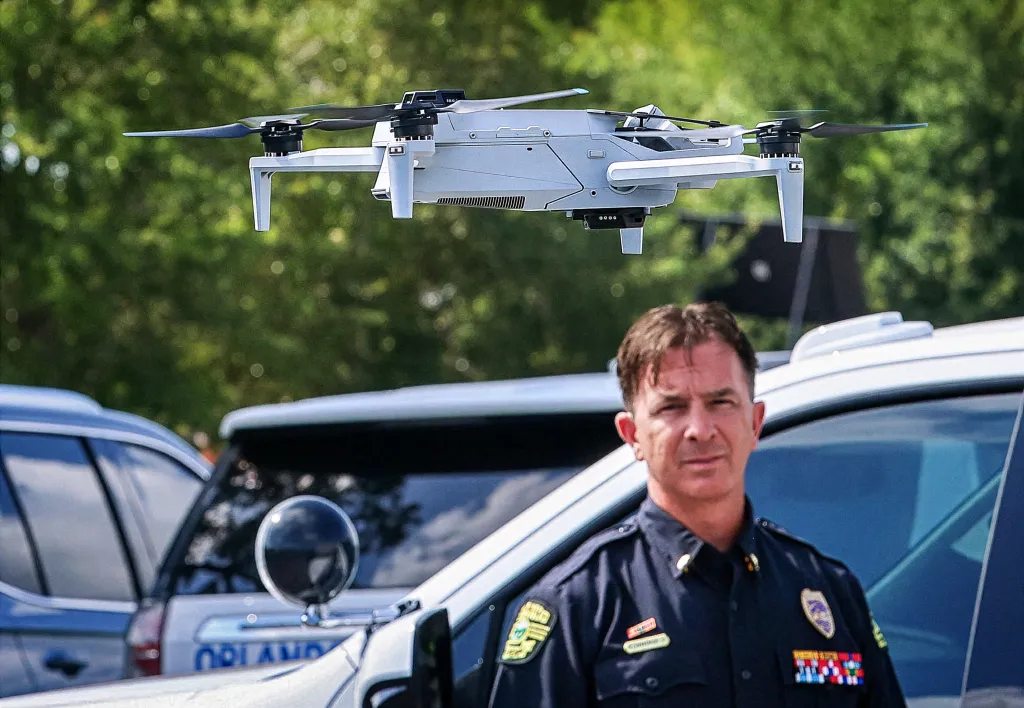
The Orlando Police Department unveiled its new drone-as-first-responder program Wednesday, joining a nationwide trend as city and police officials promise it will reduce response times while providing critical information to officers rushing to a scene.
Read more In a rainbow-trimmed robe at the World Cup, a gay Qatari doctor advocates for equal rights
The program, known as DFR, costs around $6.8 million over nine years, or $759,000 annually, with 11 drones stationed in key areas around Orlando city limits.
The agency invited reporters to observe the capabilities of the drone located on the roof of its headquarters in the Parramore neighborhood, nicknamed the “Downtown Defender,” as it “pursued” an OPD-issued truck west of downtown.
Along with being able to lock onto GPS coordinates and automatically follow a target vehicle, the drones are also equipped with thermal imaging and can zoom in to license plates and inside vehicles from dozens of feet above the ground. The pilots can control the drone from OPD’s real-time crime center using a mouse and keyboard or an Xbox controller.
Orlando introduced its program amid a massive 58% decline in homicides and 19% drop in overall crime in the city from 2024 to 2025.
“We believe that the drone-as-first-responder program will build on that impact,” Mayor Buddy Dyer said in a press conference prior to the demonstration.
DFR programs have been sprouting at agencies in Florida and around the country as law enforcement leaders modernize its response to emergency calls. The Chula Vista Police Department in California was the initial agency to pilot such a program in 2018, while St. Cloud was the first Central Florida police department to embrace the technology last year.
OPD has been testing its program since October and have deployed drones more than 900 times in that period, Chief Eric Smith said. In total, he added, they helped locate 90 vehicles and more than 150 suspects as part of its investigations, beating officers to reported crime scenes 43% of the time while “providing useful information” in 92% of cases.
Read more Disney World: Dates set for Very Merry, Jollywood holiday events
In one such case from May 31, a drone was dispatched to a neighborhood in MetroWest following a report of a possible stabbing in which the 911 caller could only provide a nearby intersection as its location. The drone arrived before the officers and was able to confirm where the incident took place while providing updates as multiple people fled the area.
According to police, a woman was caught on video punching a victim and was later arrested at the scene and charged with domestic battery, a misdemeanor. That case is ongoing in Orange County court, but the arrest affidavit was not immediately made public.
There is little in Florida law codifying policy on drones, which can differ from agency to agency.
Unlike St. Cloud’s program, OPD’s does not provide a way for people to search for drone deployments online, but Smith said that could change in the future. He also plans to explain the DFR program next month as part of a series of community meetings in neighborhoods around Orlando.
When asked about the privacy implications of using the drones, Smith said they are only to be used for crimes in progress, most critically violent crimes where a drone could be useful for reconnaissance as officers make their way to a scene. The drones are also not equipped with AI software such as facial recognition.
“This isn’t something that’s just launched to go look in people’s windows and people’s backyards, to see what you’re doing — that’s not something we do,” Smith said. “This is to keep officers safe, help officers respond quicker and keep our community safe.”
Read more Maxwell: Even as it’s abandoned, boondoggle ‘Alcatraz’ may cost taxpayers more