
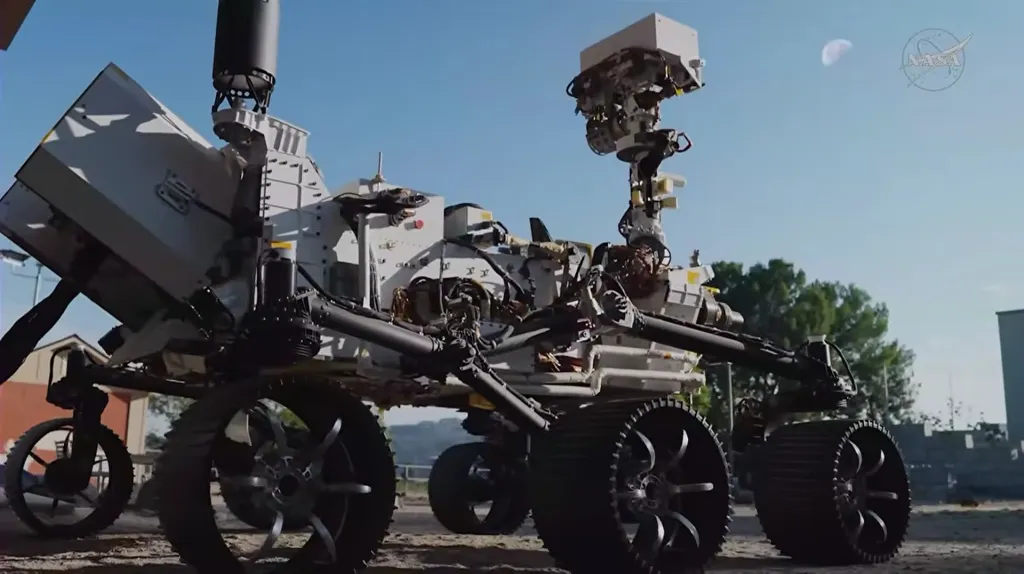
NASA announced four new contracts for commercial lunar landers for the agency’s moon plans, but dropped news that it’s toying with the idea of sending to the moon a sister rover to the ones currently active on Mars.
Read more New UCF women’s coach Gabe Lazo, who grew up in little Havana, leans on life-changing lessons
“It’s existed. You just didn’t know its name,” said NASA Administrator Jared Isaacman during a Tuesday update. “It’s probably going to find its way to the lunar South Pole.”
Its name is “PROMISE,” which stands for Polar Rover for Observation, Mapping, and In-Situ Exploration. It’s a sister to the Curiosity rover launched from Cape Canaveral in 2011 that has been traveling the Martian surface since it landed in 2012.
As Isaacman toured the various NASA centers and got the lay of the land after he was confirmed as administrator, he noted the Jet Propulsion Laboratory had this hardware and it became a prime contender to venture to the moon.
Not originally built to travel off-planet, its purpose has been as an engineering development unit, used to test out software and maneuvers before sending them to the active rovers on Mars. It’s also been used to support Perseverance, NASA’s rover that launched in 2020 and arrived on Mars in 2021.
But Isaacman said PROMISE could be reassigned.
“We’ve had years now of experience operating the two rovers on the surface of Mars, and we’ve got this hardware that the taxpayers have invested a lot in. So the question was posed, what if we send it to the moon?” Isaacman said.
He noted JPL was on board working with the idea.
As far as what a rover like that can bring to the moon? For one, it runs on a Radioisotope Thermoelectric Generator (RTG) reactor, which relies on heat generated by a decaying nuclear isotope, and so does not rely on solar power for energy, said Carlos García-Galán, NASA’s Moon Base program manager.
“It allows us to go anywhere we want, regardless of the illumination,” he said. “Surviving the lunar night is going to be one of the bigger challenges. With this capability, we wouldn’t have to worry about that.”
It will let the rover travel longer distances and reach remote destinations just like its Mars counterparts. It also has a large capacity.
“We’re going to work with our partners in the Science Mission Directorate to find the best payloads we can have, put them on this rover, and get groundbreaking science out of it, he said.
Carlos García-Galán said he and Isaacman tried to drive it themselves, “but experts took it over.”
“It’s there, and it’s been tested extensively in the JPL Mars rock yard,” he said.
Isaacman said some instrument changes could be in order, but getting hardware like the Promise to the moon would “bring an immense capability to the lunar south pole in short order.”
Isaacman said it’s not a done deal, though.
“I think that the farthest I can go is, we’re thinking about it, but I promise you, we’re thinking about it,” he said. “We’ve got the hardware, and this is exactly what we should be trying to do to put wins on the board, getting a capability like Promise to the surface of the moon.”
Read more Blue Origin reveals new launch pad design following May explosion
More moon missions
What is more nailed down is more moon mission contracts under what had been NASA’s Commercial Lunar Payload Services (CLPS) program, which falls under NASA’s larger Moon Base Program.
Three companies that have all attempted lunar landings already, and have more in the works, received the next four contracts.
Astrobotic received two awards while Firefly Aerospace and Intuitive Machines got one more each, with all four worth a combined $600 million.
Astrobotic, which flew its Peregrine lunar lander on the first CLPS mission in 2024 but failed to reach the moon, is set to fly before the end of 2026 on its second attempt with a much larger Griffin lander. Its two new contracts worth a combined $297.9 million will be for deliveries using updated versions of the smaller Peregrine lander, both to fly before the end of 2028.
Intuitive Machines flew its Nova-C lander on two partially successful lunar landing missions in 2024 and 2025 that saw the hardware land, but tip over both times. It has a third Nova-C mission that could fly by early 2027 and two others beyond that, the fifth of which will use a larger Nova-D lander. The new contract, though, worth $148.3 million, is yet again for a Nova-C lander to fly in 2028.
Firefly Aerospace was the first commercial company to stick its lunar landing successfully with the Blue Ghost lander in 2025. It has more missions on tap as well, including its next that could fly by early 2027, but this new contract for $144.2 million will be for another Blue Ghost lander to fly in 2028.
“We’re building a proving ground for Moon Base operations,” said Ryan Stephan, NASA’s Moon Base acting director of cargo landers. “Accelerating our moon mission ordering cadence and launch opportunities enable us to move quickly to learn, iterate, and improve.”
The four new contracts bring the total of NASA missions from multiple providers to 17 in the coming years.
Isaacman has said he wanted more CLPS awards with 10 each year for three years starting in 2027.
It’s part of Phase 1 of NASA’s moon base plans, with missions through 2029 that aim to secure reliable access to the lunar surface and experiment with technology.
That includes a pair of lunar rovers NASA awarded contracts for earlier this year.
Phase 2 will establish an initial moon base operating capability between 2029-2032. Phase 3 beyond 2032 has a goal of a semi-permanent crew presence on the moon.
Read more Orlando victim named in fatal Seminole County alligator attack