
Bob Dugan’s life changed forever without warning.
The lifelong golfer and avid angler was overseeing the prestigious Northern Amateur in July 1986 when he met the inventor of Thor Guard, a lightning prediction system. Dugan was intrigued by the man’s fish finder but skeptical when the conversation turned to predicting lightning.
Read more DeSantis locks in funding for AIDS drug program
“I said, ‘You can’t predict lightning. I’ve played golf my whole life at a very high level. Can’t do it,’” Dugan recalled.
The inventor insisted on bringing his device to the tournament.
Late one afternoon, he radioed tournament officials and told them to suspend play because lightning was imminent. Dugan and others walked onto the patio, looked toward the sky and scratched their heads.
There wasn’t a cloud in sight.
The inventor soon became more urgent and implored officials to clear the course. Skeptically, they suspended play as volunteers and players slowly returned to the clubhouse, despite seeing nothing imminent overhead.
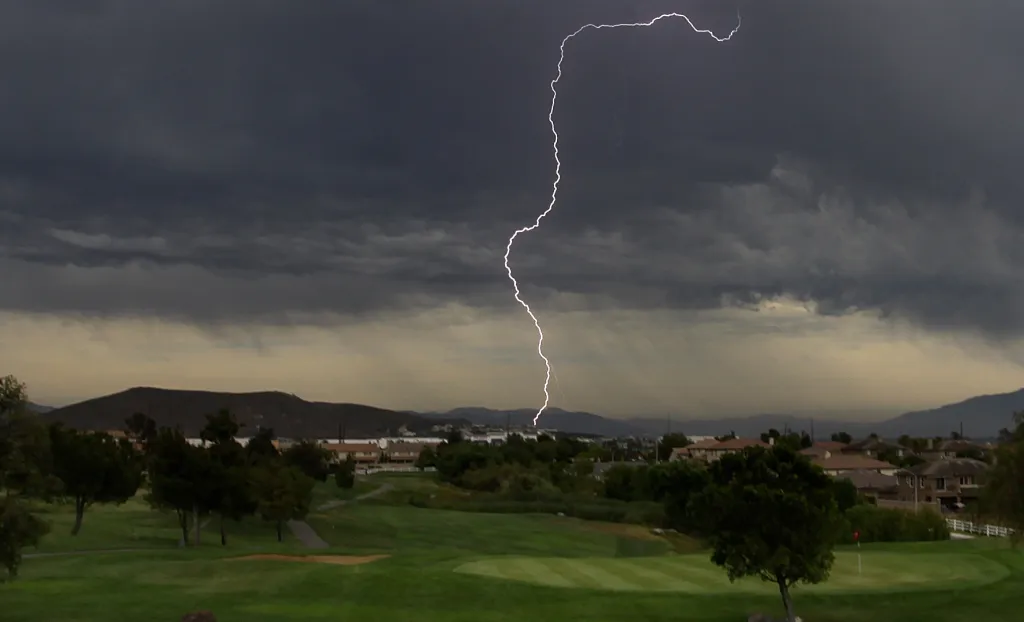
However — before all the golfers could take shelter — 11 minutes after the initial warning, a single bolt shot from a storm 50 miles away and struck six golfers on the 18th fairway.
“The strike I saw was called a bolt from the blue,” Dugan said.
The experience shook him.
He couldn’t stop thinking about how close the incident had come to becoming a tragedy and how helpless everyone on the golf course had been.
Four years later, he joined Thor Guard, where he now serves as CEO and president of the industry leader in lightning and severe storm prediction.
As July arrives in Florida, few places are more dangerous than the Sunshine State, where sea breezes from the Gulf of Mexico and Atlantic Ocean collide daily to produce sudden and powerful thunderstorms.
“There’ll be lightning everywhere,” Dugan said. “It could happen anytime during the day.”
Florida recorded 22 million lightning strikes in 2025, including 6.5 million in South Florida. The most dangerous corridor stretches along Interstate 4 from Tampa to Daytona, with the north end of Tampa Bay the hottest spot for activity.
To Dugan, those aren’t merely statistics but reminders that danger cannot be detected by sight, sound or instinct.
“For so many years, everybody thought they could just look at the storm and know whether they’re safe or not,” he said. “Don’t push your fate, because if you make a mistake and you get hit, the consequences are you’re finished, or your life is going to be a lot different than it was before you got hit.”
Thor Guard has grown into a global operation, serving thousands of customers at thousands of properties, including NASA, the U.S. military, airports, universities, NFL teams and golf courses.
Golf remains one of the company’s largest customer bases, especially in Florida, where clients include UCF, Rollins College, Orange Lake Golf Resort, Seminole Golf Club, Trump Doral, Boca West and the University of Miami.
Dugan wishes more facilities would embrace the technology.
Thor Guard has worked with the USGA since the 1995 U.S. Open at Shinnecock Hills, also site of the 2026 edition. LIV Golf uses the system, and the LPGA Tour was a longtime client.
One of Dugan’s early close calls came during an LPGA event in Illinois. Stationed in a restroom building with power and a radio, he watched the electrical readings climb and urged officials to suspend play despite blue skies overhead.
“They’re standing around and asking what’s going on,” Dugan said. “I showed them the numbers and said, ‘Suspend play right now.’”
Read more NASA considers moon mission for Mars-type rover
About 15 minutes later, lightning struck roughly 100 yards away.
“That was the beginning of our career with the LPGA,” he said.
Soon afterward at another tournament, Thor Guard detected unusual electrical activity that Dugan later learned was caused by a tornado that passed a quarter-mile north of the golf course and destroyed event tents.
That experience eventually spurred a technological upgrade allowing the company to also predict tornadoes and severe storms.
“No one in the world has anything like this,” Dugan said.
Thorguard’s footprint is vast, with 3,500 to 4,000 customers worldwide deploying the system at 8,000 to 9,000 properties, Dugan said.
The technology isn’t inexpensive. A portable system starts around $9,700, while a full weather station with a warning horn costs about $24,000 installed. Larger properties can add horns for $4,500 each.
Dugan believes it’s money well spent.
When he joined the company in the early 1990s, roughly 100 people were killed annually by lightning in the United States and more than 500 others were injured.
By 2025, fewer than 20 people died from lightning strikes nationwide, including five in Florida.
“That is a significant drop,” Dugan said. “The presence of this technology has made a huge difference. People understand the dangers and are making smarter decisions.”
The company was founded in 1973, two years before golfers Lee Trevino, Jerry Heard and Bobby Nichols were struck by lightning during the 1975 Western Open.
Dugan said Trevino was “levitated and pulled.”
The Hall of Famer later joked about the incident by raising a 1-iron whenever storms approached and proclaiming, “Not even God can hit a 1-iron.”
Years later, Dugan asked him to stop.
“I said, ‘Mr. Trevino, would you please stop that? There are kids who would do that,’” Dugan recalled. “He never did it again.”
Dugan has made it his life’s work to educate people about lightning and save lives.
Following the death of his wife, Susan, three years ago, he felt called to tell his story.
He wrote “All I Am,” a memoir about his life in golf, his career at Thor Guard and his marriage to his longtime golfing partner. The audiobook is narrated by Morgan Freeman.
“The most important people in your life are your friends,” Dugan said. “Do not lose contact with them.”
The book also helped him process his grief and redefine his purpose.
For more than three decades, Dugan has tried to protect people from physical harm. Now, he hopes his experiences and faith can help people in a different way.
“Instead of saving physical lives, I’m trying to save souls,” he said. “If I were to die tomorrow, I’ve done about as much as I can do on this earth.”
Read more New UCF women’s coach Gabe Lazo, who grew up in little Havana, leans on life-changing lessons
Edgar Thompson can be reached at [email protected].