
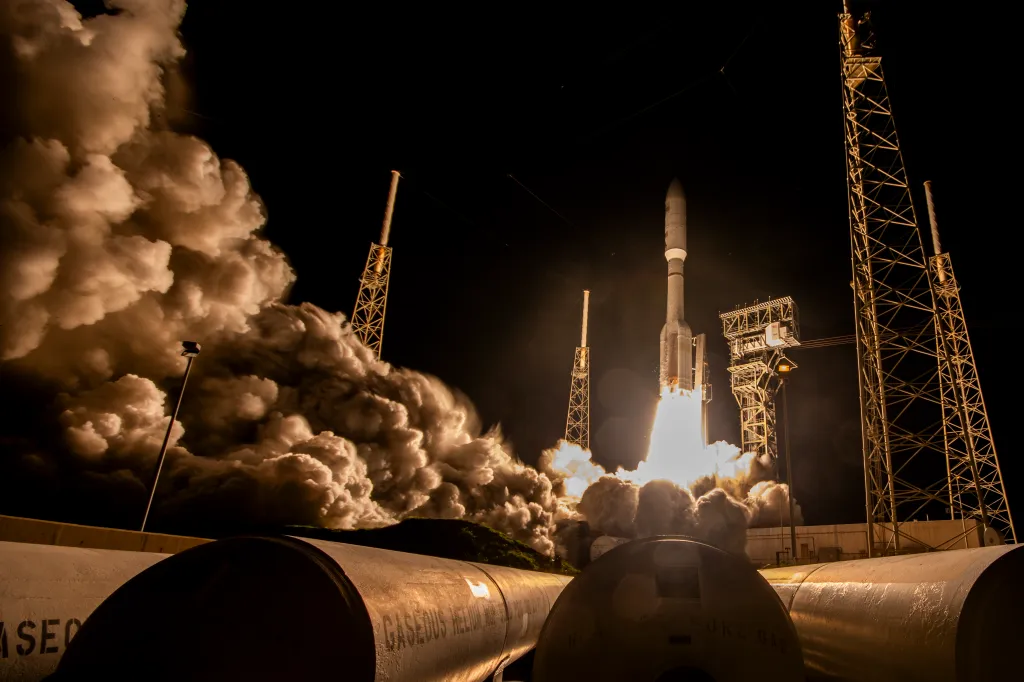
The sight of United Launch Alliance’s Atlas V rocket in its most powerful configuration has flown for the last time.
Read more Iran warns oil tankers to use approved routes in Strait of Hormuz or face a ‘forceful response’
The rocket sporting five boosters launched at 12:30 a.m. Thursday from Cape Canaveral Space Force Station’s Space Launch Complex 41 on the Amazon Leo 8 mission.
All six remaining Atlas V rockets have been reserved for future launches of Boeing’s Starliner, which use only two boosters, although when that spacecraft’s next launch will be remains in question. This version of the Atlas V generated 2.7 million pounds of thrust at liftoff.
LIFTOFF of the United Launch Alliance Atlas V rocket with a star‑spangled start to the Amazon Leo 8 mission as America’s 250th Birthday approaches! pic.twitter.com/JUTHoXnaQN
— ULA (@ulalaunch) July 2, 2026
For this launch, on board were 29 of Amazon’s satellites to add to its growing constellation that seeks to compete with the likes of SpaceX’s Starlink.
Amazon now has more than 350 satellites in orbit, part of a plan to get more than 3,200 in space over the next several years.
This was the last of nine Atlas V rockets Amazon bought to help grow that number with the first in 2023 sending up a pair of test satellites of what had been previously called Project Kuiper. The last eight with operational satellites have all flown in just over the last 14 months.
“Atlas V has played a critical role in the early deployment phase for Amazon Leo, launching 224 satellites with a 100% success rate across all eight missions, and we’re excited to build on that foundation with ULA as we transition to Vulcan,” said Melissa Wuerl, Amazon Leo Director of Launch Systems. “With hundreds of flight-ready satellites standing by at the Cape and a new, dedicated vertical integration facility ready to support Leo Vulcan 1 and subsequent missions, we have a clear path to increase launch and deployment cadence, helping us quickly expand network coverage following an initial service rollout later this year.”
Amazon has contracted 38 launches on ULA’s new rocket Vulcan, but ULA is still working on solving an issue with that rocket’s solid rocket boosters.
Read more Lert Thai Street Food dishes out authenticity in East Orlando | Review
With missions with Arianespace out of the South America as well as SpaceX and in the future Blue Origin’s New Glenn, Amazon has spread out across four providers with more than 100 launches planned to tackle satellite deployment.
New Glenn remains without a launch pad, though, after the explosion at the Cape in late May, and it’s unclear when Vulcan will launch again.
In ULA’s lone Vulcan launch in February, which was also only the rocket’s fourth since its debut in 2024, one of the nozzles on the boosters, provided by Northrop Grumman, burned through during liftoff.
A similar issue happened on Vulcan’s second launch, and the Space Force announced it would not fly again on Vulcan until it solved the booster problem.
This marked the 44th flight from the Space Coast so far in 2026.
SpaceX has flown the majority of those with 37 launches while ULA has now flown five this year with one Vulcan and four Atlas V missions. Blue Origin flew New Glenn once and NASA flew its Space Launch System rocket on the Artemis III mission.
The next launch is planned for Sunday, when a SpaceX Falcon 9 on the Starlink 10-50 mission with 29 Starlink satellites aims to lift off from Cape Canaveral Space Force Station’s Space Launch Complex 40 during a launch window that runs from 6:36-10:36 a.m.
The first stage booster for this mission is flying for the 13th time and will attempt a recovery landing downrange on the droneship A Shortfall of Gravitas stationed in the Atlantic.
Read more Asking Eric: I want my sister-in-law to know I got her insulting accidental voicemail