
It’s not about the money, said a jubilant Beverly Robinson of $4 million to be shared by the Groveland Four families.
Read more Today in History: July 3, beloved TV sheriff Andy Griffith dies
“No, at this point, it’s about righting the wrongs,” said Robinson, 70, a cousin to the late Samuel Shepherd, one of the four Black men who were falsely accused in the summer of 1949 of raping a white, teen-age housewife on a dark roadside in rural Lake County.
Florida Gov. Ron DeSantis signed a state budget Monday that included the millions as “compensation” for the decades-old prejudice and injustices heaped upon the quartet, all now long dead — Shepherd, Charles Greenlee, Walter Irvin and Ernest Thomas.
As a cousin, Robinson said she will not share in the pay-out awarded to closer kin. But she rejoiced for them.
“It’s a massive step forward, massive, and I’m so grateful,” she said.
The families fought for years to clear the names of men, who history has proven were railroaded.
Irvin and Shepherd were Army veterans of World War II; Greenlee was just 16; Thomas was married and working near Groveland.
“This is about the only remedy Florida law allows,” said state Sen. LaVon Bracy Davis, D-Orlando, who pushed fellow legislators to recognize both the painful consequences and the state’s complicity in the notorious Jim Crow-era case. “You can’t bring people back to life, you can’t give them back the time the state stole from them. All you have is compensation. So, this is not about a payday.”
The money, to be divided equally among four families, is the latest and likely last state effort to atone for its failings.
Gerald Threat, 68, an Ocoee resident and nephew of Irvin, said the more important effort was completed in November 2021 when his uncle and the other members of the Groveland Four were exonerated — determined by a judge to be innocent —after a hearing on a filed by Bill Gladson, the elected state attorney for the Fifth Judicial Circuit which includes Lake County.
“I was never looking for money,” Threat said this week. “I was looking for justice. That’s all I ever wanted.”
Judge exonerates Groveland Four in notorious rape case from 1949
Threat recalled traveling twice a month as a child in the 1960’s with his grandmother and his mom to the Florida State Prison in Raiford to visit his incarcerated uncle, whose death sentence for the alleged rape had been commuted by the governor to a life term in 1955.
Irvin was paroled in 1968, but died about a year later.
“What’s happened now, in my eyes, is justice,” said Threat. “It’s just a little late.”
He said he is disappointed so many family members did not live long enough to hear the Groveland Four were, in fact, innocent.
His grandmother died in 1993, his mom in 2012.
The money, to be divided equally among four families, is the latest and likely last state effort to atone for its failings.
The Florida House of Representatives issued “a formal and heartfelt apology” to the men and their families in 2017.
Read more Meet Orlando’s biggest star: 9-year-old Scarlett Spears
Two years later, Gov. Ron DeSantis and the Cabinet posthumously pardoned the men after a hearing at which relatives of the men testified as did accuser Norma Padgett, who stuck to her version of events, despite medical evidence contradicting her rape claim.
“I’m begging y’all not to give them pardon because they done it,” she said sitting in a wheelchair at the hearing.
She died in 2024 at age 92.
The medical evidence, a report from a doctor who had examined Padgett the day after the reported rape, was never presented to a jury, but was disclosed by author Gilbert King in his Pulitzer-Prize-winning, historical account of the infamous case, “Devil in the Grove.”
In 2020, Lake County unveiled a memorial to remember the Groveland Four.
The memorial stands in front of the old Lake County Courthouse, which now houses government offices and a history museum but was the venue for the original Groveland Four trial and where jailers had tried to beat confessions out of the defendants in the basement.
Lake County unveils Groveland Four memorial, hopes to shed racist reputation
The memorial plaque reads: “Eyewitness accounts, records, and subsequent investigations revealed that these men were subjected to racially motivated oppression and were never given the opportunity to legitimately defend themselves in a court of law.”
It makes no mention of former Lake County Sheriff Willis V. McCall, a villainous figure in the saga.
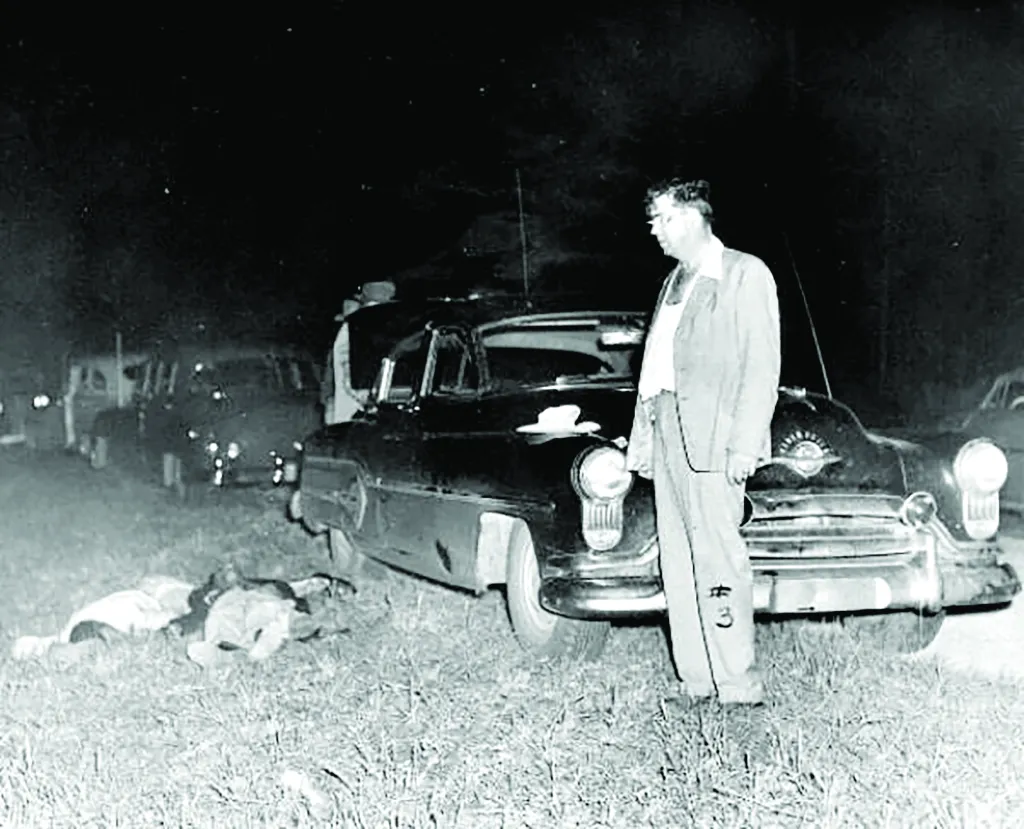
In November 1951, McCall shot Shepherd and Irvin while returning both from prison for a re-trial ordered by the U.S. Supreme Court. Shepherd died but Irvin survived to tell FBI agents the shooting was unprovoked and McCall staged the scene to make it look like an escape attempt.
Thomas never got to tell his story. Fearing mob violence and to avoid arrest, he fled to Madison County, 180 miles away, chased by a deputized white posse that caught up to him in a swamp 10 days later. He was shot 400 times. But a coroner deemed his death a “justifiable homicide.”
To the community and the families of the Groveland Four: We’re sorry | Editorial
In 2019, The Orlando Sentinel also apologized in an editorial for its role in the injustice.
Gladson, the state attorney, brought the case of The Groveland Four back to a circuit judge in Lake County in 2021 citing newly discovered evidence in a battered brown box, marked “exhibits 6-9-52 Walter Lee Irvin – vs – State.” It contained a pair of Irvin’s trousers which had “smears” on the front that had never been scientifically analyzed but were presented to jurors as evidence of Irvin’s guilt.
DNA testing at the FDLE lab in Orlando identified no semen.
“The significance of this finding cannot be overstated,” he said.
Before the lab report, Gladson said he was prepared to draft a remorseful letter to the families of the men, closing the case.
Circuit Judge Heidi Davis posthumously exonerated the men.
Carol Greenlee Crawley, born four months after her father Charles’ arrest, erupted in tears.
Samuel Shepherd’s cousin, Beverly Robinson, exclaimed it was a “glory hallelujah day!”
“We have come a long way since 1949 and, while it is easy to spot intolerance, the sin of indifference is more insidious,” Gladson said this week. “It is a rare opportunity to be able to correct the sins of the past by confronting the Groveland Four injustice head-on.”
Read more Commentary: Social Security and Medicare’s insolvency dates don’t matter. Insolvency does
He said the governor and Legislature chose “a path of courage over convenience.”