
Earlier this week, as temperatures rose, Greg Harris sat at a table in a church off Orange Blossom Trail working on a word search puzzle, eating fruit snacks and delighting in the air conditioning.
Read more Orlando Sentinel 150: Friday Flashback to July 4 parade in 1886
The 74-year-old veteran has been homeless for three months, sleeping in a wooded area near downtown Orlando. It is not so bad at night, he said. But during the day, the heat is unbearable. Somedays, he rides the train back and forth from downtown to Kissimmee just for the air conditioning.
But this week, he had another option. When temperatures reach a certain point, Orange County opens cooling centers, like the one at the church, and then Harris doesn’t have to travel so far to escape the heat.
“It’s a place where you can go and just be cool, chill out without the sun,” he said. “This is a blessing.”
In June, municipalities across Central Florida opened cooling centers for the first time this season. These are air-conditioned spaces — in churches, nonprofits and libraries — where the homeless are invited in to sit out the hottest part of the day. When the centers are open, Lynx provides free bus service for people to get to them.
In previous years, cooling centers in Central Florida didn’t open until the heat index reached 108 degrees, the threshold that the National Weather Service has set for a heat advisory. The heat index, the agency says, is what the temperature feels like to the human body when relative humidity is combined with the air temperature.
In May, Orange County lowered its threshold to 103, worried that too many were suffering in the region’s hot and humid weather. At the time, Orange Mayor Jerry Demings called the matter a “public safety and health issue.”
The threshold in Seminole and Osceola counties, however, is still 108.
“The 103-and-above heat index is really hard on our seniors, or on anyone, really, because even the younger people, I see them struggling,” said Mel Camarillo, a volunteer at Service and Love Together, or SALT, the nonprofit that operates the cooling center in the church where Harris goes.
But Osceola officials insist the heat index threshold isn’t a big deal since the majority of their cooling centers are in libraries, which are open regardless of the temperature.
Finding a place for the homeless to rest is an ongoing challenge for officials in Central Florida, as the area’s homeless population has outpaced its shelter capacity. A state law, new in 2025, that requires municipalities to ban camping in public spaces and subjects anyone caught sleeping in a public space to arrest has made it even more difficult for the homeless to find respite.
SALT’s center is in a space it leases from Powerhouse Church that fits 15 people. The nonprofit also operates a drop-in center on the property where the homeless can go for a shower, to do their laundry, to get free hygiene products and clothing and to talk with caseworkers who try to connect them with other social services.
For its cooling center, SALT prioritizes those over age 55, a growing and vulnerable segment of Central Florida’s homeless population.
Harris said he is diabetic and has a heart condition, so has to be extra careful not to get overheated.
Read more Families of wrongly convicted Groveland Four offer thanks for $4M state compensation
“I know when I’m getting ready to go down, and I got to get out of the heat,” Harris said.
On Tuesday, the heat index reached 103 and Harris was able to go into the cooling center. But the next day, the heat index peaked at 100, so the centers were closed, and Harris and others had to find other means of staying cool.
Julianne Johnson, 55, was passing through Orlando on a bus from California two weeks ago, she said, and got stranded after her wallet and phone were stolen. With no money for a place to stay, she is sleeping outside.
Her ankles are swollen, she said, due to the heat and her high blood pressure and sleeping on concrete exacerbates an old spinal injury. She goes to SALT’s drop-in center each morning to shower and do laundry. If the cooling center is open, she’ll then sit inside for hours sipping coffee and chatting with staff.
“We have heat in California, but you’re not soaking wet,” she said, referencing the humidity. “If it wasn’t for this cooling center, I’d probably be in the hospital.”
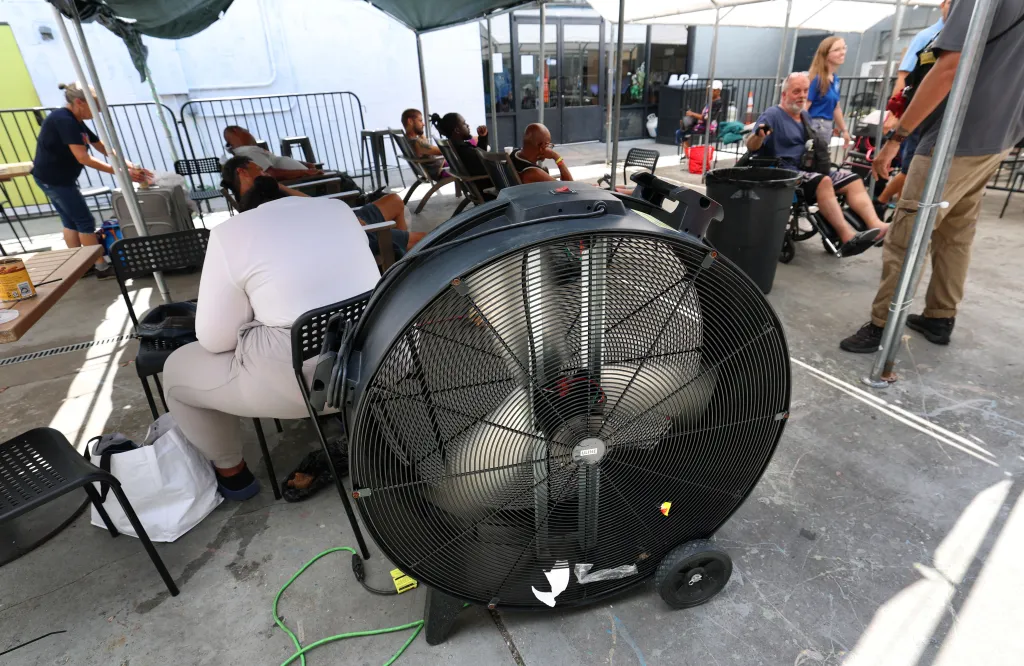
Don Thomas, 50, has been living on the streets for close to four years, he said. Since SALT’s cooling center is reserved for those 55 and older, he is not allowed inside. But SALT has a courtyard in the back of the church. The area is tented for shade and offers chairs, an ice machine, water and large industrial fans. It’s also where the showers and laundry facilities are.
“In some ways, this is also a cooling center,” said Kathleem Jorge, SALT’s homeless outreach director. “As the temperatures rise, a lot more people need access to showers. They’re like, ‘I don’t want hot water. I just want a cold shower because it’s been getting so hot’.”
SALT’s drop-in center at Powerhouse serves about 100 people each day, including Thomas. They sit in the courtyard, waiting for their laundry or their turn in the shower. The shade and the fan help.
“Everybody gets frustrated when there’s heat. It ain’t pretty,” Thomas said. “They don’t know what to do, don’t know where to go. They want to get mad. They want to argue. They want to do all kinds of stuff.”
Jorge said the staff is trained to keep an eye out for people who appear to be in extreme duress and will offer them a chance to sit inside, if possible.
“But, of course, we have limited space,” Jorge said.
Both SALT and the Homeless Services Network of Central Florida are looking for supplies to help those without housing deal with the heat, including water bottles, towels and electrolyte packets. The Homeless Services Network has an Amazon Wishlist for those who want to donate.
“It just keeps getting hotter and hotter,” Jorge said. “So we’re trying to do as much as we humanly can with the limited resources that we have.”
Read more Today in History: July 3, beloved TV sheriff Andy Griffith dies