
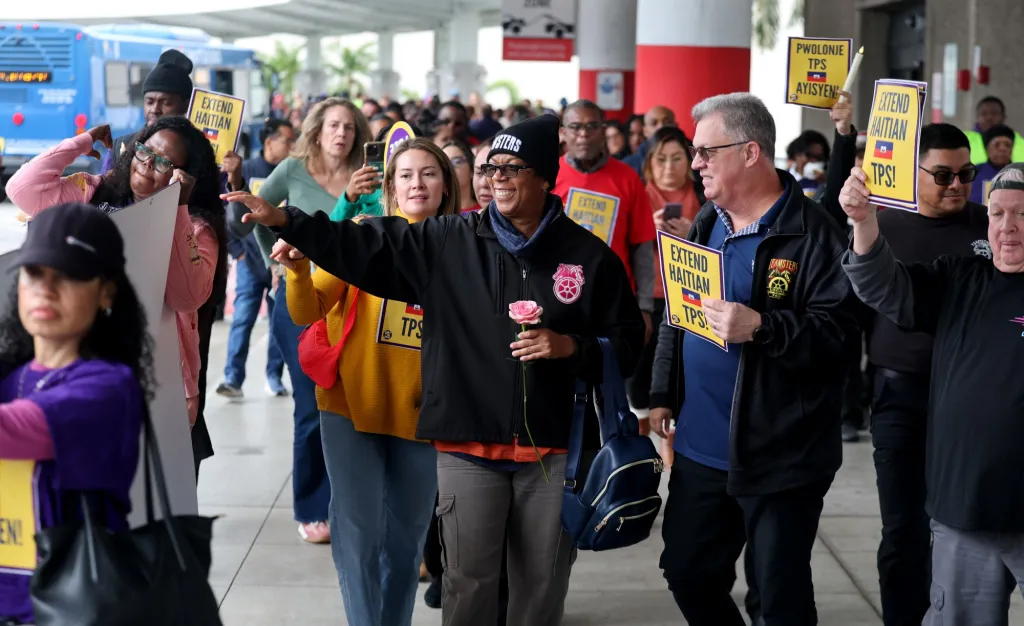
Hospitality trade groups from Florida and nearly a dozen other states have asked this question of the federal government after the U.S. Supreme Court upheld its right to strip temporary protection status from Haitian and Syrian immigrants:
Read more An exclusive look at Jackie Siegel’s almost-completed Versailles
Can we have more time to figure out what to do?
In a June 29 letter to Homeland Security Secretary Markwayne Mullin, the Florida Restaurant & Lodging Association joined the National Restaurant Association and 11 other state hospitality associations to share impacts related to terminating the Temporary Protected Status [TPS] for Haitians and Syrians who are living and working in the United States.
“The Supreme Court’s decision has significant implications for the more than 93,000 Temporary Protected Status [TPS] holders who have built their lives in Florida, as well as for the hospitality and tourism businesses and communities that rely on their contributions,” Carol Dover, the FRLA president and CEO, said in a statement this week. “Together, these individuals contribute an estimated $2.6 billion annually to Florida’s economy, underscoring the far-reaching impact this decision could have across our state.”
Samantha Padgett, vice president of government relations and general counsel for the FLRA, answered several questions posed by the South Florida Sun Sentinel about the situation facing business owners.
Q: Does anyone know if there is a date certain for the start of deportations?
A: “As of this moment, there is not a date certain. Rule 45 of the [Supreme Court] allows up to 32 days before the Supreme Court must issue its mandate, which will remove the injunction of the lower court. The administration also has the option of setting forth a specific timeline for implementation after the Court proceeds in compliance with Rule 45. We are asking for a more lengthy implementation period [90-120 days], to allow employers time to address the considerable vacancies that may occur.”
Q: Are there any alternatives for Florida employers to explore that would allow them to retain their workers?
A: “Individuals that are currently authorized under TPS will have to determine if there are other avenues through which they can be lawfully authorized to work.”
Q: Does the FRLA and/or individual members have a plan to help TPS-protected workers file asylum applications or some other work authorization application that would allow them to remain in the United States?
A: “No, we will not be able to assist with asylum applications or other work authorization applications, but we will continue to provide education and information to our members that can assist them as they work to comply with existing laws and regulations, including the most recent ruling, and assist their employees moving forward. We co-hosted with the American Business Immigration Coalition [ABIC] a webinar that provided guidance and a toolkit for employers to fully understand the current status of the situation, next steps, expectations, and resources for both them and their employees.”
Q: If all of the TPS-protected workers are forced to leave en masse, what types of alternatives do employers have to backfill vacancies on their workforces? Is there a big enough labor supply to fill a potential void?
A: “If all of the TPS-protected workers are forced to leave en masse, it will create a gaping hole in the hospitality workforce in some areas of our state. It will be a challenge to fill these vacancies, and that is why having a longer runway for implementation is necessary.”
The associations’ initiative is the latest among immigration advocates and leaders of various industries who fear that mass deportations of lawful immigrant workers may hollow out key sectors of the state’s labor market, including construction, healthcare, hospitality and transportation, among others.
One recent study concluded that Florida leads the nation in employed asylum applicants who could face deportation as the government moves to cancel pending asylum claims.
No time for waiting
There was no immediate indication that Mullin’s agency had responded to the associations’ joint request.
Read more Central Florida cooling centers open as homeless brace for the summer heat
Two members of Congress — Rep. Debbie Wasserman Schultz, D-Fla., and Rep. Set Moulton, D-Mass. — are pressing legislation designed to allow lower federal courts to review executive branch decisions regarding immigrants’ protection status.
But executive actions to expel those who are losing TPS are more likely to occur before any legislation gains traction.
Immigration lawyers are now advising their employer clients to be proactive in assessing the employment authorization status of their foreign-born workers, even though the government has extended the expiration date of TPS employment authorization documents from last Wednesday to July 10.
Among other things, each employee should be evaluated individually, as many who now reside in the U.S. under TPS may hold some other form of employment authorization or immigration status.
(Article continues after document.)
Evelyn “Alexandra” Batista, a West Palm Beach immigration lawyer not involved with the association, said business owners should be quickly auditing the work status of their employees and start looking for alternatives that would allow them to stay.
“They need to conduct immigration reviews and encourage affected employees to come forward and consult an attorney to see what else they could qualify for,” she said.
There is a wide array of visa possibilities pegged to work in various professions and industries, non-agricultural and agricultural.
Employer sponsorships are among options for businesses with multiple immigrant workers.
“If an employer has a large number of employees who are affected by this, it may be time to start thinking about immigration visas that are group-based,” Batista said.
Industry associations, particularly in hospitality or agriculture, can team as joint employers. Under this scenario, employers share the workforce and their administrative costs.
One thing employers should not do: continue to employ people who no longer have valid work authorizations, or who have work authorizations that are still being processed.
Civil and criminal fines, asset seizures and even imprisonment can be the result, other legal sources note, depending on the extent of the offense.
Read more Orlando Sentinel 150: Friday Flashback to July 4 parade in 1886