
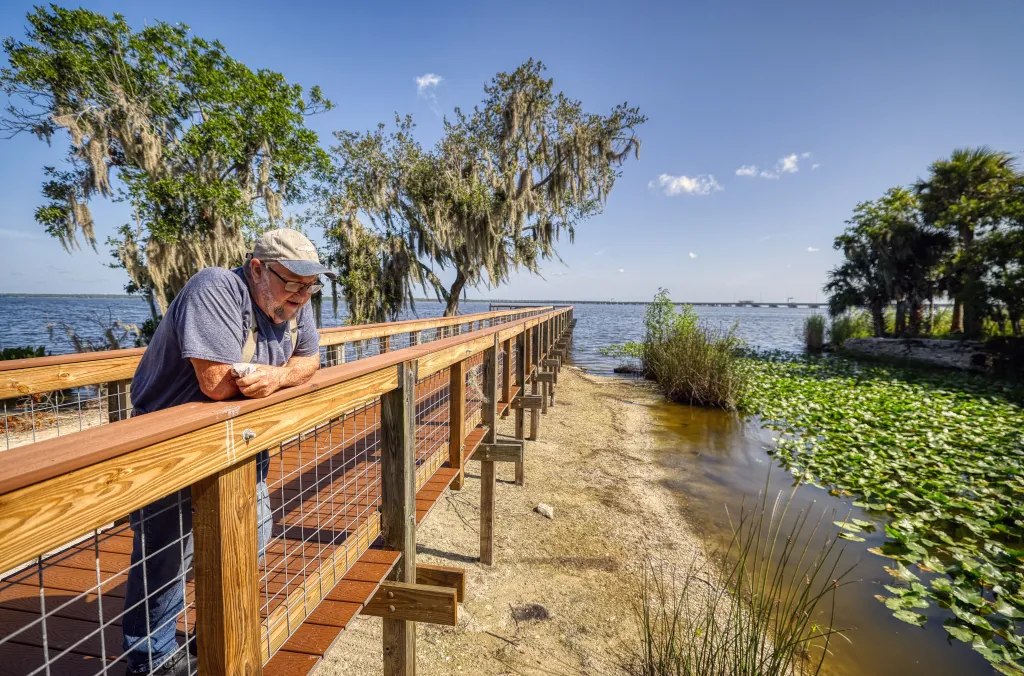
Lake Jesup, one of Central Florida’s largest water bodies, is also one of its sickest.
Read more Europe’s early heat wave led to a spike in deaths, may have killed over 10,000
Urban runoff filled with a noxious brew of fertilizers, stormwater and sewage has flowed into the Seminole County lake from as far as Orlando, Winter Park and Altamonte Springs for decades.
Even the state’s Department of Health regularly alerts the public — as it did again this month — not to drink, swim, or use personal watercraft on Lake Jesup because of harmful blue-green algae toxins. A permanent sign at one of the lake’s boat ramps warns of blooms.
Now, yet again, state and local governments are launching an effort to help clean Lake Jesup, this time by removing some of the pollutants on a narrow creek before reaching the lake, which sits about 14 miles northeast of Orlando.
Using $415,600 from a state environmental grant, Seminole plans to set hundreds of filters into Salt Creek — a slim 5.3-mile waterway that meanders through the Black Hammock Wilderness Area and drains into southern Lake Jesup.
As the creek water flows through filters housed in small boxes, officials hope they will capture most of the phosphorus and other pollutants that stoke algae blooms. Thick algae stops sunlight from reaching the bottom of a lake, preventing the growth of beneficial plants that fish use to forage or lay eggs. Blue-green algae also can kill animals — it is particularly dangerous to dogs — and even humans.
But longtime residents who have advocated for a healthier Lake Jesup say the government’s latest effort “has promise,” but it’s merely a “drop in the bucket” in getting the 25-square-mile lake in better shape.
“It looks good. It sounds good. But this isn’t a solution,” said Robert King, 66, who has lived his entire life in the Black Hammock along Lake Jesup. “It’s almost insignificant.”
Jeff Abbott, president of the Friends of Lake Jesup, a conservation group set up decades ago to restore the lake’s ecosystem, agreed. The cause of the pollution is much larger than a single creek, he said.
Other waterways feeding Lake Jesup with toxic urban runoff include Gee, Soldier and Howell creeks, all of which wind through neighborhoods of thousands of homes and are rife with lawn fertilizers, detergents and sewage from septic systems, he said.
“People just routinely over-fertilize and use the wrong detergents,” Abbott said. “As long as we keep putting phosphorus from fertilizers [into the creeks], the problem is not going to go away. But we’re asking to change peoples’ behaviors.”
He added: “If we’re able to filter all the other creeks, then we’ll have more luck.”
Shannon Wetzel, manager of Seminole’s watershed management division, said the Salt Creek filtering program is a “small scale pilot project” for now, and that county officials will monitor it for about two years.
“Depending on the results of the study, we may leave them in” or expand the project to other creeks, she said.
The 1,200 filters — at 25 pounds and roughly 30 inches long, a foot wide and four inches high — will be placed near Packard Avenue bridge early next year. Officials will check phosphorous levels upstream and downstream from the filters, along with water levels. Seminole plans to hold public workshops detailing the project. A final report will be presented in 2029.
Salt Creek was selected for the test because of its high concentrations of phosphorus. “Salt Creek Basin does not meet state water quality criteria for total phosphorus,” according to a county report.
Read more Orange County has a housing crisis. How will the next mayor fix it?
Half a century ago, Lake Jesup teemed with striped bass, ducks and other wildlife, attracting fishermen from around the country. Once more than 20 feet deep in some areas, Lake Jesup today is barely six feet deep as muck and other debris have accumulated on the bottom.
It’s now famous for having one of the highest densities of alligators in the state, primarily because its swampy shores are ideal for laying eggs.
But the years have brought troubles for the lake. Road building projects dating back generations — including the State Road 46 causeway — choked off cleansing currents from the St. Johns River that naturally flowed in and out at the northeast end.
“Then there’s other problems, that because of the pollution, the ecosystem of the lake has found a different equilibrium that’s not positive,” said Abbott, a Black Hammock resident.
Some portions are much cleaner than others, hosting alligators, birds and sometimes manatees, Abbott said. But near Salt Creek, the lake is marred by “brown sludge.”
“It’s just opaque,” he said.
Over the years, state agencies and local governments have made attempts at cleaning Lake Jesup but none have been enough to turn the tide.
In 2021, the St. Johns River Water Management District used an “algae harvesting unit,” a small barge that dragged along a large hose. As the trawler floated around Lake Jesup, the hose sucked in thousands of gallons of the murky beige-and-green water, and siphoned it into a holding tank. A filtration system removed the algae, phosphorus and nitrogen before dumping the clearer water back into the lake. That pilot project lasted for roughly a year before it was discontinued.
In 2015, Seminole built a $7.7-million facility off County Road 427 near Country Club Road to clean the waters of Soldier Creek by combining it with liquid aluminum sulfate, or alum, before it flowed into Lake Jesup. The alum attaches itself to pollutants, including algae, and creates a snowlike mixture that settles to the bottom of the facility’s pond.
“None of them are the magic bullet that ends it all,” said Seminole County Commissioner Jay Zembower, who has long been outspoken about the lake.
Though he would prefer to see a “major once-and-for-all overhaul” of Lake Jesup rather than a series of smaller projects, he said the effort would be too costly.
However, Zembower is still hopeful the new Salt Creek filters will make a meaningful dent.
The St. Johns River Water Management District currently has its own long-term projects, one of which treats the lake through a process called biosorption, in which microorganisms are injected into the water to bind with pollutants, including phosphorus.
The district also separately monitors the lake’s water quality and plans to further study the river’s flow through it, said Cammie Dewey, strategic planning basin coordinator for the Middle St. Johns River basin.
“It took us a lot of decades to kind of get Lake Jesup into the condition that it got into,” Dewey said, regarding the pollution. “Unfortunately, we can’t just flip a switch and make it all better.”
Read more Foodborne illnesses at restaurant chains are rare but can sicken customers