
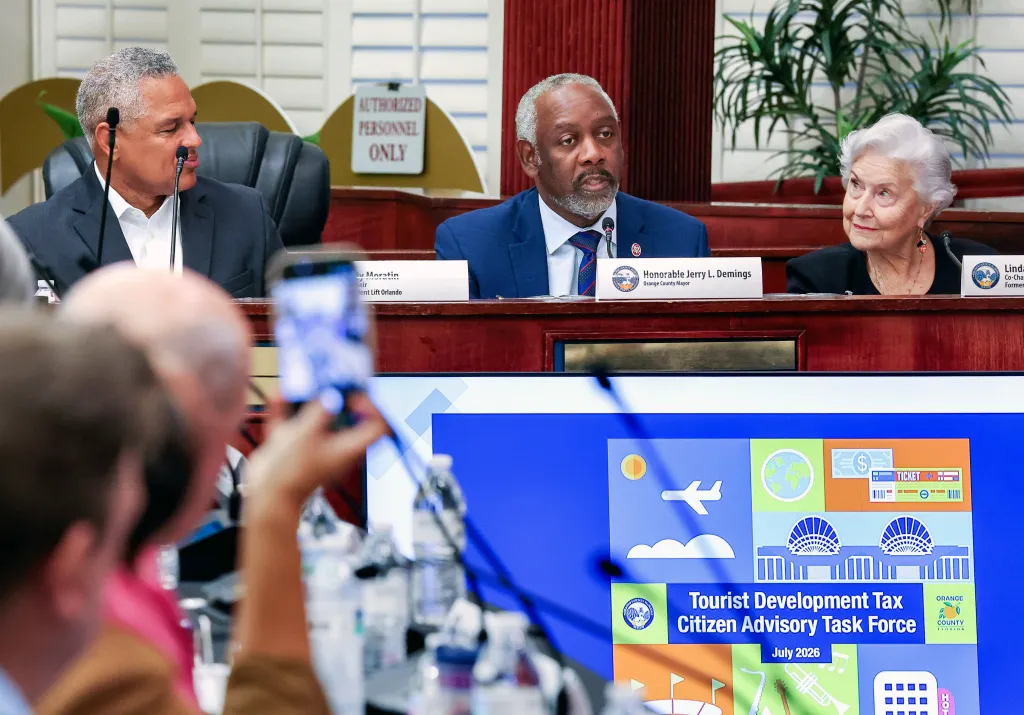
Orange County Mayor Jerry Demings’ newly impaneled tourist-tax task force got lessons Tuesday in tax law, economics and politics at their first meeting where six of the 24 applicants for a share of the public bounty were dropped from consideration — then quickly re-added before the session ended.
Read more Editorial: The attorney general should work for Americans, not Donald Trump
The list was ultimately pared by just one — Lake County-based Arching Oaks Japanese Art & Cultural Center, which wanted $20.5 million to attract delegations of Japanese tourists to the Orlando area through an initiative featuring anime, martial arts and other cultural events, was deemed to be ineligible.
“Orange County’s TDT funds need to stay in Orange County,” said Whitney Evers, a county attorney advising the task force.
Six others applicants were offered a chance to refine their requests and clear up eligibility questions that put their funding appeals in peril.
Those include the 4Roots Foundation’s request for $35 million for a welcome center on its campus; Ocoee’s request for $30 million to make over the Forest Lake Golf Club into a multi-use recreational and entertainment destination; Eatonville’s request for $22.5 million to create a Heritage Tourism District in the nation’s oldest, self-governing, all-Black municipality; and a $21 million dredging project proposed by Winter Garden to promote ecotourism on Lake Apopka.
TDT is an acronym for Tourist Development Tax, a 6% levy added to the cost of a hotel room, home-sharing rental or other short-term lodging.
Through eight months of 2025-26, TDT collections have topped $291 million, a record pace that could push revenues over $400 million for the first time in the history of the tax, approved by voters in 1978 to build a civic center to host conventions. The tax raked in $384 million in 2024-25.
Two dozen applicants have pitched $3 billion in ideas on how to spend tourist tax dollars, though its unclear how much is actually available. County Comptroller Phil Diamond described for the task force how revenues have surged and dipped and surged again since 1978, when the tax was first implemented. He also told them how much in current receipts have been committed to projects, and how much is being kept in reserve for economic downturns.
But Diamond did not venture to answer what may be the key question for many task force members: How much money would it be prudent to spend?
The $3-billion wish list is led by the Orlando Dreamers, an investment group hoping to build a baseball stadium to lure a Major League Baseball team.
They want $975 million to build a 45,000-seat domed stadium on a plot of county-owned land north of SeaWorld. The group intends to offer to reimburse the county hundreds of millions of dollars to use on transportation, workforce housing and other community priorities if it wins TDT funding.
Other pricey petitions were submitted by the Dr. Phillips Center for the Performing Arts, which wants $750 million to develop a project known as the North Block, part of a master plan to grow the downtown state-of-the-art campus from nine to 20 venues and creating new opportunities to attract visitors.
Read more Georgia still class of SEC, but gap narrows with NIL and transfer portal
The Orange County Convention Center applied for $523 million toward a 200,000-square-foot multi-purpose hall added onto the North-South Building. It had already been initially funded and had an approved construction contract by the Board of County Commissioners, but was canceled in August 2020 as hotel tax collections collapsed amid the pandemic.
The task force is expected to hear detailed pitches from most of the applicants at public meetings, beginning next week.
Peter Bluestone, a fiscal research professor, has been hired to analyze applications for their return on investment.
Appearing by video at the meeting, Bluestone said projects would be analyzed to the extent their proponents provide necessary data for a complete analysis. “Others are a little premature, and so I’ve done a cursory analysis of the projects.” he said. “Some of these projects are in very, very early stages and don’t yet provide nearly enough data to do a thorough economic impact work-up.”
But Nelson Betancourt, who spoke during a public comment period, urged the county to take a more expansive look at its needs.
He said the county needed to find a way to leverage TDT funds to help a community short on affordable housing. “Orange County is like a parent who has a sick child, but instead of taking him to a doctor, takes care of him by painting his toys,” he said. “We live in a community where fantasy is our primary product, and our public servants, for the most part, live in a fantasy world, too, building more entertainment and distraction to avoid the hard decisions of taking better care of its working population instead of the corporate few.”
Before the panel met, advocates of diversifying uses of TDT rallied in front of the County Administration Building. They called on expanding possibilities for the money, generated by the millions of visitors who travel to Orlando for the epic theme parks, sunshine, 5-star restaurants, wildlife and night life and family get-aways.
Some of what they want, however, is beyond the ability of the task force to deliver, because Florida law limits tourist tax spending to purposes that support tourism, including marketing efforts and public projects that attract more visitors.
District 5 Commissioner Kelly Semrad, who led the rally, challenged past spending decisions. “Before we talk about any projects, let’s remember one thing: TDT is not private money,” she said. “TDT is not the industry’s money, TDT is the people’s money, and the people’s money should solve the people’s problems.”
State Rep. Anna Eskamani, who has lobbied her fellow lawmakers to expand uses of TDT, said the money could help the community if it could be spent on transit.
Expanding SunRail to Orlando International Airport would cost about $500 million. “In the context of TDT, that’s not a lot of money,” she said.
Read more Orange school board to ban e-bikes, e-scooters for students without licenses