
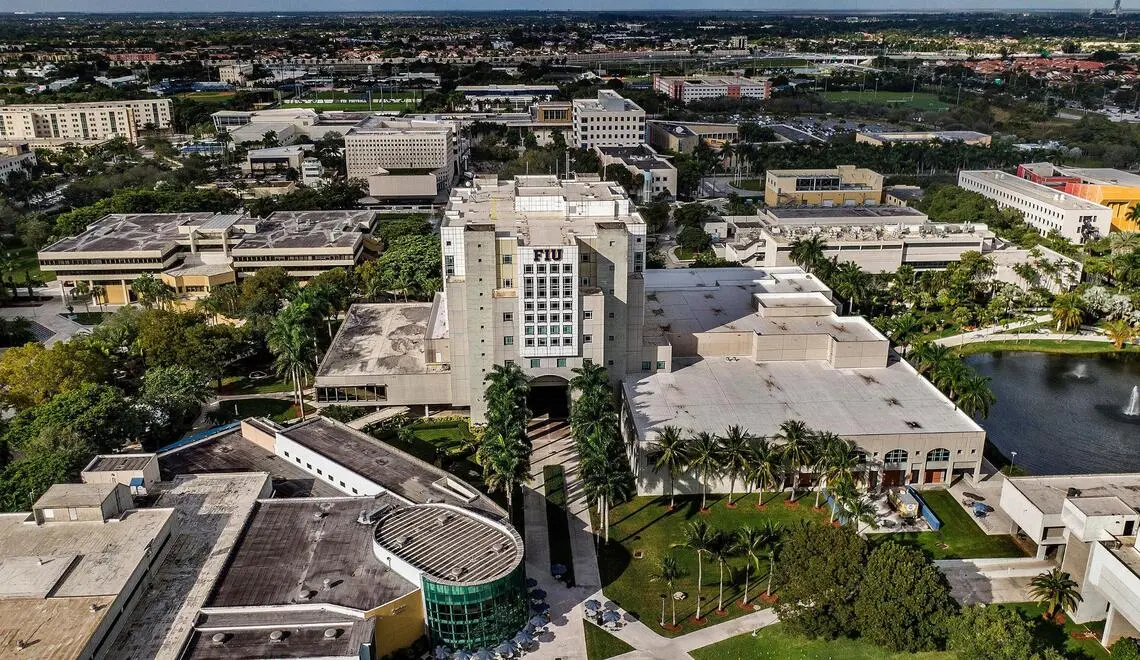
Florida International University’s incoming interim law school dean wasn’t just passed over as a finalist during the university’s national search. He didn’t even make the committee’s top 20 candidates, according to internal documents and a search committee member — yet FIU leaders appointed him anyway.
Read more Burned in a bombing in Gaza, a Palestinian teen finds healing with Jewish surgeon
After finalist interviews, FIU Provost Elizabeth Béjar declared the search to be failed. Months later, she and FIU President Jeannette Nuñez named Daniel Z. Epstein, who is best known for representing President Donald Trump in personal lawsuits against government agencies and media outlets, as interim dean.
When Epstein’s appointment was announced, his political leanings – his cover letter for the role laid out an explicitly conservative vision – as well as his relative lack of experience rankled many FIU law faculty members.
Now, days before Epstein is set to take over the FIU’s College of Law, that decision is drawing renewed criticism after a federal judge sanctioned the Trump attorney and barred him from appearing in the Southern District of Florida over what she called an improper lawsuit. Search committee members and former law school leaders say the ruling deepens concerns about a hiring process they argue discarded merit in favor of politics.
Chief among the critics is H.T. Smith, a renowned Miami civil rights attorney, prominent community leader and founding director of the law school’s Trial Advocacy Program. Smith was on the 11-member search committee that picked the finalist candidates and weeded Epstein out of the list of top 20 candidates.
When Smith learned that Béjar and Nuñez, former lieutenant governor under Gov. Ron DeSantis, named Epstein to the position, he didn’t even remember Epstein’s name because he and other committee members so quickly dismissed his application.
When he learned that Epstein was Trump’s personal attorney, he had a brisk assessment: “It looks like politics has superseded merit.”
FIU officials have not responded to a Herald inquiry on whether the provost or president’s decisions were influenced by officials in Tallahassee or Washington, D.C. Epstein has not made available by FIU for an interview.
Smith’s evaluation of Epstein and that of others in the FIU law community has soured even more since Epstein was sanctioned by U.S. District Judge Kathleen Williams in a ruling stating Trump’s lawsuit against the Internal Revenue Service amounted to improper self-dealing.
The proposed settlement originally intended to create a $1.8 billion fund intended to benefit Trump’s allies, possibly including people who stormed the U.S. Capitol as part of the Jan. 6, 2021 riots. In the ruling, Williams blocked Epstein from appearing in the Southern District of Florida “pro hac vice,” which is a mechanism attorneys use to practice law in a state or jurisdiction where they’re not licensed to practice. Epstein is not a member of the Florida Bar Association.
Williams wrote the case “was brought for an improper purpose — to gain the imprimatur of judicial legitimacy for a ‘settlement’ that had no viable basis in law or fact.”
The judge also referred Alejandro Brito, a Coral Gables attorney who also represented Trump in the case, to the Florida Bar for potential disciplinary action.
For Smith, the ruling affirmed his belief that Epstein is not qualified for the role he is set to begin Aug. 1.
“Central to the values [of FIU] is preparing the law students to meet a high ethical and professional standard. Nothing could undermine these principles of ethics and professionalism than to have a poster boy for ethical corruption serving as the dean of the law school,” Smith said.
Smith is not alone in his assessment.
Len Strickman, the law school’s highly-regarded founding dean, told the Herald the ruling was “fairly serious.” It also raises a PR problem, he said.
“Does the university want to present to the public a face of having its law school led by somebody who has been disciplined for unethical conduct? That’s obviously up to the powers that be in the university for now,” Strickman said.
Above the Law, a legal affairs blog, wrote recently that a U.S. law school has never had a dean facing court sanctions like Epstein’s.
Both Smith and Strickman expect Epstein to appeal.
Smith said he hopes the university could use it as an excuse to “pause” his hiring, even though it was announced three weeks ago that Epstein will start in August.
The higher education bona fides of Epstein’s resume were thinner than many of the other applicants for the role. He has served as the chair of Palm Beach State College for roughly a year, serving on the board of trustees for a year-and-a-half prior. He has also worked as a professor at the law school for St. Thomas University, a small private Catholic school, for more than three years.
His resume working in conservative politics, for Trump and alongside Trump advisor Stephen Miller, is much longer and includes many high-profile roles.
Read more More families in this city are using ‘cargo bikes’ to haul groceries and children
He represented Trump in his challenge against the U.S. Justice Department’s investigation into possible ties between Russia and his 2016 campaign as well as the FBI’s 2022 search of Mar-a-Lago for classified documents. Epstein also served as a
White House lawyer during Trump’s first term and was nominated to the U.S. Court of Federal Claims in 2019, but the Senate took no action and the nomination was returned to the president.
Epstein is now vice president of America First Legal, the conservative litigation group founded by Miller, and has advised the Commerce Department; he also founded Cause of Action, which represented plaintiffs in a landmark Supreme Court case that curtailed federal agencies’ regulatory authority. He is licensed to practice law in Texas, Maryland and the District of Columbia, per Williams’ ruling.
Epstein is one of several politically connected Republicans to have earned top roles at one of Florida’s public universities in recent years, including Nunez, who was recommended by Gov. Ron DeSantis.
Smith said, and a document obtained by the Herald shows that during the search process applicants were split into “Tier 1” and “Tier 2” based on their qualifications.
Epstein was one of nine applications put into the second tier, not among the 20 placed in Tier 1.
Tier 1 featured a federal judge, a retired three-star vice admiral in the U.S. navy, an internal associate dean, a general counsel for a wing of the U.S. Air Force, multiple deans of smaller schools and more – not to mention the three finalists.
Smith said that, at one point, a member of the search committee moved to bring Epstein up into the first tier of candidates being considered for the role. When it was put to a vote among the committee, the other ten members voted against the motion, he said.
The finalists in that search process were David Brennen, former dean of the University of Kentucky’s law school for ten-plus years; Andrew Dawson, vice dean for academic affairs at the University of Miami’s School of Law; and Sean M. O’Connor, formerly of George Mason University’s Antonin Scalia Law School. They came to campus and participated in open forums in March.
“We knew that if the provost took a dart and threw it at the three names, whatever name she came on, we felt that the College of Law, which is already on a meteoric rise, will continue that trajectory upward,” Smith said.
A relatively young institution — it’s only been around for 26 years — the school is roughly on par with the University of Miami’ School of Law in U.S. News & World Report rankings, and has a higher Florida bar exam passage rate, despite UM being four times as old.
Smith said that, at some point before the search was called off, Béjar reminded the committee that in rare cases a search could be declared failed.
“We looked around and we said, ‘There’s no way that’s going to happen.’ With these three, it’s just a matter of which vision you like the best,” Smith said.
Smith, who is retiring from his role at FIU next month, said he is taking the rare step to speak out in the best interest of the university.
It’s not about the timing of his retirement, either. Smith pointed out that he spoke against the 2009 hiring of Alex Acosta, a Miami native who resigned from a Washington cabinet role after facing scrutiny over a plea deal brokered with notorious sex offender Jeffrey Epstein (no apparent relation to Daniel Epstein).
“I’m doing this because it’s the right thing to do. I’m doing this because it’s best for the students. It’s best for the reputation of law school, and it’s best for the university,” Smith said.
“Look, what happened in the committee is not subjective. What I mean by that is, Daniel Epstein, in a committee that diverse, did not make the top 20. Gee whiz. And so, they’re going to appoint him the dean? Do you realize how unusual that is?”
©2026 Miami Herald. Visit miamiherald.com. Distributed by Tribune Content Agency, LLC.
Read more Rays beat the Guardians 11-3 behind homers from Ryan Vilade and Richie Palacios