
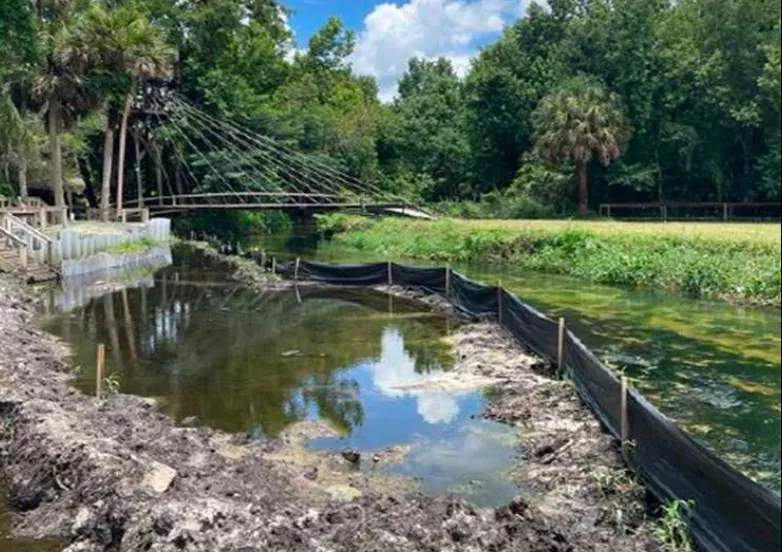
A former bail bondsman who faces years in prison for coercing jailed women to have sex with him, now finds himself in trouble with Seminole County after illegally using heavy machinery to dig out and widen the shoreline of the environmentally-sensitive Little Wekiva River — a waterway his parents fought for decades to protect.
Read more Police: A family’s plan to scare a thief ended with a gunshot and death
“In my brain, as tiny as it is, I didn’t feel as though I was widening” the river, Russell Bruce Moncrief said recently to a Seminole code enforcement magistrate. “I felt I was removing the sediment that had dropped on my water shoreline. I’m restoring my shoreline, is what I felt I was doing.”
But Seminole’s Special Magistrate Sherry Sutphen chastised Moncrief, a resident of The Springs neighborhood, for likely damaging the river’s ecology behind his home and obstructing its natural flow. The damage, Sutphen said, could now take years for the county to restore and affect property owners downstream.
“Had you gotten a permit to do what you were trying to do, you would have experts guiding you,” she said. “Unfortunately, we don’t know whether down the road it’s going to cost the county money to do any restoration activities because of what occurred here.”
The roughly 15-mile Little Wekiva flows north from Orange County under state roads 436 and 434 in Altamonte Springs, before joining with the larger Wekiva River just west of the Alaqua Lake subdivision.
Because of its ecological attributes, the tributary was designated in 1984 as an “Outstanding Florida Water” by the Florida Legislature. The main Wekiva River was designated by Congress in 2000 as a protected National Wild and Scenic River.
But according to a complaint and photos filed by a neighbor to Seminole County, Moncrief used a rented backhoe to dig up aquatic vegetation and sand and drop it on the bank of his backyard in early July.
“Widening or channelizing a river lowers its velocity, smothers the floor with sand and completely destroys the native baseline ecosystem in a way that regular restoration cannot easily undo,” said Christina Seckinger, a natural resource officer with Seminole, at the hearing. “Local and state agencies have spent years fighting severe erosion and sediment buildup on the Little Wekiva River.”
Seminole spent $4.3 million in 2020 to restore 3,500 feet of the Little Wekiva by removing invasive aquatic vegetation. The project was completed last year.
“It’s a significant amount of [river] bank that was removed,” John Martin, Seminole’s code enforcement division manager said. “When the bank is disturbed, you’re losing valuable microorganisms…..You can’t just put it all back.”
In July, the St. Johns River Water Management District sent Moncrief a “compliance assistance offer” letter that requires him to provide to the state agency a report on how he plans to correct the “unauthorized” dredging and “fill activities within a wetland and surface water without a valid” state environmental permit.
At the Aug. 13 code enforcement hearing, Sutphen ordered Moncrief to pay a $1,000 fine and obtain the proper permits within 90 days to begin restoration of the shoreline.
He also will have to obtain county permits for a gazebo, seawall, walkway and stairs leading to the river, which Moncrief claims were built on his two-acre property before he bought the 3,200-square-foot home off Starbuck Run in 2014.
It could have been worse: County staff had recommended Moncrief be fined $15,000 for the shoreline destruction.
A contrite, apologetic and at times tearful Moncrief, 77, said at the hearing he wanted to settle the code enforcement issue before January.
Read more Sustanee, a planned East Orange subdivision, wins court battle to force higher-density development
That’s likely because Moncrief, the retired owner of Moncrief Bail Bonds, is scheduled to be sentenced by an Orange County judge on Jan. 8 after pleading no contest last April to a racketeering charge by pressuring women seeking to bail out of jail into having sex.
Neither county staff nor Sutphen referenced his criminal case during the code enforcement hearing.
Moncrief was arrested in October 2024 after a years-long police investigation found that he developed a system to exploit desperate women by spreading his company’s reputation in jails across the state.
According to court documents, jailed women would call Moncrief after receiving his personal number from other inmates and use various secret phrases — such as washing his cars, cleaning his house, or licking his eyebrows — to refer to sexual acts. After a woman was released on bail, they’d become his “sex slave,” according to documents.
As part of a plea deal with state prosecutors, five human trafficking charges against Moncrief were dropped. The plea agreement recommends Moncrief be sentenced to just over 34 months in prison, including the seven months he’s already served after he was held without bond. He also will serve six years of probation and be required to pay $80,000 to the women and $23,795 to the Orange-Osceola State Attorney’s Office, according to the agreement.
Moncrief’s company had offices in Orange, Osceola, Brevard and Pinellas, but Moncrief has since had to forfeit his bond license. His office said this week he has retired.
In Seminole’s code enforcement case, county staff said Moncrief was willing to correct his misdeed.
“I do want to note that Mr. Moncrief at no time dragged his feet,” Martin said at the hearing. “When he was cited, the next morning he was in my office.”
Moncrief also erected silt fencing along the shoreline to help prevent any more erosion.
“I’m not trying to avoid my responsibility on this,” he said at the county hearing. “It’s my responsibility as the property owner.”
In an ironic twist, Moncrief’s late mother, Katie Moncrief, sought for decades to protect the Wekiva River, tributaries and surrounding wilderness.
She and her late husband, Russ, owned Katie’s Landing along the Wekiva River, which brought thousands of visitors to rent canoes and get a chance to explore the river’s unique ecosystem. She urged visitors to “be nice to nature.”
Katie’s Landing is now part of the Lower Wekiva River Preserve State Park.
Russ Moncrief died in 2015 at the age of 92. Katie Moncrief died in January 2024 at age 98.
Read more US plans to pay $850 million of the $5 billion it owes the United Nations