
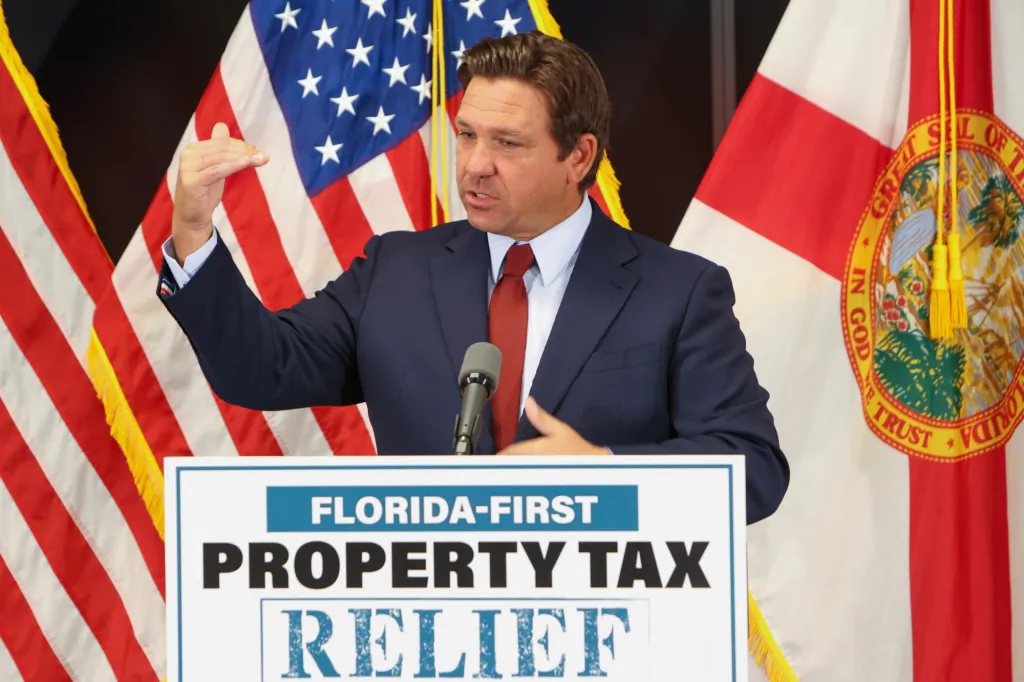
Supreme Court Justice Louis Brandeis called state and local governments “laboratories of democracy,” places to test policies without risking the entire country. Florida is about to run one such experiment with its property tax system — and this version is so blunt it could damage the very communities it is meant to help.
Read more Commentary: Florida workers are better off thanks to the Working Family Tax Cut
Gov. Ron DeSantis has framed the problem as runaway local budgets driven by rising property values. The Legislature’s proposed amendment fits a democratic instinct: If taxes are too high, let the people decide. But what we put before voters matters; this measure is closer to a sledgehammer than a scalpel.
Because it relies on a large, fixed exemption rather than a percentage of value, the impact will vary dramatically. Larger, affluent cities with high property values and broad commercial tax base will feel discomfort but not crisis. Small and less affluent municipalities do not have that luxury.
At a certain point, the numbers do not work, and the municipality is forced to “give back the keys” to the county or drastically cut basic services. Ironically, the most affordable places are the ones most likely to see their budgets gutted. Likewise, special districts that fund things like parks, healthcare districts or flood control face similar threats but lack sales taxes, resort fees or high-end commercial corridors to fall back on.
There are better ways to structure relief. One alternative is to make any new exemption proportional to value, with a cap — for example, 25% of assessed value up to $250,000. A $200,000 home would get a $50,000 reduction and pay tax on $150,000; a $1 million home would get the full $250,000 and pay tax on $750,000. Both see real relief, but the tax base in lower-value communities is not wiped out.
Florida also has not exhausted less dangerous tools for restraining local budgets. Colorado, California, Massachusetts and New York all limit property tax growth and require public votes for major increases. These approaches are not perfect, but they share a principle: Before you expand the budget beyond a baseline, you must ask permission. Florida’s proposal moves the fulcrum to the other side. It slashes the base itself and then forces local governments to choose how to maintain services with what is left.
Read more At the World Cup, Nike and Adidas duel over the future of soccer
Local governments also underuse tools like public-private partnerships, transit-oriented development, and carefully planned commercial growth that could broaden the nonexempt tax base and create more stable revenue because they are not popular with voters. Boca Raton, for instance, rejected a major partnership that could have created an income stream insulated from homestead cuts. It illustrates a political reality: Communities often say no to projects that would help them weather the next round of state-mandated tax relief.
Higher user fees offer another path. Many services now subsidized from general funds — solid waste, stormwater, some recreational amenities — can be funded through non-ad valorem assessments or usage-based fees that more closely reflect actual costs. But when residents see that trash collection or sewer service costs far more than their current bill, they gain a clearer picture of what property taxes have quietly covered.
The proposal will also intensify a glaring feature of Florida’s tax landscape: Two neighbors can face dramatically different tax liabilities. Long-time owners unquestionably benefit, and many genuinely need the relief. But newcomers, seasonal residents and commercial taxpayers will shoulder an even larger share of the cost. At what point will this cause Florida’s gravy train to stop? And what happens when it does?
None of this is an argument for ignoring Florida’s real affordability gap. Property taxes strain many household budgets, especially for long-time residents on fixed incomes; reform is warranted. But Florida voters here are deciding not only their own tax bill but the ultimate survival of small cities and regional agencies. Other states show it is possible to restrain budgets, require voter approval for increases, and still preserve a coherent tax base. In this laboratory of democracy, the danger is that the experiment will blow up not only in the faces of local officials, but in the lives of residents who depend on services those officials can no longer afford to provide.
Marc Wigder is a Boca Raton attorney, former city councilman and former director for the Palm Beach County League of Cities.
Read more Wednesday has fewer storms but a few could develop in the afternoon