
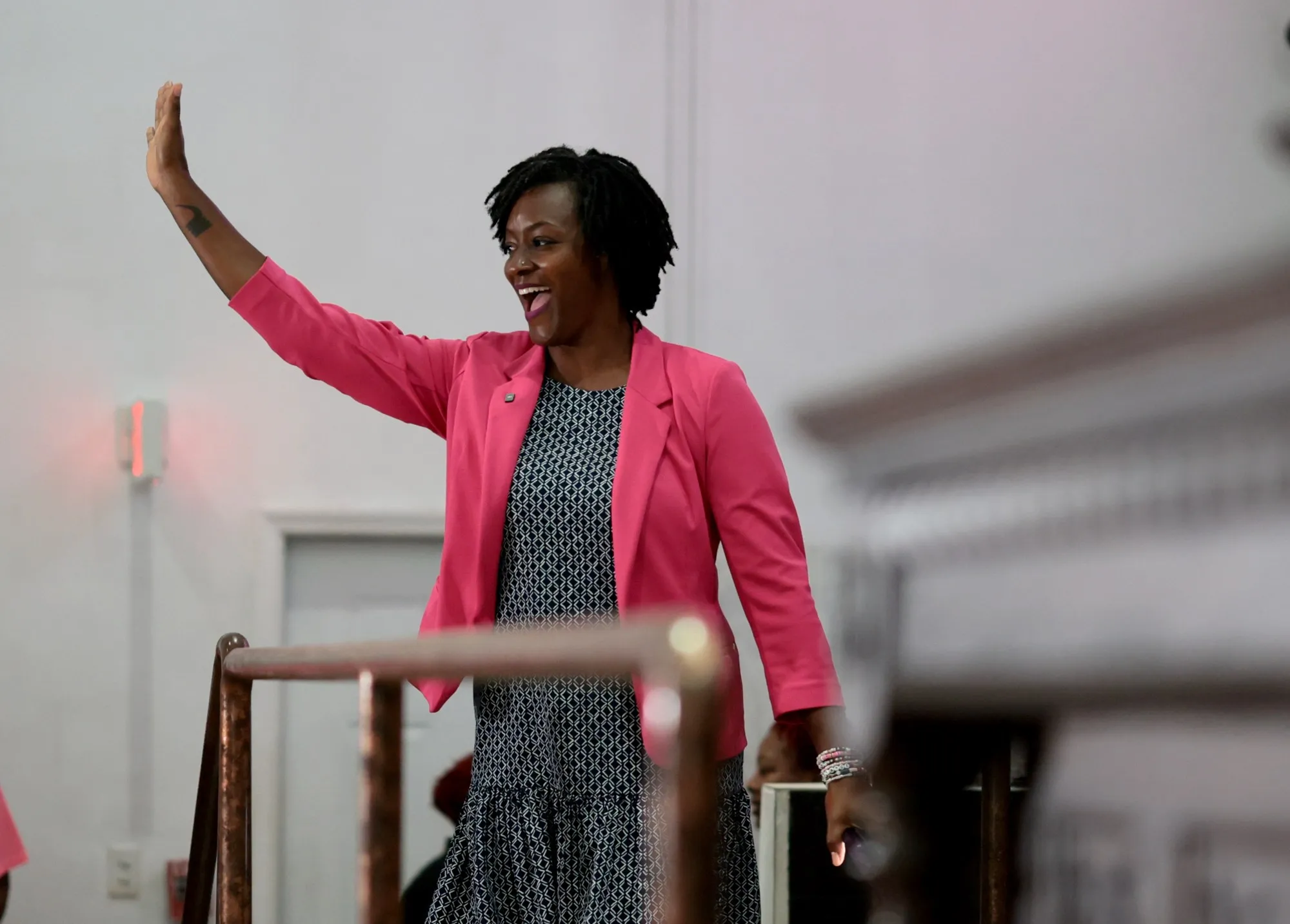
Angie Nixon’s impressive nomination for U.S. Senate was the biggest surprise Tuesday — and one of the biggest in Florida history. What began as a quiet revolution by a little-known state legislator from Jacksonville became a resounding victory that shocked the political world.
Read more Orlando Sentinel 150: Friday Flashback to ‘He-Coon’ Gov. Lawton Chiles
Nixon’s message of economic populism struck a real chord with Democrats all over Florida. It got through loud and clear, even though she did not have money to run a single TV spot in a state where victory is seen as impossible without saturation advertising.
Her primary opponent, frontrunner Alex Vindman, ran a lackluster campaign and seemed to take victory for granted by sitting on millions of dollars of campaign money. Nixon will face Republican Sen. Ashley Moody in November. Given Nixon’s politics, Moody probably got the opponent she wanted.
But a bigger story lurks deeper in Tuesday’s numbers that could spell trouble for Republicans in November.
A lack of enthusiasm
In deeply conservative areas of Florida, Republicans are not nearly as enthusiastic about Byron Donalds as their nominee for governor — and showed it by shunning him in large numbers.
Despite a ringing endorsement from President Trump, a record haul of campaign money and weak opposition, Donalds failed to win a majority of the Republican vote statewide. The unofficial returns show that he received slightly less than 48% of the vote.
Donalds did well with Republican voters in South Florida, and in Southwest Florida, where he is most familiar as a member of Congress.
But in 14 smaller MAGA-friendly counties, mostly in North Florida, Donalds finished second to Lt. Gov. Jay Collins, who did much better than the polls predicted, with 25% of the statewide vote. In three more counties — Dixie, Lafayette and Liberty — Donalds ran a weak third, trailing both Collins and little-known Bobby Williams in an field of 11 candidates.
So much for Trump’s endorsement.
To be sure, all of these 17 counties are small (the largest is Columbia, population 72,000, where the county seat is Lake City). But together they make up a reliable part of the Republican base.
Read more Disney World shares details, but waiting, wondering continues
They are culturally rural and Southern places, and every one of them voted for Trump in 2024. The reddening of rural Florida began in the 1990s, and is a vital part of how Republicans have become so politically dominant statewide.
Race as a possible factor
It’s possible but unlikely that Trump’s sagging popularity dragged down Donalds. The candidate’s enthusiasm for hyperscale data centers also may be a factor. But another logical explanation for Donalds’ poor showing in rural Florida is race.
No Black candidate has ever won a partisan statewide office in modern times in Florida. Donalds’ upstart rival, James Fishback, repeatedly used racial code words such as calling him “Byrone,” a “slave” to his donors and a “DEI hire.”
Voters who reject Donalds should do it because of his ideas, not the color of his skin.
Nevertheless, what Tuesday’s numbers show is that Donalds has a serious problem with his base that an endorsement from Trump cannot fix — and not just in the hinterlands. He performed below his statewide 48% showing in larger counties such as Polk, 39%; Bay, 42%; Okaloosa, 42%; and Duval, 43%.
Republican voters in those counties need to get to like Donalds, and soon. If they don’t, they could express their displeasure by staying home in November, or even voting for former Republican David Jolly, now the Democratic nominee for governor.
Jolly must do what previous candidates failed to do — cut into the Republican advantage in those counties.
The Sun Sentinel Editorial Board consists of Opinion Editor Steve Bousquet, Deputy Opinion Editor Dan Sweeney, editorial writers Pat Beall and Martin Dyckman, and Executive Editor Gretchen Day-Bryant. To contact us, email at [email protected].
Read more More than 2,300 Mexicans sent to Guatemala and Honduras as Trump ramps up third-country deportations