
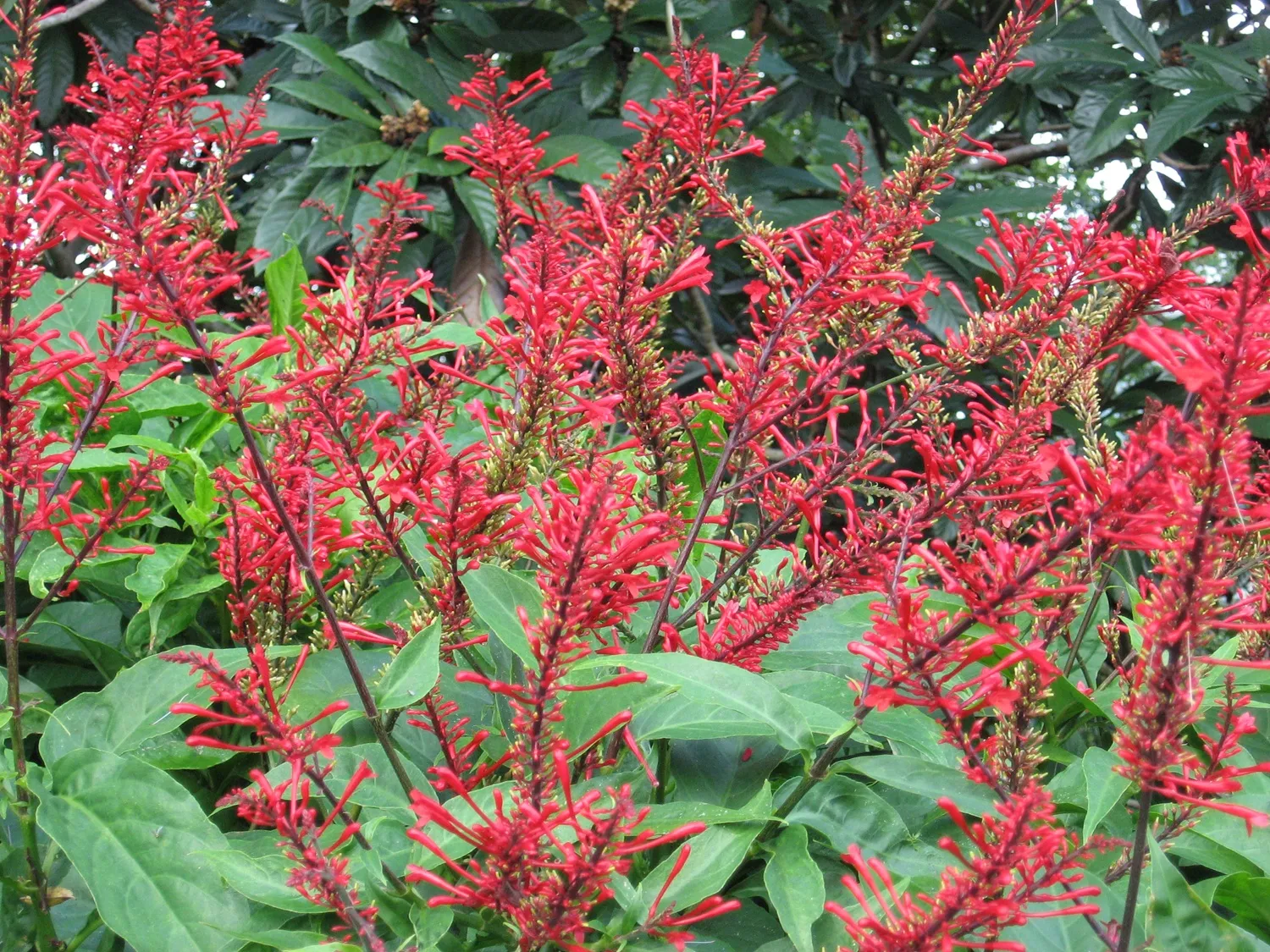
Q: We have butterflies visiting our flowers, but would also like to see hummingbirds. What flowers can we plant to invite them to visit?
Read more Guest Commentary: Screen time isn’t to blame for youth mental-health issues
A: Butterflies seem to wander everywhere in neighborhood landscapes, but hummingbirds are more particular. They seem to only visit if they have a natural wooded area in the vicinity of your landscape. Adding flowers they like may not ensure visits to their blooms. If you find hummingbirds anywhere in the area, adding bright flowering plants may bring them into visit. Some good orange to red flowering plants they like include firebush, firespike, salvias, pentas and native honeysuckle. Good news is if the hummingbirds aren’t able to visit the blooms, butterflies will.
Q: Several holly trees were removed from our yard due to a disease of the stems. The trunks were ground down but most of the roots remain. Should we have the trunks ground down more so we can replant with other trees?
A: Most trunks are ground down well below the soil surface, but portions remain with all the lateral roots. More grinding is probably not going to help with the replanting problem. The remaining trunk and lateral roots have to be removed. They must be dug out by hand or with equipment. Take it from one with lots of experience — hand digging is no fun. Use of a tractor-mounted backhoe or scoop makes preparing the site much easier. Some of these pieces of equipment are narrow versions that can squeeze into small yards. After a majority of the roots have been removed and the soil leveled, it’s planting time.
Q: I have a trio of roebelinii palms in my front yard damaged by the freeze in February. Is there anything I can do to save the palms? Will palm fertilizer help?
A: Only time will tell how well roebelinii palms can recover. Your email mentioned one of the palms was not severely affected, but the others were damaged. Since there have been several months of good growing weather, we might by now expect to see some signs of growth and green tissue from the buds. If there is any sign of survival the palms should recover, and fertilizer may help with the new growth. Regretfully, fertilizer use is prohibited in most of Central Florida until October. If there is no sign of survival, there is still hope the palms could recover. Unless the top or bud area is shriveling or toppling over, I would leave the palm to possibly start growth through fall.
Q: Our dracaena, which is a beautiful part of our landscape, has become afflicted with “nodules” at the ends of a number of stems. Is this a symptom of something that we should be treating?
A: Although it looks like a problem, your dracaena is normal and producing flowers at the ends of the stems. Your email photos showed tight buds that should open into compact clusters of white and maybe fragrant blooms. Give them time to develop, and when flowering is complete, the clusters can be cut from the ends of the stems.
Plant Doctor: Post-freeze bougainvillea came back with vengeance, but where are blooms?
Q: I need to transplant several azaleas in my landscape. Should I dig a large root ball and move them now or wait until fall?
Read more Guest commentary: Florida leads the nation in vaccine ignorance
A: Now is not the best time to transplant trees and shrubs. So much of their root systems are damaged in the digging and moving that it’s hard for them to recover. If possible, delay the transplanting for two or more months when cooler weather arrives and there is less stress for you and the plants. Still, do get a large root ball with as many intact roots as possible. Wet the soil thoroughly a day or two before the move, and keep the transplant site moist during recovery.
Q: I did not prune my azaleas this year. Is this a problem?
A: No problem and your plants may be better off with a skipped trimming. Azaleas do not need major pruning every year. You could do a little grooming to remove out-of-bounds shoots or weak plant portions. Too much pruning throughout the growing season, which often includes hedging, reduces springtime blooms. Pruning to greatly reduce plant height and width is only needed every three to four years.
Q: Several of our trees have a green crusty growth on their trunks. What is this and is it harmful?
A: Gray green to rusty brown leafy to crusty growths are usually lichens. They may give an unusual appearance to tree trunks and limbs but are harmless. Some trees seem to encourage more of these coverings than others. They can also be found on rocks. What you are seeing is a combination of fungi and algae living symbiotically. This means they help each other grow and only use the tree portions as support. No control is needed, but if you don’t like the look, application of a copper fungicide as instructed on the label for your tree can slowly eliminate and prevent the growths.
Q: Our ligustrum hedge has grown over the sidewalk. Can it be pruned back at this time?
A: Give your hedge the needed pruning — but soon. You can reduce both the height and width of the ligustrum planting at this time so it can produce and mature new shoots and foliage before winter. Seldom is ligustrum damaged by freezes, but it has occurred, and new growths would be most susceptible.
Tom MacCubbin is an urban horticulturist emeritus with the University of Florida Cooperative Extension Service. Write him: Orlando Sentinel, P.O. Box 2833, Orlando, FL. 32802. Email: [email protected]
Are you a Central Florida gardener? Here’s your to-do list heading into September
Read more Letters: Data centers’ impact | Parents solve pre-K dilemma | Hope Florida misuse