
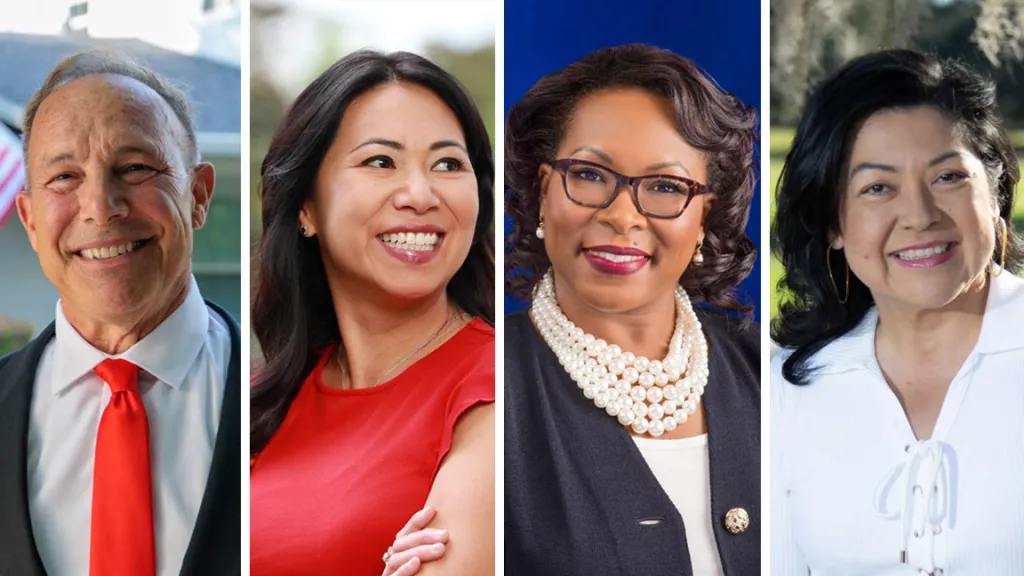
The mayor of Orange County is arguably the most powerful elected position in Central Florida, overseeing a budget of $8 billion and helping shape the quality of life for the entire region. This year, voters will select the sixth person to ever hold this post.
Read more Teen arrested for sex assault on a mom with kids on NYC subway is Yale student
Readers had a lot of questions for the candidates. I whittled them down to 16. And to their credit, the four candidates answered every single one.
Some of their responses were lengthy and detailed. Some were lengthy and yet vague. If you want to read them for yourself, you can read their unedited statements — more than 12,000 words in total — at orlandosentinel.com/2026/07/10/mayoral-responses
But here, I thought I’d try to summarize their stances on some key issues with an eye on both specifics and contrasts.
The four candidates are former Congresswoman Stephanie Murphy, Orange County Clerk of Court Tiffany Moore Russell, County Commissioner Mayra Uribe and Chris Messina, a tech entrepreneur who mounted a previously unsuccessful campaign for mayor. The three women are Democrats. Messina is a Republican. The office is nonpartisan.
SunRail
The question here was: “Do you believe SunRail should be expanded? If so, how and to where?”
Uribe and Murphy said yes and offered specifics.
Uribe said she believes the trains should run to the airport and more on nights and weekends, making the case that, the more useful it is, the more people will use it.
Murphy also cited the airport but said “The first priority should be connecting people to jobs” and that she would like to see greater cooperation between SunRail, Lynx and Brightline.
Moore Russell said she supported expansion, but offered no specifics.
And Messina said “Not unless it can be self-sufficient.”
It’s worth noting hardly any commuter rail systems anywhere are self-sufficient, even extremely well-used ones like the New York City Subway. Nor are roads, unless they’re tolled. Which brings us to …
Toll roads
Florida has more miles of toll roads than any other state. And Central Florida is the most-tolled region of America’s most-tolled state. Basically, it costs motorists more money to drive here than most anywhere else.
So the question here was: “Do you support expanding the number of toll roads we have, reducing them or keeping them the same?”
Messina was the only one to flatly say that, after the region is done building the Osceola Parkway, “that’s enough.”
Murphy and Moore Russell said they wanted to consider toll-road requests on a case-by case basis.
And Uribe said she believes “new toll roads can play an important role in alleviating congestion,” but also cited a specific goal of reducing and eventually fully eliminating some tolls.
Property taxes
The question: “Do you plan on voting yes or no on this year’s constitutional amendment on lowering property-tax collections for local governments?”
Messina said yes. Murphy and Moore Russell said no. Uribe said she was undecided.
Hotel taxes
More readers cared about this issue than any other.
Orange County collects hundreds of millions of dollars in hotel taxes each year. But right now, state law requires Orange County to spend most of that money on things that promote more tourism, like visitor advertising and convention center expansions.
Other Florida counties fought to successfully change state law to allow them to spend hotel taxes on things like affordable housing. So the question was: “Do you plan on actively pushing state lawmakers to change the law to allow more flexible spending on local needs?”
On this front, only one candidate, Uribe, sounded a clarion call for change.
Messina said he believed hotel taxes “should only be used for authorized tourist promotion … as proscribed by state statute.” And Moore Russell said she’d prefer to look for local solutions “before seeking changes from the state.”
Murphy said she’d try to work with legislators to “explore reasonable flexibility in state law.”
But Uribe said she strongly agrees with residents who want to use hotel taxes for housing and transit. She also noted that she spoke up when she thought funding for Visit Orlando was getting too excessive. As a result, she said the tourism lobby has targeted her, “spending over $1 million to try to unseat me” in 2024 “… all because I dared to ask if Visit Orlando’s ballooning budget was ‘too much money’.”
Homelessness
The question here was very specific — and for good reason. Everyone says they want to help prevent homelessness. The rub comes when specific solutions are proposed. Last year, opposition from neighbors helped derail plans to turn a former work-release center just south of downtown into a shelter or service center for those experiencing homelessness.
Read more Heat advisory returns to Central Florida from 11a to 8p
So the question was very specific: Do you support that specific plan for that specific property on Kaley Avenue?
Two candidates gave clear answers.
Messina said yes, saying “it should be a combination shelter, service and job training/placement center.”
Uribe said no, citing concerns about “public safety” and “neighborhood impact” but said she would consider it for “a potential low-impact housing for women and children … employed but still homeless in need of stable, supportive housing.”
Moore Russell did not address the Kaley center specifically. She instead described homelessness as a “complex challenge” and said she was “open to considering proposals for facilities throughout Orange County … while also respecting the concerns of the surrounding community.”
Similarly, Murphy didn’t take a concrete stand on Kaley, saying it “should be evaluated as part of [a] broader strategy.”
Scott Maxwell: Orlando Health, neighbors helped kill homeless shelter. What now?
Baseball
Messina and Moore Russell said they supported the idea of bringing Major League Baseball to Orlando and using hotel taxes to help make it happen.
Murphy and Uribe both said they were open to the idea, but wanted a more specific proposal before contemplating funding. And Uribe said the baseball discussion should take a backseat to more pressing needs like housing, transportation, and infrastructure.
Split Oak
The Central Florida Expressway Authority decided to run a toll road through a portion of Split Oak Forest — environmentally fragile land in southeast Orange County that local leaders had previously vowed to protect forever.
I asked the candidates what they thought of that decision and whether they would seek to continue the county’s fight in court to force the road to go elsewhere.
None explicitly vowed to continue the legal fight. But Uribe voted to do so as a county commissioner and said she thought the expressway authority made the wrong decision.
Messina said he also thought the authority made the wrong decision, but opposed more legal action, saying he thought it would be “protracted, expensive to Orange County taxpayers and ultimately not successful.”
Moore Russell called the matter a “complex issue” but said she thought the authority “made the best possible decision.”
And Murphy said she thought the decision to run the road through the preserve while taking as little land as possible “represented a meaningful effort to balance both priorities.”
The Split Oak betrayal: Will Florida ever change? | Commentary
Bus service
All candidates agreed that Lynx — the bus system that offers painfully long rides of two hours or more for some daily commuters — should serve residents better.
But only two, Murphy and Moore-Russell, said they were open to the concept of a dedicated funding system for that. Neither said what that source should be.
Messina said he liked the idea of smaller vehicles offering more personalized service.
And Uribe had a specific goal of making no route longer than 45 minutes, but didn’t offer a specific plan for how to make that happen.
Lynx buses: A neglected lifeline for Orlando’s working class | Commentary
Arts, taxes, jobs
There’s much more. All four candidates, for instance, said they believed the county should continue supporting arts and culture. They also offered thoughts on mental health, rural boundaries and sales taxes.
I also read, re-read and re-read again their plans for attracting higher-wage jobs, appreciating their collective, expressed desire to get new industries in town, but struggling to see many specifics, particularly when it comes to financing their ideas. There was lots of talk about helping small businesses grow and beefing up things like “workforce development partnerships.” Messina talked about trying to lure a federal “Space Force Academy” for graduating high school students. But I had trouble seeing many specific plans that made me think: Now that’s a precise blueprint for landing new manufacturing, health science and technology jobs.
But you can read their answers for yourself on all these topics and see what you can divine.
Read more Asking Eric: Should I hear my brother’s explanation of his horrible behavior?