
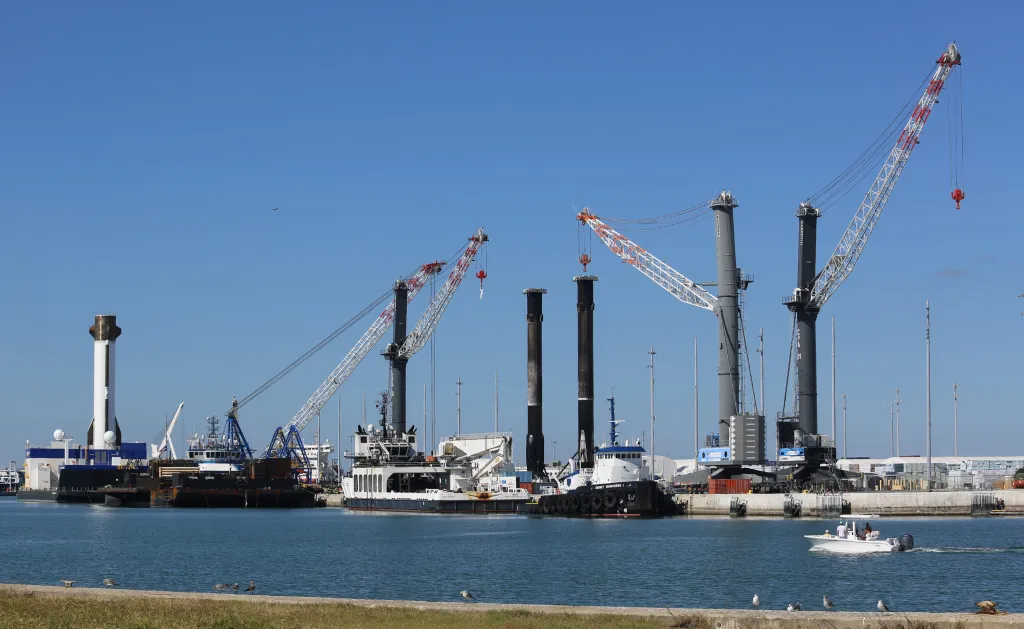
The cruise business remains king at Port Canaveral, but the burgeoning space industry has muscled its way into the duties performed by the port authority.
Read more 2 toddlers shot, killed in Orange County, deputies say
Despite the port having already passed a 2019 resolution of support of that industry, several commercial launch providers lobbied to have it added to the port’s charter, a move that was ensconced into law in 2024. Now the port is required to hold regular public hearings on it, the first of which was held Wednesday.
A presentation detailed the port’s history and recent construction updates that support its two primary commercial launch providers, SpaceX and Blue Origin. While those two companies have been busy at the port, they are still a relatively small portion of business.
“They don’t pay the bills around here,” said Port Canaveral CEO Capt. John Murray during an interview at SeaTrade Cruise Global in April.
For fiscal 2025, the port hit a record of nearly $220 million in operating revenue, with about $182 million credited to cruise-related operations including parking. Cargo, which includes space, came to $24.5 million. Of that, SpaceX and Blue Origin combined to shell out more than $4.2 million, a big jump from previous years, but still only 2% of total revenue.
While still small, it is a growing footprint. Space-related cargo revenue was only just under $3 million in 2024, a little over $1.7 million in 2023 and over $1.3 million in 2022.
As it has grown, the port has had to come to an especially smooth relationship with the most active launch company, SpaceX.
Elon Musk’s company in 2025 hit a record 109 launches from the Space Coast, with the majority using recovery vessels for booster landings downrange in the Atlantic. That translated to 90 boosters transported and offloaded on the port’s north cargo terminals by the authority’s three mobile harbor cranes. SpaceX also recovered 192 fairings, or nose cone halves, that also had to move through the port.
“SpaceX is a very important customer to us now,” Murray said. “We have a fantastic relationship with them. … They couldn’t do what they do without us, and we just do everything we can to support them.”
When SpaceX first began recovery operations at the port, it had a fleet of six ships including the large droneships. That grew to 14 vessels in 2025, but Murray said they have fallen into a comfortable pattern with daily operations.
“For a long time, they were frustrated because they had to move all over the port every time we have ship coming in,” Murray said. But the port has since expanded its berth space on the north side of the port, though there’s still a need to move at times. “SpaceX will tell you it’s not ideal, but they understand, and they make it work.”
Murray noted that SpaceX has grown into what he sees as optimum partners at the port.
“They spend more time at sea than they do alongside. So they come in there, they’ve evolved into what they should be all along as a operator that comes in, does the business and gets out,” he said. “They’re just like a cargo or cruise ship. So they don’t spend much time alongside. … They come in, they get the booster off, and they go back out and catch another one.”
Blue Origin is the other active launch provider using the port, but Jeff Bezos’ company is still getting started. Before the May 28 explosion that damaged its launch pad at Cape Canaveral Space Force Station, the company had only launched its New Glenn rocket three times.
The company brought in its own crane to handle the larger boosters of the New Glenn, but so far has only been able to use it twice for recovered first stages. That came after November 2025 and April 2026 missions during which Blue Origin was able to stick their landings on the recovery vessel Jacklyn.
Jacklyn and a support vessel named the Harvey Stone have been docked at the port since 2024. Murray said Blue Origin had been discussing bringing on a second recovery vessel as well.
During the commission meeting, a letter from Blue Origin’s government relations executive Anna Spencer highlighted some of the company’s collaborative work with the port, noting it had directed about $5 million in private capital into the port infrastructure.
“While these investments were scoped to support Blue Origin operations, each improvement was deliberately designed to deliver multi-users public benefit and remains a permanent asset serving the full port tenant community,” she wrote.
That includes road widening, communications upgrades and new building construction in the last three years. It shares a portion of the north cargo area with SpaceX.
Read more US attorney opens investigations into California’s elections, sends prosecutor to LA vote center
“As we grow our presence here, we do so with a genuine commitment to being a good neighbor, investing not just in infrastructure, but in the health, safety, and characters of the community and environment that surround us,” the letter continued. “We look forward to the next phase of collaboration and remain dedicated to ensuring that Port Canaveral strengthens its position as a premier gateway for American space transportation.”
For both Blue Origin and SpaceX, the port has had to shuffle the vessels around. Both companies’ vessels have jumped around as needed, spending some time docked at cruise terminals and even along seawall of the Cove District, which is where the port’s restaurants reside.
“They don’t like to play the shell game,” Murray said. “And what we’re telling everybody is, find another home to park your boat. Just going to sit alongside for a year at a time. Go to Jacksonville, go to Fort Pierce, go somewhere else. We can’t be a parking lot. It just doesn’t work.”
For most of the week, all six of the port’s cruise terminals have ships coming and going as its primary business has reached near capacity. A seventh cruise terminal is being planned, but would not be open until 2029 at the earliest.
So already the ship traffic jams are a real issue, but SpaceX and Blue Origin are just the beginning of what is forecast to be dozens more maritime vessels supporting the space industry.
The port is in talks with companies such as Relativity Space, Stoke Space, The Spaceport Company, Seagate Space and Skyward Hydra, all expected to need a presence at the port.
“As they come in with their equipment, you know that can only have so many of these things in port,” he said. “If you’re going to launch like SpaceX, do your business and get out, great. But if you’re going to leave it alongside for six months, eight months. … You can’t do that with four or five providers.”
The prospect of multiple launch providers sending up hundreds of rockets a year from the Space Coast drove Space Florida to commission a study released in 2024 that suggested a $2.1 billion long-term solution that would carve out new space at the port to provide parking space for those companies.
The Florida Spaceport System Maritime Intermodal Transportation Study suggested the Space Coast could handle close to 200 launch and recovery missions annually by 2028, a number forecast to balloon to more than 1,250 missions in the next five decades.
With an average of four maritime vessels supporting each of those missions, the port could be expected to supply nearly 2 miles of dedicated berth space.
The near-term solution was to provide more space in the port’s middle turning basin on the north side of the port, something that is under way. The long-term solution suggested the conversion of federal land used by the Air Force and Army to construct an expansion into the Banana River on the north side.
Murray agrees more space would be needed, but by the time that is constructed, SpaceX might not need it since it’s shifting from Falcon 9 rockets to the new Starship and Super Heavy, which have a goal of moving to land recoveries.
“SpaceX isn’t going to do anything, because the time anything got built, they’ll be finished with the water side stuff,” he said. “My view has been all along that if you can fly back to land, it’s always going to be better for the operator, because they can put that booster back in service faster.”
SpaceX for now, though, has taken advantage of the maritime option as it allows for them to carry more payload to space, since flying back to a recovery vessel downrange takes less fuel than a return to the launch site.
“When those things land, they come back with virtually no fuel on board. So that gives them as much fuel to get up as high as they can, or as heavy a payload as they can get up into lower Earth orbit,” he said.
The wharf study said the average average cost paid by SpaceX for a recovery operation is $61,000.
But it’s actually the cruise revenue that is brought in that really lets the port keep up with all of the needs of the port.
“Cruise generates the income that allows us to do a lot of what we do at Port Canaveral,” Murray said. “We wouldn’t have built cargo docks or upgrades to the park, or just about anything we do here without the revenue from cruise so that is a big economic driver for us.”
Read more ‘Scare tactics’ and ‘survival mode’: Battle looms on Florida property tax vote