
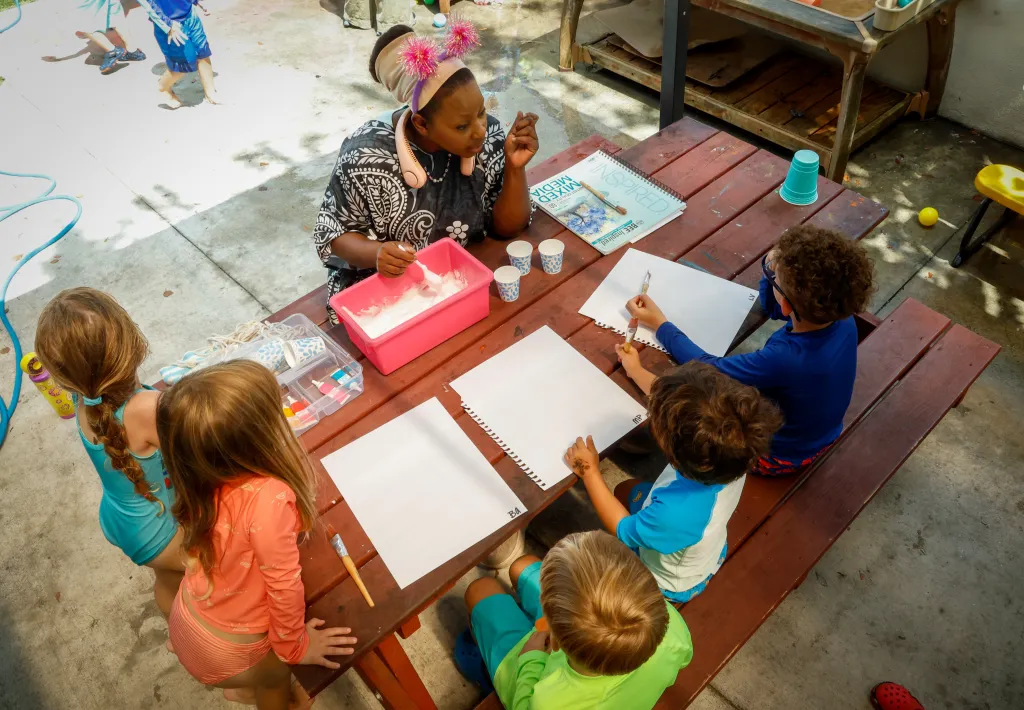
The mother-daughter owners of an Orlando preschool are licensed for 28 children but now enroll only 23 because of an ongoing teacher shortage that forces them to rely on substitutes, some hired through a new Uber-like app.
Felicia and Rodnecia Jones, owners of Little People Learning Center in west Orlando, concede substitute teachers are not best for young kids but often have no other way to keep their classrooms staffed, even with reduced enrollment.
“Being inconsistent in a younger classroom really can affect the learning, or their trust issues like, ‘Oh, I’m seeing a new face now. How long are we going to have her?’” said Rodnecia Jones, the younger of the two Joneses. “They don’t know what to expect and then they start crying, acting out and it impacts the learning.”
In the past year, the Joneses have raised teacher pay from the $14 minimum wage to $16 an hour. They now pay a $500 retention bonus when teachers make it to 90 days, offer one-week paid vacation and allow teachers to work a four-day week to keep them from getting burnt out. But still they struggle. The most senior teacher at the school has been there less than a year.
Florida, like much of the country, has a shortage of preschool teachers. Preschools often operate on thin margins and cannot pay teachers much, making it hard to draw people into the profession. As a result, schools are turning families away, which interrupts children’s early learning, leaves parents without childcare and hurts schools’ bottom line, making it even harder to pay teachers more.
“I’ve even seen schools that have sent kids home. They’ll say, ‘I can’t take your child today, I’ve got two teachers out,’” said Jennifer Grant, CEO of the Early Learning Coalition of Seminole County, which helps oversee the state’s subsidized childcare funding. “The flu is going through and they have to call families when their child isn’t ill and say, ‘We don’t have the manpower today.’”
In Florida, 38% of preschools operate under capacity due to staffing and affordability issues, according to a recent survey by the National Association for the Education of Young Children.
Michelle Voeller, owner of Hyer Street Preschool in Orlando, which serves 85 children, said she struggles with a high turnover rate due in part to low wages.
“I definitely feel that my teachers are way underpaid. And that tremendously affects the quality of people that you can get,” Voeller said. “What you find in this field is that teachers are only staying places for six months to a year and then they move on.”
She would like to pay her teachers more but teacher pay already eats up 70% of her school’s income, leaving her with little leftover for other expenses.
Schools serving more affluent families can attract and retain teachers by paying more and passing the cost on to families by raising tuition. But schools serving low- and middle-income families, such as Voeller’s school, don’t have that option.
First Academy Preschool in Leesburg also struggles to retain teachers, who are paid between $14 to $20 an hour, depending on their experience and education. Owner Brandi Simmons would like to increase teacher pay. But the only way for her to do so would be to increase tuition, which would put her at risk of losing families.
“It becomes cheaper for them to stay home,” Simmons said.
She had three families this year who stopped sending their older child after they had a second. Unable to pay tuition for two, the mothers quit their jobs to stay home with their children, she said.
As in most preschools, the majority of Simmons’ teachers do not have college degrees. She’d love to recruit better-educated teachers but cannot compete with public school salaries. Some employees use the childcare centers as a “stepping stone” to gain experience while in college and, upon graduation, get jobs in the public school system, she said.
“Which is sad because then they go on to leave me.”
The Joneses said the teacher shortage has become so acute that they sometimes have trouble even finding substitutes. They now use Tandem, an app-based company similar to Uber that, instead of helping people find rides, connects preschools to substitute teachers.
About 1,000 teachers and 500 schools in Central Florida are registered with Tandem.
Read more Orlando Museum of Art gets record gift, acquires fan favorites
Through the app, Central Florida preschool teachers earn an average of $15 an hour. Tandem pays them within 24 hours and then the school reimburses the company, plus a 35% fee.
On June 1, the Early Learning Coalition of Orange County partnered with Tandem so the coalition covers the 35% fee, allowing Orange preschools to use the service without incurring the added cost.
The Joneses said Tandem has allowed them to keep classrooms open when they were short on teachers. But they also caution that the program has made it even tougher for them to recruit teachers who can earn the same pay working as substitutes for Tandem without having to commit fulltime to a school. And with Tandem they get paid right away rather than waiting for a paycheck.
Just as Uber had a negative impact on the taxi industry, the Joneses worry Tandem will have a similar effect on the preschool industry, turning its teachers into gig workers and making it hard for preschools to have consistency in the classroom.
“It was designed to help, but it created something else,” Rodnecia Jones said.
The founder of Tandem, Olivia Weinstock, doesn’t disagree.
“Do I think that substitutes should be used long-term forever as the only way to keep a program running? Probably not,” Weinstock said. “We need to work to develop better ways of recruiting and retaining long-term, permanent teachers. That’s actually something that we’re acutely aware of.”
But for now, Tandem is filling a critical need and allowing schools to keep classrooms open.
Schools in wealthier areas have more resources and can offer more enticing benefits, making it easier for them to hire and keep teachers.
Mia Young owns Bright Scholars Learning Academy, a Lake Nona school with 225 children enrolled. Staffing is one of the biggest challenges in the industry.
“For childcare in general, this has always been the Achilles’ heel,” Young said. “If someone will give a teacher an extra 25 cents, they’ll leave you. So I have to constantly find ways to stay ahead.”
Most of her teachers, even the newer ones, make at least $19 an hour. They get a $50 monthly bonus each month that they don’t miss any days of work. The school also takes part in a program funded by the state that provides yearly retention bonuses of about $1,500 and college tuition.
“It’s an extra boost and I am very, very grateful for that,” said Karen Hyre, a teacher at Bright Scholars for the last six years. “And it means a lot because it shows that the organization values our service as teachers.”
Young also treats her staff to professional development retreats. This summer, she is renting a 15-bedroom house in Kissimmee with a pool and inviting all her staff for a weekend.
She still struggles with higher turnover than she’d like but has a small group of teachers that have been with her for years, in part, she’s convinced, because of the additional teacher benefits she’s built into her school.
But Young knows that not all schools can afford such perks.
“I have a large school. So the more numbers you have, once you hit your break even with the students, then everything there is profit. So we do fairly well,” Young said. “And I’m able to do more because I am in a more affluent area, and I’m not living like some of the other childcare owners, who can barely keep their heads above water.”
Read more Disabled oil tanker received dozens of warnings before US opened fire, AP source says