
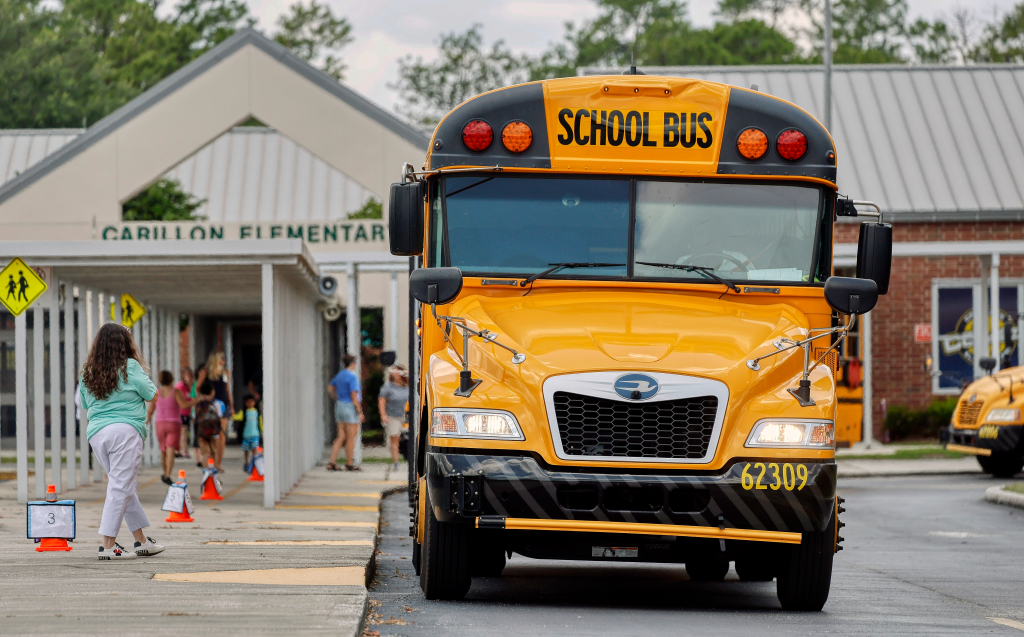
Central Florida’s school districts face a “bare bones” financial year driven by declining student enrollment and lackluster state funding that have prompted fears of multi-million dollar budget deficits and cuts to teaching staff.
Read more Merrywood gets demolition delay, but Winter Park house expected to become history
School districts in Orange, Seminole, Lake and Osceola counties will each approve budgets in the next month and have been busy trying to make the numbers work. Rising costs, a slim 1% increase in per-student funding that doesn’t keep pace with inflation and a projected loss of about 5,500 traditional students have made that job challenging.
In Seminole County, the district faced a $30 million deficit heading into the 2026-27 school year, Chief Financial Officer John Pavelchak told the board at its June 16 budget meeting.
It made steep cuts, eliminating 190 instructional and 52 support positions, saving the district about $18 million next year without having to close schools, Pavelchak said.
Robin Dehlinger, the chair of the Seminole County School Board, said the district hopes most of the job cuts will be absorbed through retirements and teachers taking jobs outside of the district, minimizing layoffs, but the district won’t know that outcome for certain until the start of the new school year in August.
Officials in the other districts also said they hoped any job cuts were made up for by resignations and retirements, not by employees losing positions they wanted to keep.
Dehlinger described the district’s financial situation as “bare bones” and blamed the Florida Legislature for de-funding school districts by not increasing funding to match inflation.
“We’re on the losing end,” she said.
Melissa Byrd, an Orange County School Board member, agreed, saying the state government “no longer values public education in the same way that it used to.”
“We are not funded anywhere in a way to meet any of our needs,” Byrd said.
But at a Friday press conference, Gov. Ron DeSantis touted the state’s education funding, highlighting the $85 increase to per-student funding.
“We’ve had more money go into school districts than we’ve ever had … Even as we’ve done universal school choice, we’re still putting money here,” DeSantis said.
District leaders, however, say that increase doesn’t keep pace with their higher costs.
In Orange, the district cut 5% across all department budgets and closed seven under-enrolled schools this spring to help cut expenses for the upcoming year. Rising healthcare costs still threaten a deficit of more than $145 million, which the district wants to manage by sharply hiking employee costs. That has prompted an ongoing fight with its teachers union.
“It’s crushing. The amount of money that that is taking up is crushing to our budget,” said school board member Stephanie Vanos at a June 23 meeting on the budget.
Orange County Public Schools, which lost 5,600 students this past year and expects to lose about another 3,000 students next year — meaning $26 million less in per-pupil funding.
Districts are pointing to several factors for the decline in traditional public school enrollment across the state, including a historic drop in birth rates, a decrease in immigrant families enrolling children amid the Trump administration’s immigration crackdown and the rapid expansion of Florida’s voucher programs, or state-funded scholarships that pay for private school tuition or homeschooling services.
The expansion took effect during the 2023-24 school year after lawmakers made a program, once limited to lower-income families, open to anyone.
Since then, Florida’s traditional public schools saw a decline of more than 111,000 students since the voucher program expansion, according to Florida Department of Education enrollment data through April 2026.
When a student leaves a public school through the voucher program, the state funding attached to that student goes with them — but not all of the district’s costs do. A school district still has to keep the lights on, pay a principal and run buses even if fewer students are enrolled.
Combined voucher use in Seminole, Lake, Orange and Osceola has grown by nearly 200% since the 2022-23 school year, according to data from the Florida Office of Economic and Demographic Research. It is up to nearly 62,000 students, from just over 23,000, and predicted to grow another 8,000 in the coming year, the agency says.
OCPS’s one-mill property tax referendum, which represents a $1 tax on every $1,000 of property value, will be on the ballot in November. The county’s voters first approved the tax in 2010, and it has been overwhelmingly re-approved every four years since.
District officials say it is a key part of their budget. Without the tax, OCPS would lose about $256 million in funding that pays for about 2,000 teachers and several dozen extracurricular programs like sports and the arts.
Despite past support, school leaders fear for the tax’s fate this year because of DeSantis’ push to slash taxes on homesteaded properties. The governor’s proposal will be on the November ballot, too, making OCPS officials worried that voters might be less inclined to re-approve the school property tax.
In Osceola, the school district faces just over a $7 million deficit entering the 2026-27 school year, according to budget details shared at a board work session June 23.
The district has pulled about $37 million from its so-called rainy day fund in the past two years to help keep up with costs, and that pot of money is now below the 6% threshold the Osceola County School Board set for itself.
Sarah Graber, the district’s chief business and finance officer, said the aim is still to keep that reserves fund at 6%. “The objective is to live within our means and not continue to dip below this amount long-term,” she wrote in an email.
But she did not specify what the district might do to stabilize its finances, nor did Superintendent Mark Shanoff, though he acknowledged the school system faced challenges, like others across Florida.
“Because of that reality, we have had to have some very honest conversations internally. We’ve had to take some action,” he said.
The district has already cut classroom and district positions to help cut costs, Graber wrote. Graber did not specify how many positions had been cut. Some positions were vacant, but for employees whose filled positions were eliminated, the district tried to place them elsewhere within the district for the coming year, she said.
Lake County Schools expected enrollment to decline, but the latest figures show the drop will only be about 200 students, putting the district in “pretty good shape” heading into the upcoming year, said Bill Mathias, chair of the Lake County School Board.
But that’s in part because the district took preemptive measures to cut costs this year, including 5% to 10% cuts across all departments and the merging of two middle schools.
While funding from the state remains sub-par, Mathias said it’s nothing new for Lake County Schools. The district has seen lower-than average state funding for years, compared to its neighboring districts. This year, it ranked 59th out of 67 counties in the amount it receives per student from the state.
Read more Rain, mud can’t dampen spirits at this year’s Bonnaroo Music Festival
“We long learned how to do more with less,” Mathias said.
Read more Plant doctor: Is it too late to add zinnias to my flowerbeds?