
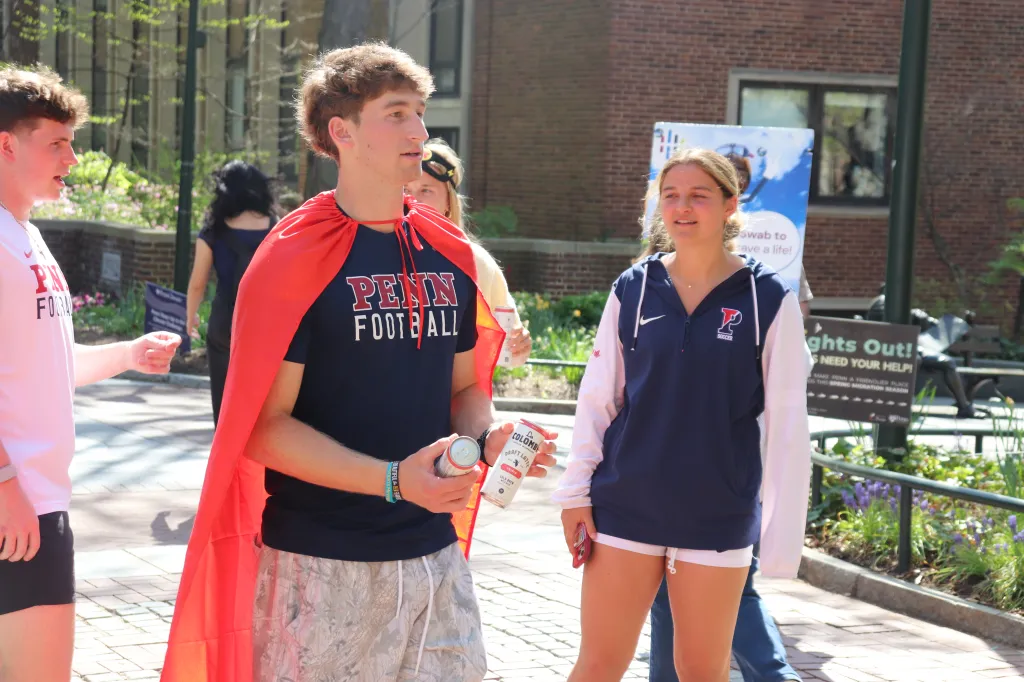
Clad in a flowing red superhero cape, Karson Siqueiros-Lasky urged students at his Philadelphia college to sign up for a marrow donor program, recruiting them with free coffee and a message about how they could possibly help someone in need — but likely would never be a match.
His fellow University of Pennsylvania football players performed cheek swabs on students who stopped to sign up at the event this spring.
About two weeks later, the 20-year-old from Lake Mary — a former quarterback and football team captain at Seminole High School in Sanford — got an unexpected email. The National Marrow Donor Program had matched him with a woman battling a rare blood disease, calling on him to donate peripheral blood stem cells through a long blood draw.
“I didn’t even have any words because I was just thinking in my head about the lines that I would say to people about how it was extremely rare to get a call,” said Siqueiros-Lasky, now a quarterback at Penn.
A rising junior majoring in finance, Siqueiros-Lasky has participated in the donor drives since his first year on the Ivy League school’s football team, urging fellow players and students to register. Most people never match with a patient in need of peripheral blood stem cells or bone marrow, or it takes years, he always told them.
He registered himself as a freshman. Though matching so quickly was a surprise, his decision to go through with the donation wasn’t to those who know him.
“The kid is just a people’s person,” said Karl Calhoun Jr., his football coach at Seminole High. “Whatever he can do to help someone, he will do it.”
Calhoun met Siqueiros-Lasky in 2021, he said, and the then-teenager quickly became one of the best quarterbacks Calhoun has ever coached.
During his time with the Noles, Siqueiros-Lasky was the first to arrive at the football field and the last to leave, a “natural leader” among his fellow players, he added.
Siqueiros-Lasky will donate next week to a woman he does not know in a location he has been asked not to disclose.
Blood stem cells can be collected through a blood draw — which accounts for 90% of donations — or surgery to gather bone marrow, according to the donor organization. For Siqueiros-Lasky, it will be similar to a routine blood or plasma donation through an IV.
Blood drawn from one of his arms will pass through a machine that separates his blood stem cells, and the rest will be returned to him through his other arm in an up to eight-hour process.
Read more Newsom urges a national ‘billionaires’ tax’ while fighting one in California
For five days leading up to his donation, Siqueiros-Lasky will receive injections that spike his blood stem cell production, which can cause bone and muscle aches. And once the blood draw is done, he might feel tired before bouncing back, according to the donor organization.
The quarterback expects recovery within a week, he said.
“I realized that it would take about a week of my time,” he said. “I realized that a week of my time to give someone else potentially years on theirs, it just turned into a no brainer for me.”
When he first found out, he quickly called his mother, Ricki Lasky.
“Yeah, I’m a match,” he said.
“Well, what do you think?” Lasky recalled asking.
“There’s no question,” her son replied. “I’m absolutely going to do it.”
Siqueiros-Lasky had just one reservation: How would the donation process impact his upcoming football season? In August, he’ll plunge into five practices per week on top of independent workouts, he said. Games begin in September.
But he was told donating and recovering wouldn’t be too long, and he was too enthusiastic not to follow up for next steps. Those included disclosing his medical history, getting his blood drawn to ensure he was the best match and getting a general check-up.
“The whole process so far has been really cool,” he said. “It’s been extremely easy.”
The organization, a national registry of volunteer donors that helped almost 9,000 patients through cell therapy last year, estimates the proceedings to take 20 to 30 hours total over a period of four to six weeks, including phone calls, appointments and the donation. Minimizing disruption to work or school is a priority, according to its website.
Siqueiros-Lasky knows next to nothing about the woman he’s helping beyond her age and medical condition. It will be up to her to reach out in the future, he said, but he hopes to one day meet her.
“This could affect her life for years to come,” he added. “I just feel like it’d be really cool to meet her in person and just see her feelings… but also learn more about her.”
Lasky will accompany her son to the donor location. Growing up, her son watched over his younger twin sisters, so she’s not surprised by this selfless act.
“So just to see him kind of step up and go through all this testing and then go through with what he says is no big deal,” she said, “I think it’s an amazing thing to do and am just really, really proud of him.”
Read more Central Florida schools eye ‘bare bones’ financial year as costs rise