
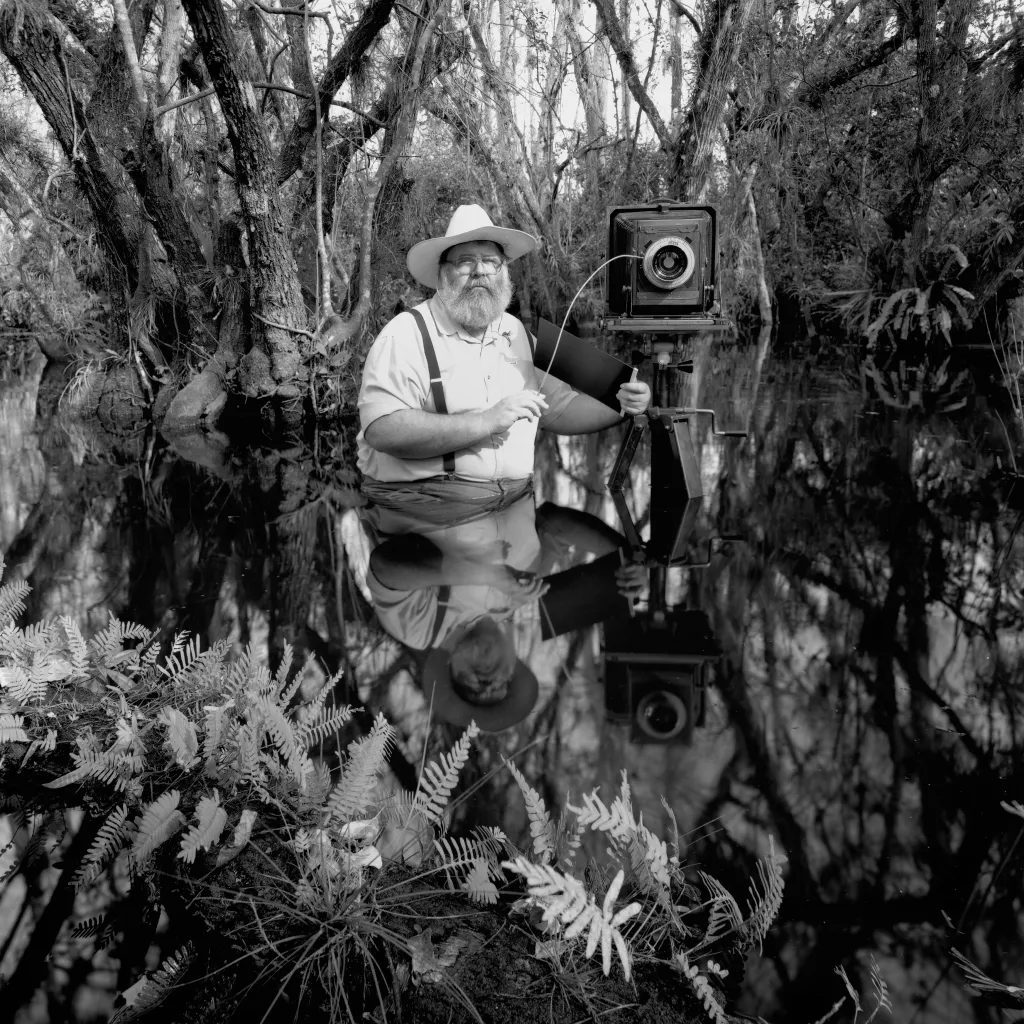
Since discovering the beauty of Florida more than four decades ago, Clyde Butcher has become known for his giant black-and-white photographs showing the dramatic majesty of the state’s landscape — especially the Everglades.
Read more ‘No brainer’: Former Seminole High quarterback to donate blood stem cells
Though he now makes it his mission to share the Sunshine State’s wild side through his art, there was a time he couldn’t find anything to photograph here after living on a sailboat in California for seven years.
“We came came here permanently in 1980. I didn’t see anything to photograph here until 1984,” he said. “It took me four years to discover what Florida was all about.”
After some fateful encounters with people in the Everglades, namely folk artist Tom Gaskins and fifth-generation Floridian Oscar Thompson, Butcher went from being a swamp skeptic to one of the land’s biggest advocates.
At Gaskins’ Cypress Knee Museum, Butcher got his first glimpse of the swamp after navigating a “board” walk on a single plank above the water.
“They had a little platform with this gorgeous view. That little walk, walking first through the palm trees and then into the cypress, I felt that this is Florida,” he said. “I actually came back the next day with my camera, and I hadn’t taken a picture in Florida before this for a total of six years.”
Soon after, a visit to Thompson’s camera shop in Fort Myers proved fateful, as Butcher recalls: “He’s the one who taught me about the Everglades. He convinced me I could go into the water without getting killed.”
More than four decades after the “Ansel Adams of Florida” first fell in love with the Everglades, and more than 70 years after his earliest photographs, the 83-year-old Butcher is reflecting on his career amid retrospective shows around the state.
Fans of the renowned photographer have chances to meet Butcher at his Big Cypress Gallery (July 12) in the Everglades and his Venice Gallery & Studio (Aug. 2). At both galleries viewers can behold his giant photographs in “The Land We Share,” a collection of work created over six decades heralding America’s diverse landscapes, on display through the end of the year.
Butcher’s work is also shown in current and upcoming museum shows around the state: “America the Beautiful” at the Marco Island Historical Museum (through July 11), “Lifeworks in Photography” at the Coral Springs Museum of Art (through Aug. 1) and “America the Beautiful” at the Polasek Museum in Winter Park (Aug. 18-Dec. 6).
Butcher also has a book-signing event July 1 at the Marco Island Historical Museum.
As the museum shows look back on Butcher’s vast body of work from across the United States, he recalls the pivotal moments in his life that led him to his biggest creative decisions and his move to Florida.
Born in 1942 in Kansas City, Missouri, Butcher first picked up a Brownie Hawkeye camera when he was 8 years old. During a trip to Yosemite in 1963 with his future wife Nikki, the photographer saw an Ansel Adams exhibit that sparked his interest in landscape photography — especially black and white images.
Butcher switched to color as he displayed work at art shows and found commercial success selling his work as decor to department stores like JCPenny, Sears and Montgomery Ward.
After his son Ted was killed by a drunken driver in 1986, Butcher took a critical look at the art he was producing and decided to throw about “$400,000 worth” of color photographs into the dump.
“I looked at my color work and I said, ‘I don’t think this is telling the story of Florida. The color is too confusing,” he said. “I was trying to get people into the photograph so they feel like they are there.”
In a world where it’s possible to take hundreds of photos in just a few minutes, Butcher’s practice has been built around a deep sense of patience and getting the scene just right for his large-format cameras. Some images have taken days, weeks, months or even years to perfect.
“Color can be interesting but to do a proper black and white, it has to be a good composition, good lighting and good work in the darkroom. It’s a whole different craft, then it becomes, I think, an artform,” Butcher said. “You have to look at the scene with your heart, not with a phone. You’ve got to be able to feel the scene.”
Since Clyde and Nikki Butcher bought a 14-acre property in 1992 that would become their home and Big Cypress Gallery, Florida has changed a lot. Alligator Alcatraz was built on one of the main roads Butcher used to take his photographs.
“Big Cypress was one of the few places in the United States on the East Coast where you could see the Milky Way. It killed that,” he said. “This is a gorgeous world. We just have some very angry people running it right now.”
Even into his mid-80s, Butcher has plans to photograph South Florida ranchlands this summer that are earmarked for conservation. He’s also being documented by filmmaker Dan van der Kooy, who has followed important moments in Butcher’s life for the last four years and plans to produce a feature-length documentary.
As Butcher looks back at his life and legacy, he hopes people remember him for creating images that helped people discover the Everglades and the natural world.
“I want to be remembered for educating people about this beautiful world,” he said. “My photography just happens to be the tool I’m using, like some people use music and writing. I’m using the camera and my voice.”
Learn more about Butcher’s work and upcoming events at clydebutcher.com.
Find me @PConnPie on Instagram or send me an email: [email protected]. Stay up to date with our latest travel, arts and events coverage by subscribing to our newsletters at orlandosentinel.com/newsletters.
Read more Newsom urges a national ‘billionaires’ tax’ while fighting one in California