
The minute he read the bill, diner Carl Jackson vowed never to return to Mamush Prime Kosher Grill in Boca Raton.
Read more Hurricane center forecasts system could develop off Florida coast
Beneath the charges for chicken and ribeye skewers, french fries and iced teas, the Town Center mall restaurant had added a 20% automatic gratuity and 3% service fee.
“One and done for us!” Jackson wrote above the photo of his bill, showing over $30 in surcharges, that he posted on the Sun Sentinel’s Facebook group, “Let’s Eat, South Florida.”
Jackson’s experience represents a familiar restaurant scene: confusing fees tacked on without advance warning from servers — from automatic tips for large parties to service charges to credit card fees, plus a blank line at the bottom for a voluntary tip.
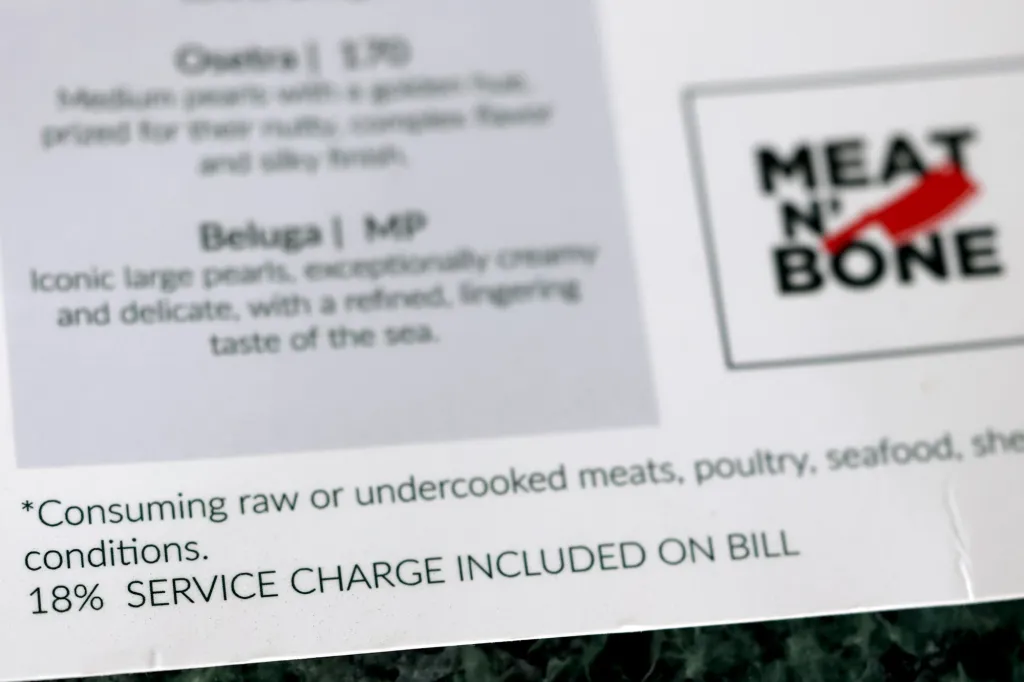
That will all change on July 1, when a new Florida law mandates that eateries reveal extra fees before customers dine in. The so-called “Operations Charge” law, signed by Gov. Ron DeSantis, requires food-service establishments to identify charges and gratuities for anything that isn’t food or drink “in an obvious and clearly readable manner” on printed menus, websites, mobile apps and the bill itself, according to the statute.
The exact percentage and purpose of the charge must also be stated “in a font that is equal to or greater than the font used for menu item descriptions,” the law adds.
Nick Henderson, a general manager at Mamush, said diners like Jackson shouldn’t be surprised because his restaurant has a “full disclosure” policy about fees, listing them at the front desk near its kosher certification and training servers to mention them before taking orders.
Still, he said Mamush’s printed menu didn’t list the fees until recently, which is why he spent $3,000 reprinting and laminating to bring them up to compliance with Florida’s new law.
“We’re not trying to hide anything from anybody,” Henderson told the South Florida Sun Sentinel, adding his menus now say that all surcharges go to staff.
Even with its promise of transparency, the new law has proven to be divisive for restaurant diners. Some in the “Let’s Eat, South Florida” group praise the law’s “clear communication” goals, while others point to government overreach or question the need for fees at all.
“As a customer, I am so sick of getting hit with random ‘surprise fees’ at the end of a meal,” commenter Yu Ting Huang wrote. “Clear transparency is 100% needed. If a restaurant wants to charge a split-plate or credit card fee, just own it and put it on the menu.”
Meanwhile, some restaurant owners and hospitality experts argue the law will create undue burdens on mom-and-pop businesses (such as paying to reprint menus). Others are annoyed that its ambiguous language will create confusion over how — or if — the state will enforce compliance.
“It frustrates me that we don’t know who’s enforcing this and what the fines are,” said Luis Mata, co-owner of The Wagyu House in Hallandale Beach. “I’m for the law, but you’re making operators change their systems and pay for new menus, so no one really profits from this.”
‘I can think of multiple times I was yelled at’
One thing is clear: Restaurant owners, hospitality experts and diners agree that so-called operations charges help prop up a hospitality industry that has long survived on slim profit margins, higher food costs, inflation and Florida’s mandate hiking the minimum wage, set to rise to $15 an hour this September.
Such service charges on dine-out menus aren’t new, but became the new normal as the pandemic constrained restaurant budgets. Some eateries imposed “COVID-19 surcharges,” trapped between rising food costs and staff wages and the fear of driving away customers.
Even with their growing adoption, these extra charges and their unclear uses have left longtime servers like Maria Stathis on the receiving end of irate guests.
“I can think of multiple times I was yelled at for telling a guest about the gratuity,” said Stathis, who has waited tables at restaurants from Delray Beach to Miami Beach. “Some people do not read. And some restaurants don’t allow staff to talk about gratuities, as some people find it insulting.”
She thinks the law’s new rules may cut down on rude behavior, but “it depends on the establishment, the rules given to the staff and what the charges are for,” she added.
Read more Everglades photographer Clyde Butcher reflects on 60-year career amid retrospective shows
Putting surcharges on checks is vital to hiring staff because servers consider it part of their tipped income, argued Gabriel Llaurado, co-owner of The Wagyu House, where 18% service fees go to servers and bartenders.
“I’ve had servers come in a day before their job interview to make sure we had service charges,” Llaurado said. “If we didn’t do it, we wouldn’t have employees. And there’s a side of me that likes the law, because the more transparency, the better, and customers deserve to know everything.”
While transparency on customer checks is a good idea, the law is “very vague” about holding noncompliant restaurants to account, said Peter Ricci, director of Florida Atlantic University’s Hospitality & Tourism Management Program.
Ricci, who’s read the law multiple times, said it fails to list penalties or name the agency that would enforce them.
“I don’t know who’s going to do it and how frequently and what the penalties are,” he said. “It’s vague by design.”
Samantha Padgett, vice president of government relations and general counsel for the Florida Restaurant and Lodging Association (FRLA), thinks she may have the answer. She said the state’s Department of Business and Professional Regulation (DBPR), which issues food licenses and fines restaurants for health code issues, is likely in charge of ensuring eateries show extra fees.
She has a point. In the same chapter where the new law appears, DBPR is the enforcing agency for “all of the provisions of this chapter,” the statute says.
The Florida DBPR did not return multiple phone calls or emails from the Sun Sentinel seeking comment on enforcement.
‘Am I ready for it?’
A clear labeling law for service charges is a “positive step” because it reduces confusion for guests and staff, said Padgett, whose advocacy group has 10,000-plus members. The FRLA not only supported the legislation, Senate Bill 606, but told members it was coming.
“Customers should always know what they are being charged and why,” Padgett said. “Our hope is that the law is implemented in a way that provides clarity for guests without creating unnecessary burdensome requirements for restaurants.”
FAU’s Ricci, for his part, worries the new requirements will catch some smaller and overworked restaurants off-guard.
“If I’m a freestanding restaurant, am I ready for it? Are staff trained? If the answer is no, it could be a disaster for the restaurant,” Ricci said. “If small business owners don’t have a budget for accountants or lawyers, are they being informed? It’s not an excuse, but a reality.”
No one told franchisee Kate McGoff how to address her current fee confusion. There are no surcharges at her Topsail Steamer in Royal Palm Beach — but her third-party online ordering platform issues a flat 99-cent transaction fee.
“Am I supposed to list it on menus if it’s not my platform?” McGoff said, who plans to ask her franchise owner for guidance. “How do I alert customers? Do I absorb the fees? I don’t want to deceive anybody.”
Having clarity around service charges is the only way eateries can survive, said restaurateur Eddie Pozzuoli, who runs Eddie & Vinny’s in Coral Springs — because the only alternative to removing fees is hiking prices.
“A customer sees a $38 chicken parm, they won’t eat there again,” Pozzuoli said. “But if the chicken parm is $30 with operations charges, they will. Just be clear about what you’re charging people.”
Sun Sentinel writer Phillip Valys can be reached at [email protected] or Twitter/X @philvalys.
Read more ‘No brainer’: Former Seminole High quarterback to donate blood stem cells