
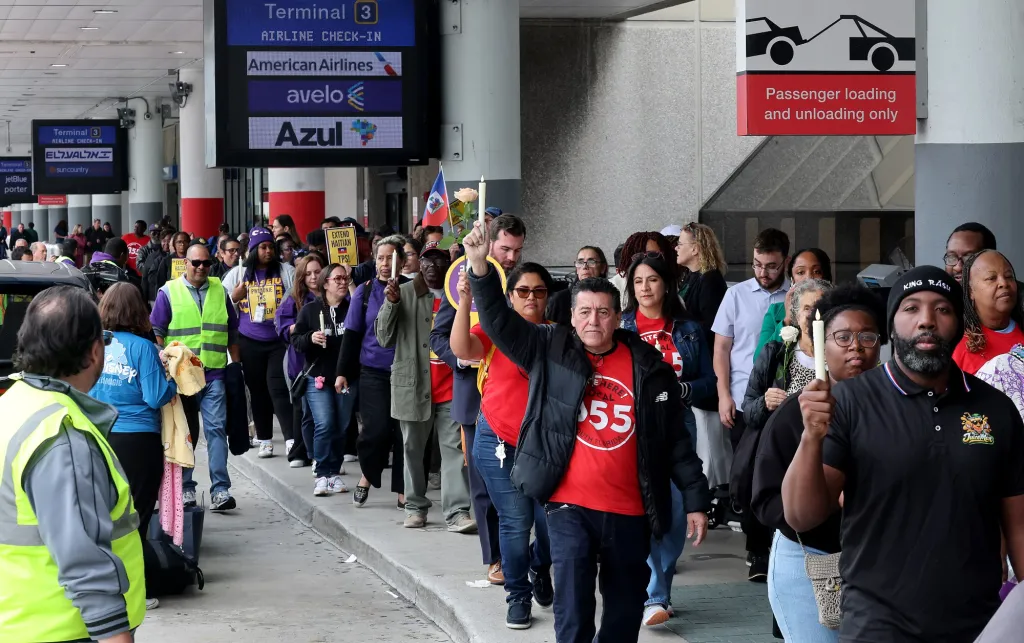
Even before the U.S. Supreme Court gave President Donald Trump twin legal victories supporting his immigration policies designed to oust migrants from the U.S., advocates for foreign-born workers and their employers were calculating the potential losses of asylum seekers who are lawfully working around Florida and the nation.
Read more Woman shot in foot by brother during group altercation in Downtown Orlando
A study released last week by Washington, D.C.-based WorkPermits.US found that 541,000 workers of foreign origin in Florida have filed asylum applications, making the state No. 1 in the country. Nationally, U.S. workers applying for asylum number at least 2.3 million, contributing more than $108 billion to the economy annually in addition to $33 billion in combined taxes.
Jennifer Stevens, vice president of healthcare at John Knox Village in Pompano Beach, openly worried about the immediate futures of Haitian staff members who help care for the nonprofit enclave’s elderly clients.
“We have a population of Haitian team members that we adore. Many of them have been with us for over 10 years, have amazing relationships with our elders, provide 24-hour care for them, all day, every day,” she said at an online news conference sponsored by an advocacy group for asylum seekers on Wednesday. “And to lose any of them, even one, is an impact to our elders. It’s just a devastating reality for us.”
The reality seemed even worse after Supreme Court justices voted 6-3 to give the Trump Administration a green light to strip away Temporary Protection Status for thousands of Haitians and Syrians living in the United States. In a separate ruling, the court ruled that agents could physically stop asylum seekers from crossing the U.S.-Mexico border as they fled persecution for their political or religious beliefs, or ethnic or racial backgrounds.
Highly vulnerable
“How are they going to make a living?” Stevens asked in a phone interview. “How are they going to go back to Haiti? It is super dangerous for them.”
The number of Haitians under John Knox Village’s employ may be small at 12, out of some 300 staff.
But they are part of a much greater population of South Florida residents of foreign origin who have applied for asylum to live in the United States. They work in a variety of key state industries: construction, healthcare, leisure and hospitality, manufacturing, professional services, transportation and wholesale and retail trades.
The challenge facing both workers and employers is not confined to TPS or stopping would-be asylum seekers at the U.S.-Mexican border.
In February, the Department of Homeland Security proposed a new rule that could eliminate work permits for most asylum applicants. The rule, which has yet to take effect, ties eligibility for work permits to a 180-day asylum application processing time. The problem is that the U.S. Citizenship and Immigration Service lacks the resources to handle high volumes of applicants within that time.
At the news conference Wednesday, WorkPermits.US unveiled a study that asserts how severe the impact on the region’s labor market could be if asylum seekers who have applied to live in the U.S. permanently are suddenly denied access to the asylum process and forced to return to their homelands.
Out of all the metropolitan areas nationwide, the Miami-Fort Lauderdale-West Palm Beach region seems positioned to lose the most if newly proposed federal regulations drive asylum seekers out of the labor market.
Cristina Moreno, who monitors federal regulatory and police changes at WorkPermits.US, said “over the past year, many fed policy changes have revoked authorizations” for individuals who were previously allowed to work in the United States.
Overall, she said, the Department of Homeland Security is making it harder for employees with pending asylum applications to retain their authorizations.
“There are more than 500,000 with a pending asylum application in Florida,” she said.
The second major change facing asylum seekers is the Trump Administration’s termination of Temporary Protection Status for Venezuelans, Cubans, Haitians and Nicaraguans.
At the end of 2024, there were 1.3 million people shielded from deportations by TPS, including 350,000 from Haiti, 600,000 from Venezuela and 4,000 from Nicaragua.
Read more Commentary: Florida’s preparedness gap is growing faster than infrastructure
“If these terminations go into effect, hundreds of thousands of individuals will lose their work authorizations,” she said.
“These policy changes are not happening in a silo,” Moreno said. “It’s critical for South Florida elected officials to speak out against these policies.”
Holding on to staff
Approximately 300,000 immigrants work in the Miami-Fort Lauderdale-West Palm Beach area alone. They contribute $11.6 billion annually to the region’s economy. They pay $3.1 billion in combined taxes, according to a study developed by Phillip Connor Ph.D., a research fellow at Princeton University’s Center for Migration and Development.
All told, 5% of the total South Florida workforce consists of asylum applicants.
“They are the people building our homes, staffing our hospitals, and keeping our restaurants and hotels running,” Connor said.
The study he conducted drew on the 2024 American Community Survey — a large-scale, annual survey conducted by the U.S. Census Bureau. It relied on “immigration status assignments for asylum applicants, economic variables in the ACS such as labor force participation, industry of employment, state and metro area of residence.” Connor said populations in the 2024 ACS were “reweighted to reflect the total number of asylum applicants as of the end of fiscal year 2025.” Allowing for several months to obtain a work permit, the estimates reflect an asylum applicant population with access to work permits as of early 2026.
It concluded that 54 per 1,000 employed people in Florida have pending asylum applications. It’s the largest such population in the nation.
Connor also found they contribute $22 billion annually to the state’s economy.
But if the workers vanish, so will the lofty numbers, advocates say.
Jason Pincus, vice president and nursing home administrator at Miami Jewish Health, which operates the largest geriatric care center in the Southeast United States, as well as the largest nursing home in the state, said his institution hasn’t faced staff retention issues in years such as the ones he’s facing now.
“Since the issue with TPS came a few years ago, that is one area Miami Jewish has really struggled with,” Pincus said. “We have over 50 employees who not only work for us, but some of our contract vendors that are under the TPS. When the [expiration] deadlines are coming up they are not sure what to do. We have actually lost several staff that left the country. Several of them worried what would happen if they returned to Haiti.”
The fear and uncertainty is adversely affecting the care continuity for residents.
“It’s very difficult for employees and employers to plan to take care of our elderly population,” he said.
“It’s tough to find staff right now because there is so much uncertainty,” he added. “We did not have this issue many years ago.”
‘Major disaster’
Renata Castro, an immigration attorney based in Coral Springs, and who was not involved in the study, noted that Haitians “have quite effectively filled a void” in the elder and long-term care job market over the years.
“It’s quite clear immigrants were not stealing the jobs of Americans,” she said. “Americans did not want those jobs.”
With the looming loss of TPS, the problem now is finding legal alternatives for Haitians to stay.
“It will really depend on whether this person has another manner in which to obtain status,” Castro said.
“This is a major disaster that we immigration attorneys have been waiting to happen.” she added. “It got here a lot faster than we had anticipated.”
Read more Hurricane center forecasts system could develop off Florida coast