
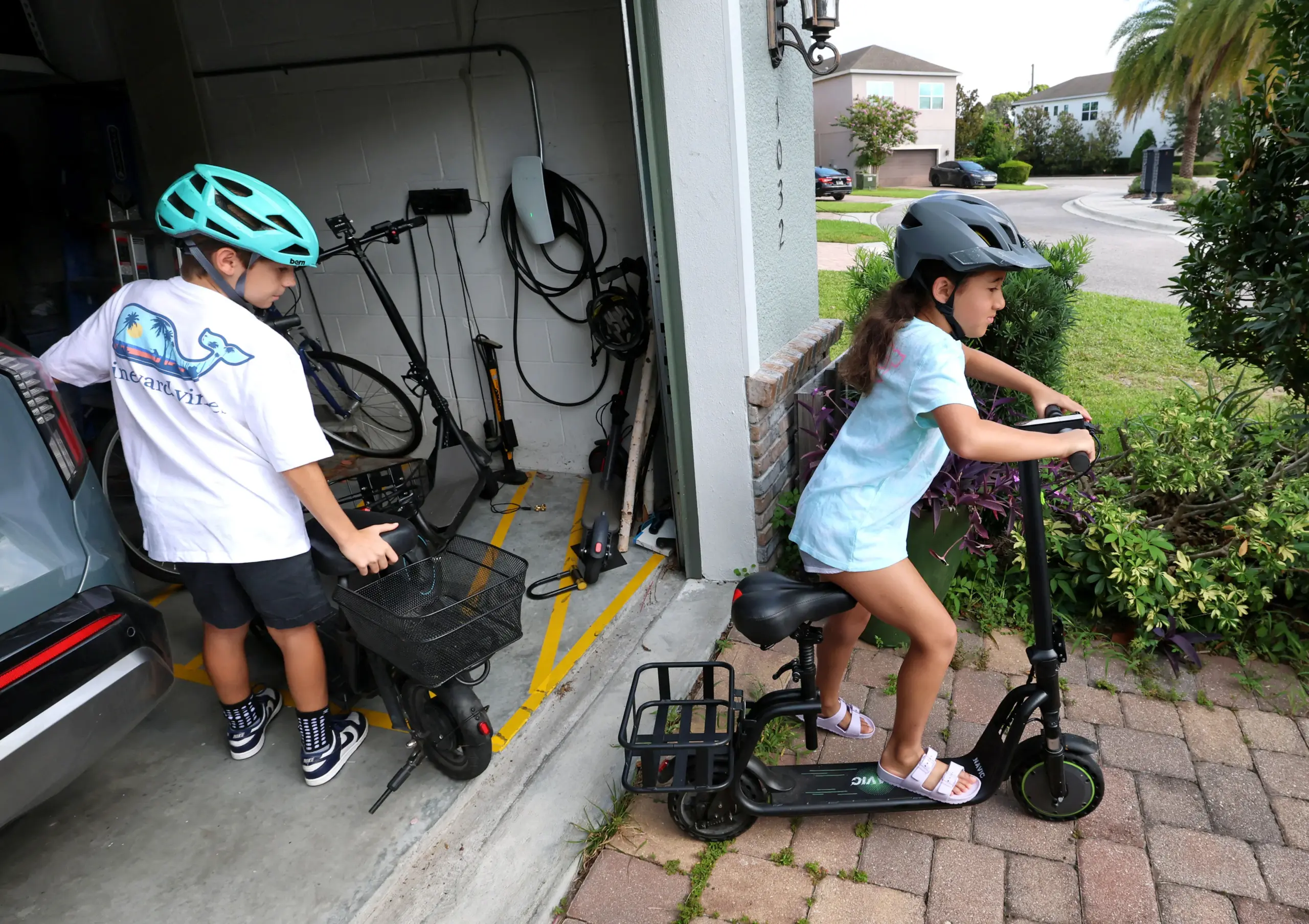
Four of Nate Clark’s kids ride e-scooters to and from school — the easiest way for them to get to three separate campuses with three different start times, all at least a mile from their Baldwin Park home.
Read more Stadiums, theaters, conventions and the arts: Orange TDT board to hear massive proposals
But now the Orange County School Board is poised to ban e-bikes and e-scooters from elementary and middle school campuses and allow them only at high schools, and only if the student has a driver’s license. The board is to vote Tuesday, with the outcome in little doubt as most members have signaled their support for the ban.
The change leaves Clark, whose kids riding e-scooters are starting grades 5, 6, 8 and 9, and many other families scrambling for transportation answers just weeks before school starts Aug. 11.
“Honestly, I don’t know how we’re going to deal with it,” he said.
Clark and his wife both work full time, and because they live within two miles of the schools they do not qualify for bus service.
“We bought our kids e-scooters specifically so that they could be more independent to go to and from school,” Clark said. “It’s not just punishing the kids. It’s punishing the parents because now I’m left with ‘How am I going to get my elementary school kid to school next year?’”
Clark called the ban a “cop out” from the district. Instead, the focus should be on teaching students traffic rules and how to ride safely, he said.
Government agencies in Central Florida face a dilemma as they try to balance convenience, and the needs of families like Clark’s, with rising safety concerns about electric vehicles that have gotten cheaper and faster while their riders have gotten younger.
Tens of thousands of Orange County Public School students — including an estimated 42% of middle schoolers — rode e-scooters and e-bikes to school last school year, according to an OCPS survey of families, as the electric so-called micro mobility devices became increasingly popular.
But school leaders also became increasingly worried as accidents spiked, one student died last year after an e-scooter crash off campus and throngs of students arrived and left campuses on the small vehicles, sometimes weaving among cars and failing to wear helmets.
A video from May taken by Orange County sheriff’s deputies and played at a Orange County commission meeting showed a huge rush of students leaving Windermere High School on e-bikes, some riding dangerously and riding the wrong way through traffic.
The Orange County School Board decided a ban for most students made sense, a decision few other school districts nationwide seem to have made, despite growing concerns. But 3,000 miles away, a school district in Orange County, CA, is instituting a similar ban for the upcoming 2026-27 school year.
Ashley LaChance’s 13-year-old son Colton Remsburg, a seventh-grader at OCPS’ Innovation Middle School, was fatally injured riding an e-scooter in May in Lake Nona. LaChance supports the school district ban on micro mobility devices.
“I know many parents are probably frustrated by this decision, and I truly understand why,” LaChance said. “I have empathy for those families whose work schedules, daily routines and livelihoods are now disrupted because an e-scooter or e-bike was their child’s primary means of transportation.”
“I get it,” LaChance said of juggling conflicting schedules. “But I also live with the unimaginable reality of what can happen. This kind of grief is unbearable…It changes every part of who you are forever.”
Colton was on his way to the store to buy flowers for her for Mother’s Day. He loved Detroit sports teams, quarterbacking his flag football team, cracking jokes and sharing his fishing expertise.
“I’m pretty sure he taught the whole Lake Nona community how to fish,” his mom said
Maria Salamanca, the school board member who represents Lake Nona, said during a discussion of the proposed ban last week that her constituents support new restrictions.
She doesn’t think educational initiatives would do enough to curb the spike in injuries from e-bikes and e-scooters.
“These students do not have a fully formed prefrontal cortex, and they’re driving 40 miles per hour and doing wheelies and putting two or three students on one bike,” Salamanca said. “It is a lot of fun. There is no Canvas course you can give these students that is going to be more exciting and more fun or more scary than putting three kids on a bike and going to do whatever you want.”
Monica Streets, the parent of an Apopka Middle School student, agrees. Elementary and middle school students are “not responsible enough to be adequately riding these e‑bikes,” she said.
Read more ‘Patriotism on Plant’ celebrates America with fervor and fun | Review
“They won’t stop for stop signs. They just roll right through. I’m guessing they don’t think that they have to obey the traffic laws or no one has taught them,” Streets said.
Her son rides a regular bike to school, and though he has asked for an e-bike, she has said no. “His safety would be at risk.”
Accidents involving e-bikes and e-scooters have jumped, both nationally and locally, doctors say.
And because the electric devices are faster and heavier than their traditional counterparts, serious injuries are more common.
The American College of Surgeons reported that over 20,000 people — many of them under the age of 14 — are injured riding e-bikes with 3,000 hospitalized annually, numbers that are not only growing but also likely under-reported.
Mitchell Michalak, an epidemiologist with the Florida Department of Health in Orange County, said ER visits here for injuries related to e-bike and e-scooter accidents jumped 273% from 2022 to 2025.
He said people aged 19 and younger accounted for over half of those ER visits in 2025.
“What’s even more staggering is that a large proportion is the age group 10- to 14-years-old,” Michalak told county commissioners mulling an e-bike ordinance. “That happens to be the middle-school age group.”
Many involve helmetless riders.
“When we get our trauma alerts, a lot of times I’m thinking, ‘OK, is it another e-bike or e-scooter injury?’ ” said Dr. Marc Levy, a pediatric trauma surgeon for Orlando Health Children’s Arnold Palmer Hospital. “Because they’ve become more and more common.”
But parents opposed to OCPS’ plans believe there are options besides a ban.
Allison Scott’s son William, who will start 10th grade at Horizon High School in August, rides an e-bike to school every morning. She called OCPS’s planned ban “extreme” and said the district should instead focus on offering safety courses or having school resource officers enforce traffic laws.
The family lives six miles from Horizon High and riding the e-bike is faster and more reliable for her son than taking a school bus, which she said is often late.
She has spoken with her son about safety, helping pick a route and reminding him to use crosswalks.
“I see both sides of the thing, but I don’t feel like as a parent you should take away how our kid gets to school. We’re doing all the things that the school wants,” Scott said.
Local governments are also considering, and making, changes to their laws to crack down on unsafe riding by children. In June, Gov. Ron DeSantis vetoed legislation that would have required e-bike and e-scooter riders to slow down around pedestrians and established a state task force to review risks, policy gaps and enforcement challenges. Instead, any regulations now fall to local governments.
Orange County commissioners may mandate helmets for riders 16 and younger and require riders to slow down when approaching pedestrians. They are to take up the proposal in August.
The city of Ocoee earlier this month set a 10 mph speed limit on sidewalks and required riders to “dismount when necessary for public safety,” with pedestrians having priority on sidewalks and shared-use pathways.
The fastest e-bikes — manufactured to go 28 mph at top speed, according to factory specifications, but can be easily modified to go much, much faster — are already forbidden in county parks and on the West Orange Trail.
Other local school districts haven’t yet taken steps to restrict e-bikes and e-scooters. But the School District of Osceola County has hosted several e-bike safety courses for students in collaboration with the county sheriff’s office.
The Newport-Mesa Unified School District in southern California is banning e-bikes and scooters in its elementary and middle schools this coming year. Like OCPS, it said the new rule aims to improve safety — a teenager in that Orange County riding an e-bike struck and badly injured a substitute teacher, CBS News reported — but it recognized its ban will “be a change for some families.”
Read more Today in History: July 26, Hillary Clinton wins nomination for Democratic presidential candidate