
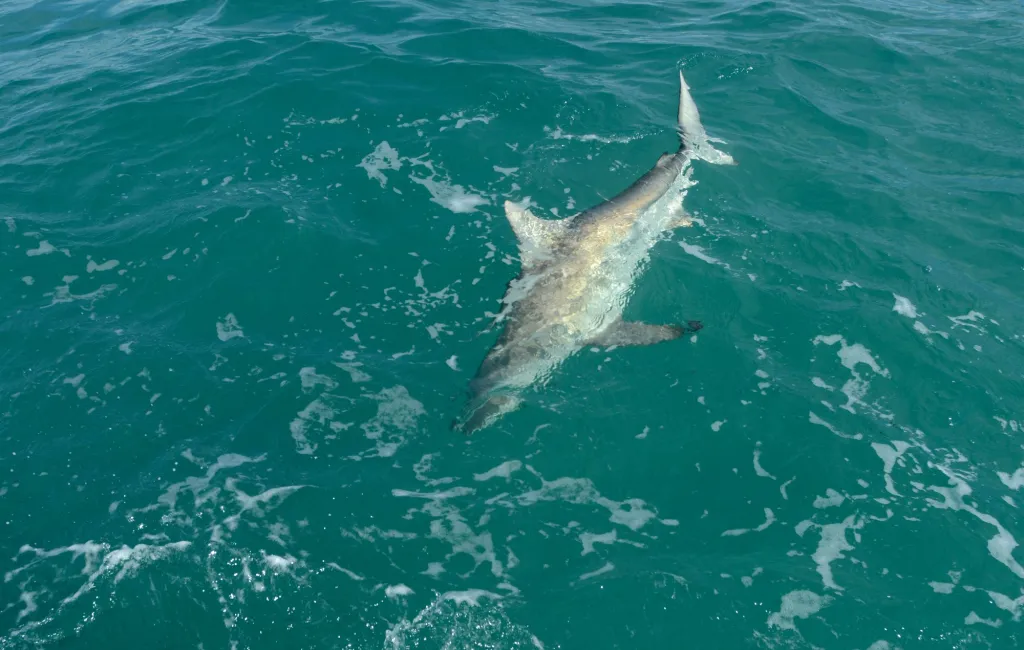
Fifteen, 20, 30 feet down, a crate of dead fish hung in the water five miles off of Jupiter’s coastline, and the sharks rode up and down with it. Every so often, Tanner Mansell would reach into the crate, pull out a fish head and wave it through the water, and the sharks would follow.
Read more Odds up to 80% tropical system will form off Florida coast, hurricane center says
One of Mansell’s crewmembers said she hand-feeds this species — silky sharks, found in tropical regions of the Atlantic, Pacific and Indian oceans — but no other sharks. The operators say offering bait directly to a shark, hand-to-mouth, isn’t how they usually work; their standard method is “passive scenting,” keeping bait sealed in a crate so it releases only scent, drawing the sharks close without feeding them.
At the operation’s center is Mansell, who runs one of a handful of shark-diving operations working out of Jupiter. To him, this isn’t a thrill ride; it’s a passion and a career that he’s staked his livelihood on.
On this day, four guests — clad in masks, snorkels, flippers, and dressed in all black to reduce the risk of being confused for a fish by the sharks — clung onto a safety line and watched as the silky sharks encircled them. Every few minutes, a cameraman, Danny Lomas, would pry a guest from the safety line and have them dive down to swim with a shark, snapping photos as the guest posed with the shark.
A bill now moving through Congress would make elements of this activity a federal crime in the waters off Florida.
The Florida Safe Seas Act runs two lines long. It adds Florida to an existing federal ban on shark feeding that already covers Hawaii and the U.S. Pacific territories, extending the prohibition to the edge of the nation’s waters — up to 200 nautical miles offshore. The U.S. House of Representatives passed it in June, and it is now headed to the Senate.
Its original sponsors — U.S. Representatives Daniel Webster, a Republican, and Darren Soto, a Democrat, both from inland Central Florida districts — say it is about keeping people safe. Shark feeding has been illegal in Florida’s state waters, out to about 5 kilometers (3 nautical miles), for years. But the dive boats operate well beyond that line, in federal waters, where the state ban does not reach. The Safe Seas Act is designed to close that gap.
“The Florida Safe Seas Act takes a commonsense step to help protect swimmers, anglers, beachgoers, and visitors by prohibiting shark feeding in federal waters off Florida’s coast,” Webster’s office said in a news release. “This legislation mirrors longstanding Florida law.” Soto’s office declined to comment.
But the bill contains a striking exception. While it bans feeding sharks for tourism, it does not restrict baiting them to be caught and killed. It also exempts shark feeding conducted as part of federally funded research.
The people who spend their lives on this water — the shark-dive operators who could lose their businesses, the marine scientists who study these animals and even the fishers the bill aims to protect — describe a problem far older and messier than the one the legislation names. It is a fight about a recovering population of predators, a shrinking catch and a question no one can answer with data: How many sharks are enough, and who gets to decide?
The fishermen’s problem
To understand why a shark-feeding bill is moving through Congress, start with the fishermen.
Captain Willie Howard has run charters out of West Palm Beach since the late 1980s and spent decades writing about the local fishery for the Coastal Star, Florida Sportsman and the Palm Beach Post. Over the past five years, he said, sharks taking hooked fish off his clients’ lines, or “depredation,” in the language of fisheries management, has gotten dramatically worse. It happens “every other trip” when they’re after bottom fish, he said. He has stopped fishing for amberjack almost entirely. Once, trolling for tuna at six miles an hour, he hooked one and reeled up only a head.
Captain Bill Taylor, a degree-holding marine scientist who has worked out of Jupiter for 30 years, tells a similar story. He says he can no longer fish a stretch south of the Juno Beach pier he used to work daily. “When the sharks hear a boat, they think, ‘Oh, lunch,’” he said.
The grievance is real, and the scientists who study sharks do not dispute it.
“I believe these anglers,” said Hannah Medd, a marine biologist who runs the American Shark Conservancy, works with both the shore-based fishermen and the dive operators and has advised Florida’s wildlife agency on sharks. Depredation, she said, is “a genuine issue.”
But neither captain is sure the bill would help. Asked directly whether banning the dive operators’ feeding would reduce the depredation he deals with, Howard hesitated.
“A lot of people in the fishing world are quick to blame the dive industry for it,” he said, “and I don’t think the cause and effect is really known.” If shark feeding stopped tomorrow, he added, “I don’t know if it would make that much difference. The sharks already know what they’re doing.”
He paused on the larger point: “There is a problem. The question is, why?”
Taylor, who is sharper in his criticism of the dive boats, still landed in the same place. “I hate to see them put out of business,” he said, “but I also hate to see what they’re doing.”
Part of what makes the conflict intractable is who is not harvesting these sharks. Neither Howard nor Taylor targets them; there is little market for the coastal species that raid their lines, and much of what an angler might catch, they cannot keep. NOAA still runs a commercial Atlantic shark fishery, but it has shrunk to a capped, permit-limited operation, and the list of off-limits species keeps growing—hammerheads became prohibited in 2024, and sandbar sharks, a frequent depredator, can be landed only by a few boats in a federal research fishery.
“Most of the sharks that we have here are not something that you’d want to take home for dinner,” Taylor said.
As he sees it, the predators aren’t being thinned, and nothing is holding the population in check. This makes the bill’s carve-out — permission to feed sharks to harvest them — read as almost theoretical. Off this coast, there is little harvest to protect.
A small industry, a big claim
Florida’s shark-diving industry is a small business of roughly a half-dozen full-time operators working out of Jupiter and Palm Beach. Its economic footprint is modest and hard to pin down: A 2017 report commissioned by the conservation group Oceana estimated that diving specifically targeting sharks generated about $127 million in direct spending across Florida in 2016, though the study relied partly on older data and focused on scuba diving, leaving out much of the snorkel-based operation the bill would most affect.
Operators warn the ban would end their businesses; Bryce Roher of Florida Shark Diving said the industry “would probably die.”
Bill supporters dispute that. The Florida Fish and Wildlife Conservation Commission said it “would continue to allow these companies to offer divers the opportunity to observe sharks in their natural environment, but they could not feed them when diving,” nor could they practice passive scenting. FWC endorsed the bill as a wildlife-management measure, but when pressed, the agency defended it as protection for divers rather than the beach-safety danger its sponsors advertise — and pointed to no shark-specific evidence behind it.
The dive operators say that without bait, there are no sharks to observe, and no business.
Read more Tech review: For your consideration — several cool new gadgets
The bill’s public justification is safety: Feeding sharks teaches the animals to associate boats and people with food, which puts swimmers and recreationists at risk.
To test that claim, it helps to know how often sharks actually bite people in Florida, and why.
According to Gavin Naylor, who directs the International Shark Attack File at the University of Florida, a database of roughly 7,000 incidents dating back decades, Florida records about 25 to 30 bites in a typical year, and fewer than one of them is fatal. Most are from blacktip sharks, animals about six feet long that bite not out of hunger but confusion, in murky water, chasing baitfish and usually mistaking a swimmer’s foot for prey.
Those bites happen where people wade and surf, not where they dive. Naylor said he knew of no bite tied to Florida’s offshore shark-diving operations.
No one can say precisely how many sharks patrol these waters. There is no census of the bull, lemon and reef sharks off Palm Beach County; federal scientists assess whole coastwide populations, species by species, and even those are modeled estimates, not counts.
What the assessments do show is a broad trend: Several large shark species, hammered by overfishing through the late 20th century, have been slowly rebuilding since protections took hold in the 1990s. That partial recovery is exactly what fishermen are running into.
Several scientists who study Florida’s sharks say the bill’s logic falls apart on geography. The sharks at the dive sites, several miles offshore, are not blacktips, but rather different species: bull sharks, lemon sharks, silky sharks and Caribbean reef sharks. Stephen Kajiura, a Florida Atlantic University marine biologist who has flown aerial surveys of the blacktip migration for more than a decade, put it bluntly: “Biologically there’s no good basis” for the idea that feeding sharks miles offshore endangers people at the beach.
The thing that actually draws sharks toward swimmers, he said, is fishing. “It’s got nothing to do with beach safety,” he said. “It has to do with fishermen having their catches snatched.”
Naylor, however, will not say feeding is harmless. “There is a trend” between feeding operations and bites, he said, “but not statistical significance.”
He has seen the pattern in anecdotes: A Caribbean dive operation that chummed heavily closed, and left behind sharks that lingered in the area; weeks later, a swimmer was bitten and killed. Such associations, he said, are “not rare” in the data, even if they fall short of proof.
“Action usually precedes statistical significance,” he said. Scientists saw the global warming trend in the data years before it crossed the threshold of statistical proof—and waiting for that proof, he argued, would have meant acting too late.
Scientists “hide behind data,” he said, while politicians act on trends. Neither is wrong, exactly. They are doing different jobs.
That is close to the conclusion Catherine Macdonald, the director of the shark research and conservation program at the University of Miami, has reached after years in the middle of this fight. The science used to back the bill, she said, functions “[as] a bludgeon that both sides would like to use against the other [more] than … an actual arbiter” of the issue. The real disagreement over feeding, she argues, isn’t empirical. “There doesn’t have to be, or is necessarily, a villain here.”
The man in the water
Tanner Mansell is, in many ways, the bill’s perfect antagonist — and the clearest illustration of how tangled this fight has become.
He grew up spearfishing in Northern California and spent five years as a technician at Intel in Oregon before a 2016 vacation to Jupiter turned his shark-diving hobby into a career. “This industry is good for sharks … It is a natural guardianship for them,” he said. “I want to show people the beauty of sharks. That’s all it comes down to.”
His crew wears the logo of Project Hiu, the Indonesia-based shark-conservation venture run by his fiancée, Australian conservationist Madison Stewart.
Mansell’s notoriety grew in 2020, when he and a boat captain came upon a longline in the water during a charter, believed it was illegal and cut some 19 sharks free before hauling in the gear. It was not illegal. The line had been set under a federal permit for shark research, precisely the kind of fishing the Safe Seas Act would still allow, and a jury convicted both men of theft. A federal appeals court upheld the convictions before President Donald Trump pardoned the pair in May 2025.
The episode has made Mansell a folk hero in parts of the dive world and a cautionary tale in others. Medd has little patience for gear-cutting even as she understands the impulse.
“I work with anglers, so I am on the side of law,” she said. “I don’t think people should be destroying other people’s property just because you don’t like seeing what they’re doing, if it’s legal.”
There is an unfairness in the Safe Seas Act Mansell has not failed to notice: The bill carves out an exception for feeding sharks in the name of research, and does nothing to restrict feeding if it leads to the harvest of sharks. But baiting live sharks so tourists can watch them would be outlawed.
Mansell believes that he acts out of dedication to shark conservation. His central claim is that swimming with sharks makes converts — a tourist who meets a shark, he believes, stops fearing it and starts defending it, so the animals are worth more alive than dead.
This story was originally published by Inside Climate News and shared in partnership with the Florida Climate Reporting Network, a multi-newsroom initiative founded by the Miami Herald, the South Florida Sun Sentinel, The Palm Beach Post, the Orlando Sentinel, WLRN Public Media and the Tampa Bay Times.
Read more Star chef Michelle Bernstein salutes South Florida restaurant icons in new doc ‘Legacy on a Plate’