
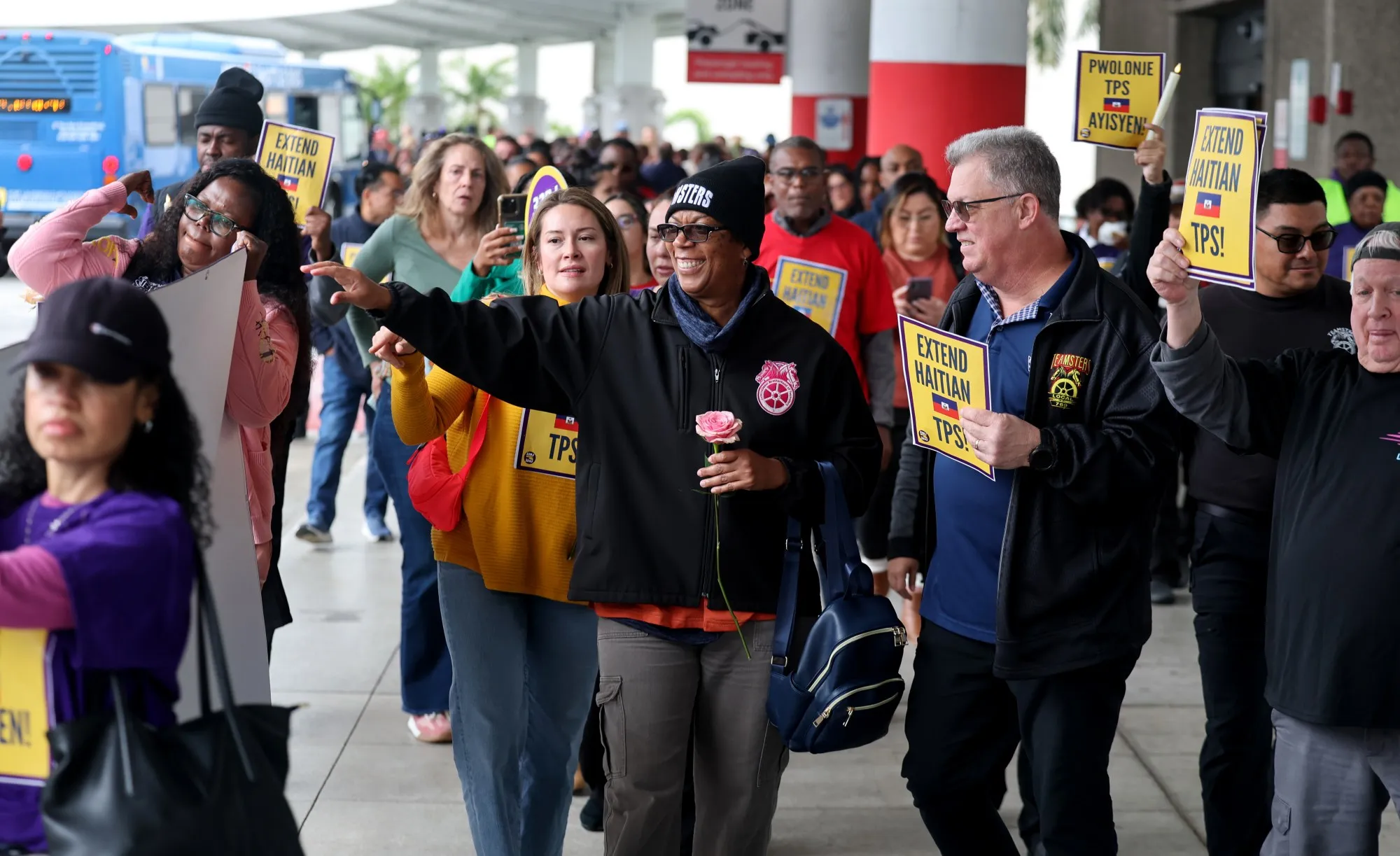
As a pep rally for Haitian immigrant airport workers gained steam earlier this month, a labor union official complained that many of her local’s 170 members who work there weren’t receiving the employer support they need to retain their Temporary Protected Status, which is targeted for elimination by the U.S. Government.
Read more America braced for the World Cup; instead, it fell in love
Despite a succession of last-minute extensions by federal immigration authorities, time appears to be finally running out for thousands of Haitian immigrants in South Florida. Come Monday, employers across the region’s health care, hospitality, and construction sectors face a potential hard deadline to terminate staff who rely on Temporary Protected Status. With the Trump administration pushing to eliminate the program, local trade groups are begging Washington for more time so these workers can figure out another legal way to stay.
The tension is already boiling over at Fort Lauderdale-Hollywood International Airport. During the rally on July 10, Wendi Walsh, secretary-treasurer of UNITE Here Local 355, reeled off the names of several concession operators and accused them of remaining silent as the administration fought in the courts.
“There is one group who is not in this room today,” declared Walsh. “There is a clear silence among our employers who should be standing up for our workers. This is an airport full of Haitian workers … we are listening and we hear nothing about you standing up for your workers.”
Then she called out one of the biggest employers at the airport: Areas USA, which operates restaurants at airports, rail stations, and roadside rest areas.
“We heard nothing from Areas USA,” Walsh told her audience. “Instead they are terminating people today.”
Around the nation that Friday, there were reports of widespread firings of Haitians as employers operated under the assumption that July 10 was the final TPS termination date in a long line of such dates. But then, the U.S. Citizenship and Immigration Services quietly announced on its website that another extension was in play, this time until July 24.
Areas USA, reached after the rally for comment, declined to discuss its airport employees’ status, citing privacy considerations.
But in a statement, a spokesperson said the company is focused on following federal law.
“Like all U.S. employers, Areas is required to comply with federal law and employment-eligibility requirements,” the spokesperson said. “When federal law no longer permits an individual to work, we cannot legally continue their employment, and any resulting action is based solely on the absence of legally required work authorization.
“Areas will continue to employ every individual who remains legally authorized to work, and we are consistently monitoring guidance from USCIS and the Department of Homeland Security, including any judicial or administrative developments that may affect the July 27 date,” she said, citing the latest date in which the government can act to end TPS for Haitians. “We are communicating directly with potentially affected employees and are committed to complying with the law while treating every team member with dignity, consistency, and respect.”
It is not known what the company and others that employ Haitian workers in South Florida plan to do this time. Industry trade groups including the Florida Health Care Association and Florida Restaurant and Lodging Association have asked the government to allot more time so members can make work force adjustments and/or help the affected Haitian workers find alternate ways to stay in the U.S.
Determined administration
The government itself appears to have kept its own counsel in the face of those requests. Its actions, however, make it clear that it remains steadfast in its determination to end TPS programs for not only Haitians, but also for those allowing other foreign national groups to remain in the U.S.
On Wednesday, a Republican-dominated U.S. Senate blocked an effort by Democrats to adopt a House action designed to extend TPS for Haitians another three years.
Even before the vote and with the Supreme Court decision in hand, the government reportedly started twice-a-week deportation flights to Haiti.
On Tuesday, the Department of Homeland Security announced more than 100 people with criminal backgrounds had been returned to the Caribbean nation on July 16 aboard a deportation flight.
“Last week, ICE deported pedophiles, carjackers, drug traffickers and perpetrators of fraud to Haiti,” Assistant Secretary Lauren Bis said in a news release. “Criminal illegal aliens have NO place in American communities. Our message to illegal aliens is clear: LEAVE NOW. If you don’t, we will find you and deport you.”
In late June, the U.S. Supreme Court ruled the Department of Homeland Security could finally terminate Temporary Protected Status for Haiti, an exercise that started last summer only to become immersed in court challenges from rights groups representing immigrants. The court held that the TPS statute bars judicial review of non-constitutional challenges to the Secretary of Homeland Security’s decisions to extend or terminate Temporary Protected Status.
The court also concluded that the people challenging the end of the Haiti TPS designation were not likely to succeed on their equal protection claims, which are still being pursued by lawyers. They have until July 31 to possibly amend their complaint to include discrimination claims on the Haitians’ behalf. But those claims, the Supreme Court itself declared, are unlikely to succeed.
But this past Wednesday, the Trump administration was denied a request by the U.S. Court of Appeals for the District of Columbia Circuit to end the program Friday. The court promptly set this Monday, July 27, as the date when the Administration can cancel TPS for Haitians.
Bureaucratic “fire drill”
Companies and their legal advisors have found it next to impossible to keep pace.
“We’ve been running this fire drill for the past couple of weeks,” said Stefanie Camfield, associate general counsel for Hollywood-based Engage PEO, an employment law advisory firm for businesses. “July 1 then the 10th, the 24th and now the 27th. All of this confusion for employers is really frustrating. I literally weeks ago had to tell my clients, ‘you have to wait and see.’ They keep pushing the date back.”
“If somebody has a work authorization, you can’t terminate them,” she added. “You can end up with a national origin discrimination claim.”
Read more Supreme Court litigator gets 6 years in prison for tax evasion case after gambling millions on poker
“Employers are expected to keep an eye on this. I don’t know how a small business owner can keep up. I’m having trouble keeping up and I’ve been practicing law for 18 years,” Camfield said. “I feel for the people whose employees are directly impacted. Employers are stuck in this impossible situation. They want to help [workers] however they can but they can’t continue to employ them once the work authorizations are terminated.”
Fear and confusion across industries
For decades, Haitians have migrated to South Florida from their Caribbean nation to escape authoritarian rule, organized gang violence, assassinations, kidnappings, military interventions, disease, and natural disasters.
The TPS now in force was authorized in 2010 after an earthquake flattened cities and killed thousands. Conservative critics in the U.S. argue that Haiti TPS has gone beyond temporary and become permanent through repeated renewals. Advocates counter the danger and suffering endured by Haitians in their homeland that has been continuous and far from temporary.
Hopes that an estimated 350,000 Haitian immigrants would be allowed to remain in the United States past the summer were deflated by the Supreme Court ruling and in Congress, where the U.S. Senate on Wednesday refused to consider a House action that would have extended their stays for three years.
In the interim, South Florida industries served by thousands of Haitian immigrants — such as health care, hospitality, construction and transportation — are finding it difficult to manage.
“I have had many calls from various tourism and hospitality industry venues, businesses, and owners,” said Peter Ricci, director of the hospitality and tourism management program at the Florida Atlantic University College of Business. “A large number of them have Temporary Protected Status employees from various countries over many years of doing business in South Florida. All are concerned about the loss of these individuals and their potential need to replace the workers. Further, there are simply the ‘human concerns’ with many of them being long-term employees, often over a period of many years.
“The main concern at this point is the ongoing change of time for their workers,” Ricci said in an email to the South Florida Sun Sentinel. “If they had a firm date, many are willing to assist their current TPS-protected workers with return-to-country flight assistance or other manners. However, with the extensions [being] somewhat of a ‘moving target’ in terms of dates, they are equally frustrated.”
He noted that for an industry that staffs hotels and restaurants based on anticipated visitor volume, not knowing whether workers will be available to fill a one- or two-week work schedule “is confounding to operators.”
Candice Mondesir, executive director of the Haitian-American Chamber of Commerce of Florida, said in an interview that the impact of ousting thousands of Haitians will be felt far beyond the labor market.
Haitian immigrants, she said, contribute $2.6 billion to the statewide economy.
“A good portion,” she said, support the health care system in South Florida as nurses and care workers. “A lot of hospitals hire Haitian TPS workers — they run very heavily into nursing.”
Throughout Miami-Dade, Broward and Palm Beach counties, many own businesses and hold home mortgages and car loans.
“They’re entrepreneurs,” Mondesir said. “They pay taxes like everybody else. What happens when you say, ‘this person is not legally here’? What happens to the Social Security number and the money they paid into Social Security? A lot of times there are so many different things that I don’t think people are looking at the full blown picture. It’s a whole ecosystem that is going to be disrupted.”
In the streets of cities such as North Miami and North Miami Beach, “you see them affected by it. A lot of the businesses are struggling because people are afraid to come out.”
“Parents are scared to send kids to school in August,” Mondesir added. “There’s a lot coming down the pipeline and it’s terrifying.”
Contingency planning abounds, she said, with many people examining the possibility of moving to Canada because that nation “has an easy pathway to citizenship and residency.”
Narrow options ahead
State Rep. Marie Woodson, a Democrat whose district includes Hollywood and Pembroke Pines, aired what many supporters of the Haitian community have been advocating: action by Congress that will provide a long-term extension of TPS and a pathway to citizenship.
““Give them a path to citizenship, that’s what they need, especially people with no criminal records,” said Woodson. She migrated to South Florida from Haiti in 1981, when the country was ruled by dictator Jean-Claude “Baby Doc” Duvalier, who became “President for Life” after the death of his father, François Duvalier.
“The situation to me, it’s more than concerning,” Woodson said. “It’s heart-wrenching to me. You have human beings — law-abiding people who came here legally and they have made a life, which means a lot of them are working.”
On Friday, some lawmakers reportedly met with immigration law experts and community leaders to discuss legal options, as well as ways to keep people safe if Immigration and Customs Enforcement agents start a deportation roundup.
Renata Castro, a longtime immigration lawyer based in Coral Springs, forecast a long road of arrests and litigation.
“Once the TPS expires, I believe that the government is going to detain people very rapidly just to spread fear in the community,” she said. “And after that, as litigation goes forward you will see people released as injunctions will be granted. I wouldn’t be surprised if we get to a place where litigation of this case will end only when we have a new president, which I wouldn’t complain about.”
Read more 502 students lose spots at Howard University over tuition payments just weeks before classes start
Countdown to the End of Haiti TPS
- June 2025: Homeland Security Secretary Kristi Noem announces Haiti TPS will be terminated.
- July 2025: Rights groups sue the government.
- November 2025: Department of Homeland Security announces termination of Haiti’s TPS designation. Later, a federal district court postpones it, finding the decision inconsistent with the law, and potentially in violation of equal protection.
- Feb. 3, 2026: An expiration deadline is placed on hold by a judge.
- June 25: The Supreme Court rules the Trump Administration may terminate TPS programs without undergoing judicial review.
- July 10: U.S. Citizenship and Immigration Services extends TPS until July 24.
- July 22: U.S. Court of Appeals for the D.C. Circuit denies Administration effort to end TPS on Friday, July 24, saying it must wait until Monday, July 27.