
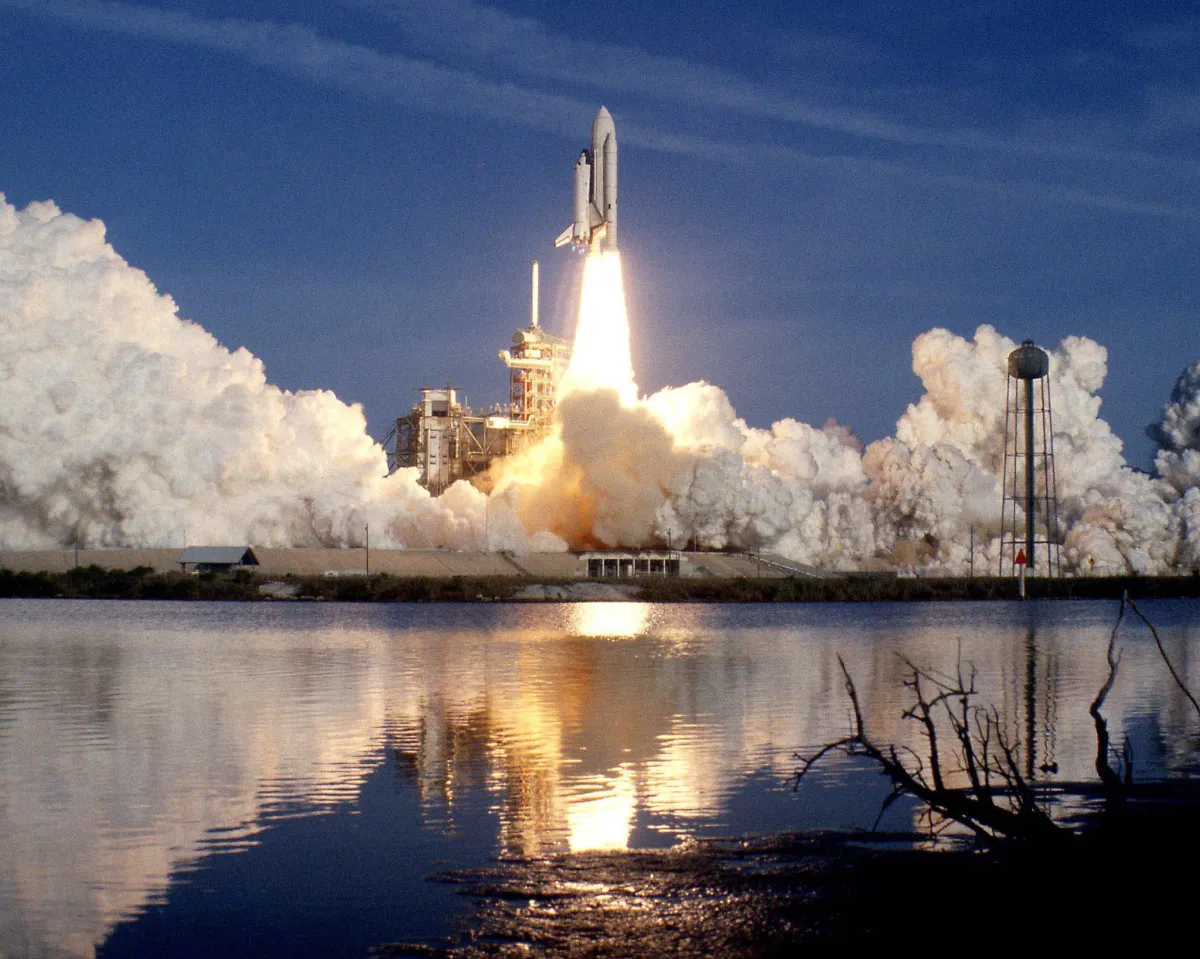
The space shuttle era began on April 12, 1981, when Columbia became the first in NASA’s reusable spaceplane fleet to rocket into obit.
Read more Guest Commentary: Democrats should be rushing to convert more Trump skeptics
Veteran astronaut John Young of Orlando and rookie Bob Crippen flew Columbia into orbit on its second launch attempt, ending a nearly six-year drought of America sending humans to space.
While the launch went fine, there were some worrisome moments for NASA. After the shuttle entered orbit and opened its cargo bay doors, it was evident that Columbia had lost some critical heat-shield tiles during its ascent.
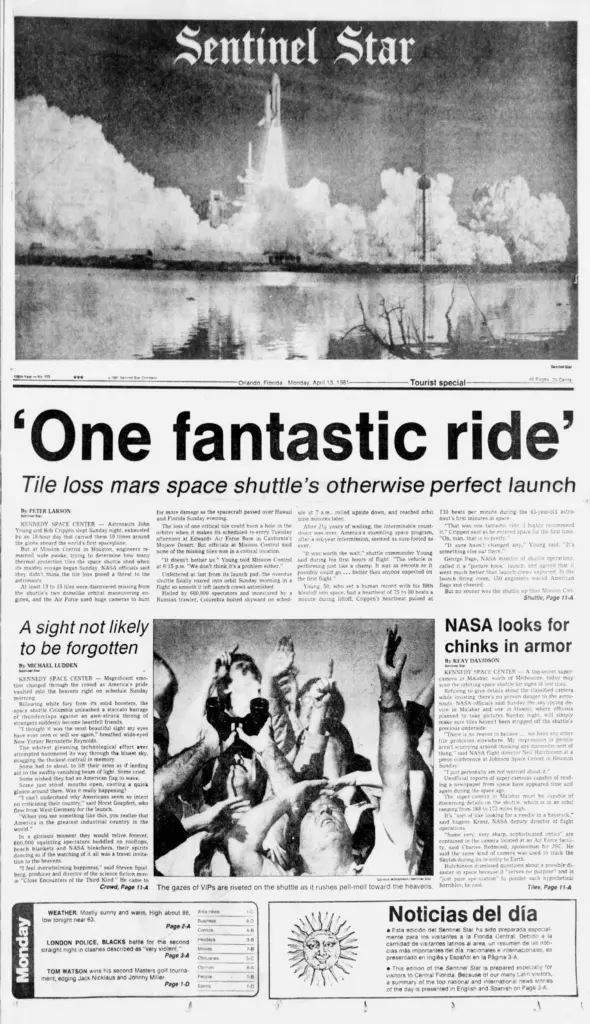
Here’s part of Sentinel Star reporter Peter Larson’s account of the first space shuttle launch from our front page on April 13, 1981. The headline was “One fantastic ride.’
Astronauts John Young and Bob Crippen slept Sunday night, exhausted by an 18-hour day that carried them 10 times around the globe aboard the world’s first spaceplane.
But at Mission Control in Houston, engineers remained wide awake, trying to determine how many thermal protection tiles the space shuttle shed when its maiden voyage began Sunday. NASA officials said they didn’t think the tile loss posed a threat to the astronauts.
At least 13 to 15 tiles were discovered missing from the shuttle’s two domelike orbital maneuvering engines, and the Air Force used huge cameras to hunt for more damage as the spacecraft passed over Hawaii and Florida Sunday evening.
The loss of one critical tile could burn a hole in the orbiter when it makes its scheduled re-entry Tuesday afternoon at Edwards Air Force Base in California’s Mojave Desert. But officials at Mission Control said none of the missing tiles was in a critical location.
“It doesn’t bother us,” Young told Mission Control at 6:15 p.m. “We don’t think it’s a problem either.”
Unfettered at last from its launch pad, the overdue shuttle finally roared into orbit Sunday morning in a flight so smooth it left launch crews astonished.
Hailed by 600,000 spectators and monitored by a Russian trawler, Columbia bolted skyward on schedule at 7 a.m., rolled upside down, and reached orbit nine minutes later.
After 2½ years of waiting, the interminable countdown was over. America’s stumbling space program, after a six-year intermission, seemed as sure-footed as ever.
“It was worth the wait,” shuttle commander Young said during his first hours of flight. “The vehicle is performing just like a champ. It was as smooth as it possibly could go … better than anyone expected on the first flight.”
Young, 50, who set a human record with his fifth blastoff into space, had a heartbeat of 75 to 80 beats a minute during liftoff. Crippen’s heartbeat pulsed at 130 beats per minute during the 43-year-old astronaut’s first minutes in space.
Read more Black, Penda return to practice as Magic keep building identity under Sweeney
“That was one fantastic ride; I highly recommend it,” Crippen said as he entered space for the first time. “Oh, man, that is so pretty.”
“It sure hasn’t changed any,” Young said. “It’s something else out there.”
George Page, NASA director of shuttle operations, called it a “picture book” launch, and agreed that it went much better than launch crews expected. In the launch firing room, 150 engineers waved American flags and cheered.
But no sooner was the shuttle up then Mission Control discovered the potential problem with the tiles, which they noticed missing 90 minutes after launch as Crippen and Young opened the Columbia’s cargo bay doors for the first time.
Scanning the far end of the 60-foot bay, television cameras aboard the spacecraft revealed 13 to 15 tile cavities atop the maneuvering engine pods that power the shuttle in space.
At Mission Control, experts theorized that a sonic shock wave shook the tiles loose shortly after launch. The tiles protect the shuttle from intense heat when it re-enters Earth’s atmosphere. Downplaying the damage, NASA officials said none of the tiles was in a critical area and would not prevent the Columbia from landing safely.
“There is no reason to believe we have more serious problems anywhere else,” said flight director Neil Hutchinson. “People are not scurrying around thinking doomsday things.”
Hutchinson said a contingency team would study Air Force photographs of the orbiter shot from Malabar, south of Melbourne, and the Hawaiian island of Maui. The team also will investigate detailed films of the engine pods taken during the launch, information supplied by contractors, and data from instruments that record heat on the shuttle’s surfaces during launch.
Of all the trials and tribulations to beset the $10 billion shuttle, the tiles have been the greatest headache. Shortly after the shuttle arrived at the space center two years ago, it became apparent that most of the thermal protection work had to be pulled off, strengthened, and glued back on again.
Fabricated by Lockheed Corp. and installed by Rockwell, 30,922 protective tiles coat the shell of the orbiter like a heat-resistant skin.
Other problems encountered during the first day in space were minor. A data device that monitors the spacecraft’s performance began running continuously and had to be turned on a and off by 1 the astronauts with a circuit breaker. Communication was also difficult, and Hutchinson blamed the problem on the shuttle’s antenna being blocked from ground stations by the orbiter itself.
The Columbia is the largest, most sophisticated manned spacecraft ever launched – capable of carrying up to seven astronauts in normal flights and 10 in an emergency, plus a cargo the size of a bus.
More stories and features from the Orlando Sentinel’s 150 years of covering Central Florida can be found at OrlandoSentinel.com/150. Sign up for our free history newsletter at OrlandoSentinel.com/newsletters. Want more Orlando history? Buy a copy of the Orlando Sentinel’s 150th anniversary book with 150 front pages from our 150 years. Get it OrlandoSentinel.com/150yearsbook and see more anniversary merchandise at OrlandoSentinel.com/150yearsmerch
Read more In ‘Rainbow,’ 2 legendary Central Floridians are brought back to life