
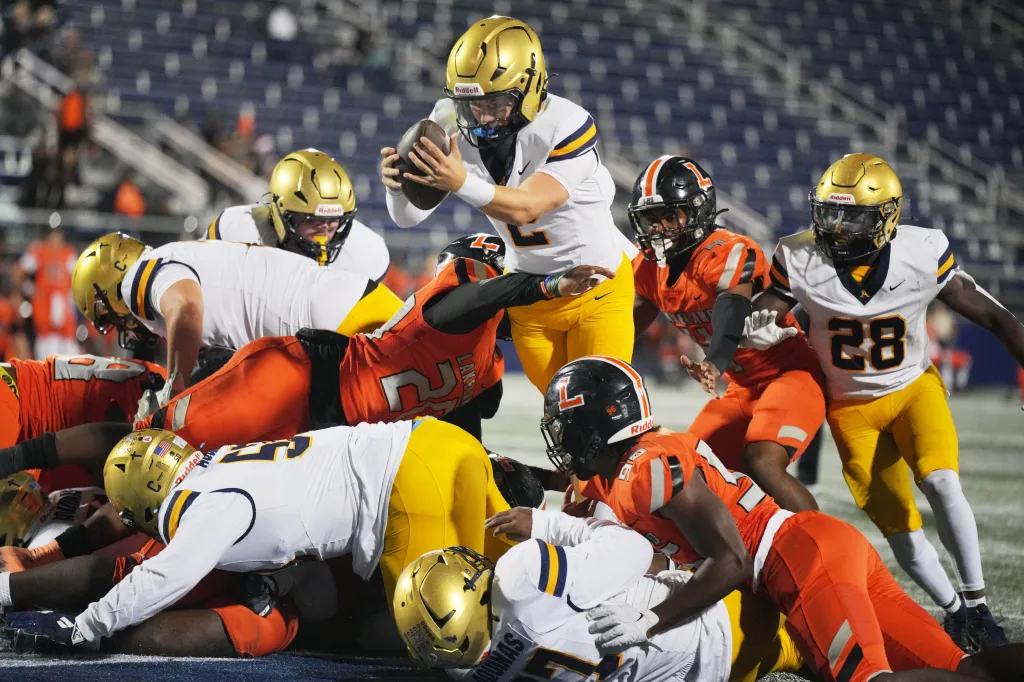
GAINESVILLE — The Florida High School Athletic Association finalized its groundbreaking Open Division playoff plan on Tuesday, setting the stage for the state’s eight highest-ranked teams in 11 different sports — regardless of school size — to compete against each other for one exclusive FHSAA championship starting with the 2026-27 school year.
Read more Gators’ Thomas Haugh: ‘It’s national championship or bust’ for star-studded roster
The association’s board of directors approved the plan, designed to improve competitive balance and fair play in the playoffs, by a 10-0 vote in a meeting at FHSAA headquarters in Gainesville.
The recommendation brought to the board by FHSAA executive director Craig Damon initially included eight major team bracket sports: football, girls volleyball, boys and girls basketball, boys and girls soccer, fastpitch softball and baseball. Three more Open Division titles, for girls flag football and boys and girls lacrosse, were added to the lineup after board members discussed the plan in a Monday committee meeting.
Damon said the additions were made because coaches on the lacrosse and flag football advisory committees asked to have Open Divisions for their sports.
Open becomes the eighth championship class, essentially replacing 7A. Teams outside the elite eight will continue to play for state championships in seven traditional classifications (1A-6A and Rural), where schools are placed based on student enrollment counts. Those brackets will stick with 32 teams per class with 16 district champions and 16 at-large teams.
Last year’s football Open Division playoffs would have included state champs St. Thomas Aquinas (Class 6A) of Broward County, Raines (3A) of Jacksonville, Cardinal Mooney (2A) of Sarasota, and Cardinal Newman (1A) of West Palm Beach — along with perennial powers Miami Northwestern (seven state titles), Miami Central (nine since 2010) and Armwood (titles in 2003 and 2004) of Hillsborough County.
Aquinas has set football records with seven consecutive state championships and 17 since 1992.
Chaminade-Madonna, which lost 17-14 to Cardinal Newman in the 1A final, set a record with its nine consecutive state final appearances — including seven titles in eight years (2017-24).
Among Orlando area teams, Lake Mary would have made the football Open cut in 2024, when it lost to Venice in the 7A final. But with a 7-3 regular season record last fall, the Rams would have stayed in 7A — where they won five playoff games and the championship.
Winter Park’s dynamic girls volleyball state title teams of the past two seasons would have been pushed to Open. Orangewood Christian’s 2025 Class 2A state runner-up would also have been elevated. Oviedo, the 6A state champ, would have been on the bubble.
This year’s historic Lake Highland Prep’s boys basketball team, which was 27-1 before losing a 3A region semifinal, would have been moved to a loaded Open Division including big-school juggernaut Miami Columbus (five 7A titles in a row), small-school powerhouse Sagemont (four straight) of Broward and Fort Lauderdale’s Calvary Christian, which was ranked No. 2 nationally by MaxPreps.
FHSAA board of directors tackles high school sports Open Division debate
Lake Highland Prep girls basketball, winners of five consecutive championships (2020-24), would have been top eight in all of those seasons — meaning showdowns with the likes of nine-time champ Miami Country Day.
Montverde Academy girls soccer, champs in three of the past seasons, would have gone Open. So would the Lake Mary girls, who won 7A titles the past two seasons. Bishop Moore’s boys soccer champs would have stayed in 4A.
No Orlando area baseball teams would have gone Open this spring. That sport’s Goliath is Parkland’s Stoneman Douglas, which won its record-setting large-class championship in a 7A field that included Hagerty.
The area’s softball Open representative would have been Lake Brantley, which ended up losing a 1-0 region final to Hagerty — which went on to win the 7A banner. The repeat 5A champ, Winter Springs, would have joined the Huskies in staying in their designated classification.
Read more Meet 4Roots Farm’s new senior culinary director: Hari Pulapaka
The Open teams will be selected after regular season play concludes for football and after district tournaments wrap up for the other sports. The football seeding will be based solely on MaxPreps’ computerized rankings. The other Open selections will be based on the FHSAA power rankings, which are also generated by MaxPreps but have differences.
A new twist for the Open tournament will be pool play.
Teams ranked 1, 4, 5 and 8 go to Pool A and the 2, 3, 6 and 7 teams make up Pool B. Each team plays the other three in its pool — with all getting at least one home game. The first and second place teams in each pool — based on their win-loss record — will advance to the state semifinal round.
It will be possible that three teams all go 2-1 in pool play. The FHSAA tiebreaker formula will use these determiners, in order:
1. Head-to-head results among tied teams.
2. Points allowed among tied teams only.
3. Point differential among tied teams only.
4. Overall point differential from all games.
Damon said the plan is for Open Division schools to share gate receipts for pool play games. He said the FHSAA will take a share of semifinal and final revenue to cover costs.
Tuesday’s vote marked another major move in the FHSAA’s effort to reach competitive equity for its more than 600 schools. That has been a challenge, as elite programs annually restock lineups with transfers and dominate.
The board in April approved creation of a separate football playoff system for the growing number of teams that opted out of district play and the state championship series. The new FHSAA Independent Division was built to offer postseason experiences for teams with games against opponents that have similar rankings.
FHSAA tees up football postseason for independent teams
Transfer change
In another hot-topic move, the board voted 8-2 to amend FHSAA by-laws and policies to dovetail with Senate bill 538, which becomes law on July 1.
SB-538 is designed to close the door on athletes playing sports for more than one school in the same season or school year; and tightens rules on “Non-Traditional” students.
Damon said the rules revisions were made by a consensus of stakeholders after many conversations with legislators and school administrators. He said the statute and the new FHSAA language were built to reel back on the abuses of school choice movements made for athletic reasons.
“School choice is a pillar of what we do here,” said board member Allen Shirley, principal at South Sumter High School. “But the freedom for choice has unintended consequences. You (should) live with your choice for at least one year. ”
FHSAA rules describe Non-Traditional athletes as the rapidly expanding number of students who are not enrolled in and do not physically attend the school for which they participate. Home-schoolers and students in charter schools and private schools that don’t have a specific sport previously were allowed to join teams in or outside the county they live in.
Now, in most cases, revised Bylaw 9.2.2.2 prevents students from joining a team outside their home county.
FHSAA board approves 7-class football plan with a twist for independents
Varsity content editor Buddy Collings can be contacted by email at [email protected].
Read more Winter Garden police sergeant arrested for stalking