
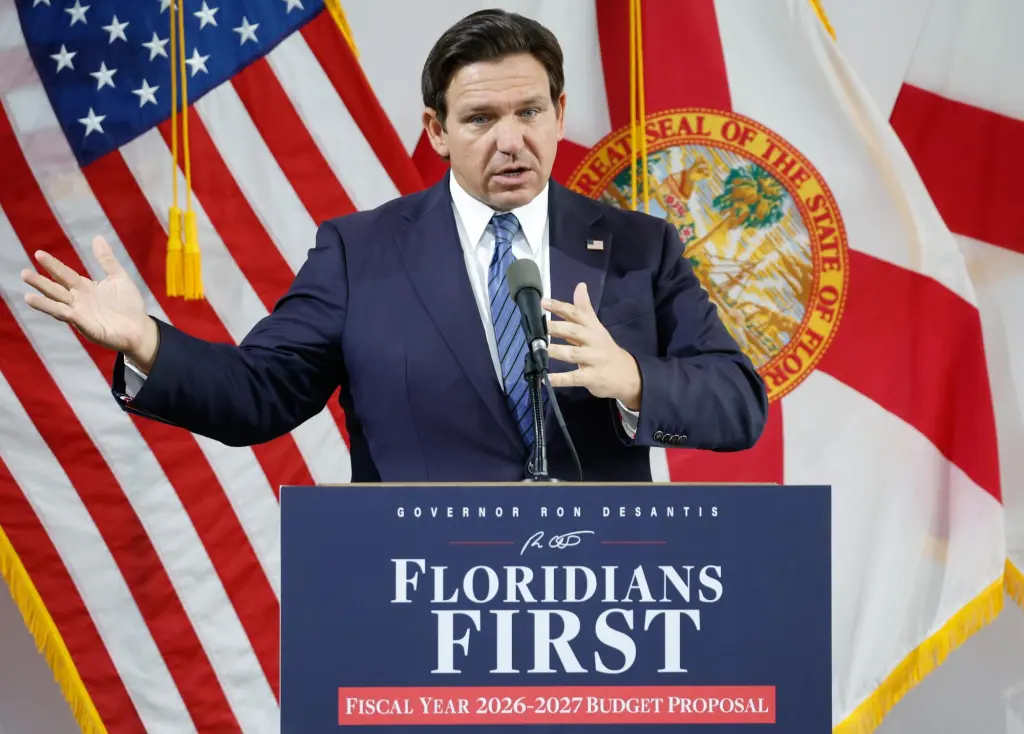
Gov. Ron DeSantis will soon list all of his line-item vetoes in a new state budget stuffed with pricey projects all over the state, many of them the result of highly secretive negotiations with too little public review.
Read more How to help your kindergartners prepare for school during the summer
If DeSantis is consistent, he will not explain his veto decisions. It’s obvious why: He flagrantly uses his veto pen for retribution and reward against individual lawmakers, slashing spending for projects in their district. This is nothing new, and this year’s budget presents him with a target-rich environment. In fact, lawmakers made it almost too easy.
And that is where Floridians should be the most vigilant — watching to see if DeSantis enforces the fiscal discipline that lawmakers could not find on their own, or simply perpetuates their partisan pettiness. Because in November, voters will be asked to shift a massive chunk of funding authority away from city and county governments to state lawmakers and Tallahassee bureaucrats. If this year’s budget is any indication of what they will do with that new power, voters will know that lawmakers and the governor simply cannot be trusted with that degree of responsibility.
Chop, chop
Of course, many Floridians aren’t looking that far ahead. They want to know what projects DeSantis is likely to kill in the budget sometime in the coming month.
Contrary to public opinion, greatly outnumbered Democrats won’t be the ones who suffer the most. The truth is that DeSantis rarely bothers to chase after the crumbs that they secure. This budget has vastly more Republican pork-barrel spending for Republicans. And the final produc shows an even further concentration, with the most powerful lawmakers scoring state funding for projects that are shameless about funding their personal pork by willfully plundering parts of the budget dedicated to other priorities.
Playing powerball
In the long run the only priorities that matter are dictated by clout. Almost all the guardrails intended to guide state dollars toward projects of merit — rules set by the Legislature itself and diligently observed by the groups requesting money and the state agencies that review those requests — are trampled as soon as they are established.
That shows this year, more than ever, in Florida TaxWatch’s release of its annual Budget Turkey Watch. The report lists 621 specific projects, totaling $830 million, that merit veto consideration because they bypassed established budget rules — in an “austerity” budget, no less. It’s a solid methodology for evaluating state dollars directed toward local government.
The report lists 484 more member projects, totaling $441 million, that show astonishing legislative audacity.
The TaxWatch report is written in a deferential tone, often reminding readers that despite carrying a “turkey” label, many projects are very worthwhile.
But its conclusions are savage: Many projects on its list were slipped into the spending bill in secret, sometimes by stripping money from other priorities.
The system exposes rank hypocrisy by House and Senate leaders. Some of the misdirection hits statewide. For example: A $260 million fund dedicated to maintenance and repairs at Florida’s universities and state universities was instead funneled to public charter schools.
But the most egregious offenses occurred in the realm of money sent to individual communities.
What ranking?
TaxWatch points out hundreds of projects where the Legislature created objective, prioritized rules for evaluating pleas for money that produced ranked lists. Then, safely behind closed doors, they tossed aside their carefully-crafted list in favor of raw power.
One truly glaring example is $9.5 million for a new library in rural Hardee County, the home of Senate President Ben Albritton, R-Wauchula.
Read more Rain chances increase inland and along the coast, heat wave incoming
For two years, Albritton’s singular priority of a “rural renaissance” for Florida’s often-neglected small counties was thwarted by House Speaker Daniel Perez, forcing the senator to find other ways to bring home the bacon.
We’re not sure where this project fell on the ranked list of library construction applications for the next budget year. The list is not on the Florida Department of State website, though it should have been visible months ago.
It doesn’t matter much in this case, however, because the project was funded from a separate pot of money set aside for cultural facilities. That official ranked list isn’t available online for the 2026-2027 budget year, either. Here’s what we can say about the cultural facilities grants: They are typically no more than $500,000, meant to support smaller facilities, repairs and expansions.
Hardee County’s new library will draw $9.5 million from that fund, nearly one-quarter of its total. That means at least 19 other projects that would have otherwise been funded were squeezed out — by a project that didn’t belong in this category at all. Adding a little extra touch of insult: Another library grant — also from a county Albritton represents —- will sip another $500,000 from the cultural facilities pot.”
Wanna bet?
TaxWatch says DeSantis should veto it. Will he? We doubt it.
The governor’s friends don’t get their stuff vetoed.
Albritton worked hard to be a DeSantis ally. He carried the governor’s dirty water on the two most highly contentious issues: a gerrymandered map of Florida’s 28 congressional districts and the property tax amendment on the November ballot.
Perez got in on the action as well. TaxWatch found nine major state university projects, worth $65 million, that were not on the state’s own priority list. Among them, allocations were targeted for Florida International University, which is in Perez’s district: First, $15 million for its Wall of Wind hurricane and storm surge simulator.
Don’t get us wrong — this simulator is an impressive facility that could help strengthen all of Florida’s response to rough weather.But what would this money go to? If it’s such a great idea, why didn’t it rank near the top of the university capital projects list on its own merit?
The same can be said for the $5 million for FIU’s Aquarius Reef Base, which explores the ability of human beings to live under water.
The cultural/library funding and the FIU allocations are just two examples. There are dozens more, but only a few are in Orange County — because its largely Democratic delegation didn’t have the clout to land any big fish.
Pay attention
Regardless of what DeSantis does, the Legislature can cancel out his line-item vetoes by a two-thirds vote of each chamber. They probably won’t. They don’t want to call attention to their own power plays, they don’t want to poke DeSantis in the final months of his governorship, and most of all, they should be wary that voters would see just how fiscally irresponsible they were. There may be more proof forthcoming on that: Today, we’re spotlighting projects that were smuggled into the budget in the dark, but we’re also hearing about big pots of money that appear to be giveaways to well-heeled donors. We’ll keep looking.
And we’re also pretty sure that some of DeSantis’ vetoes will spark genuine outrage. Meanwhile, he can’t do anything to restore funding that should have been in the budget but was diverted — such as the $100 million for conservation and preservation through the voter-mandated Florida Forever fund, or significant money to restore the troubled Indian River Lagoon.
No matter what the governor does, however, he can’t hide one basic fact: lawmakers had the chance to prove they could do a better job than city and county officials at being fiscally responsible. They blew it. Big time.
The Orlando Sentinel Editorial Board includes Executive Editor Roger Simmons, Opinion Editor Krys Fluker and Viewpoints Editor Jay Reddick. The Sun Sentinel Editorial Board consists of Executive Editor Gretchen Day-Bryant, Editorial Page Editor Steve Bousquet, Deputy Editorial Page Editor Dan Sweeney and editorial writers Pat Beall and Martin Dyckman. Send letters to [email protected].
Read more Hurricane center begins tracking 1st Atlantic basin system with chance to form