
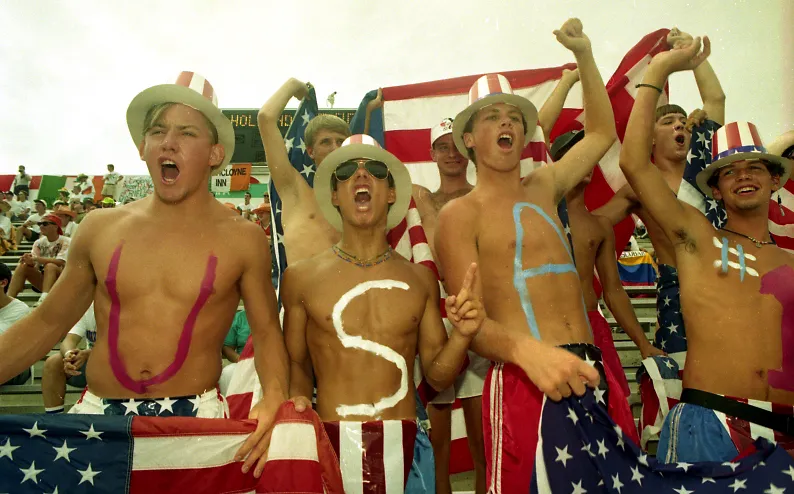
On Thursday, the FIFA World Cup begins in the United States, bringing with it all the familiar trappings of modern international sports: billion-dollar television contracts, eye-popping ticket prices, endless social media debate and the promise of a global audience.
Read more Orlando roads are still dangerous for walkers — but they’re getting better
For Orlando, however, the tournament’s arrival carries something deeper. It stirs memories of another World Cup, another summer and another America.
More than three decades ago, Orlando found itself at the center of the sporting universe when the 1994 World Cup came to the United States for the first time. For three unforgettable weeks, Central Florida became an international crossroads where Dutch fans danced in the streets, Irish supporters sang songs long into the night, Mexican fans transformed the Citrus Bowl into a sea of green and thousands of visitors from around the globe discovered that Orlando was much more than theme parks and sunshine.
For those who experienced it, the memories have never faded.
Perhaps that is because the summer of 1994 feels increasingly like a different world altogether. America was hardly free of problems then, but life moved at a slower pace. There were no smartphones documenting every moment, no social media outrage cycles and no political tribalism invading every corner of daily life. Communication happened through fax machines and landline telephones. People gathered in person. Strangers talked to one another. Communities celebrated together.
Today’s World Cup arrives under very different circumstances. The conversation surrounding the tournament has often centered on soaring ticket prices, at a time when inflation continues to strain family budgets. International tensions dominate headlines. Immigration policies have become flashpoints in a nation preparing to welcome teams and supporters from every corner of the globe. Before a single match has been played, controversy seems to have claimed almost as much attention as the soccer itself.
That’s one reason so many Orlandoans still look back fondly on 1994.
Back then, the focus wasn’t on politics or pricing. It was on possibility.
And no one embodied that spirit more than Joanie Schirm.
Ironically, Schirm wasn’t even a soccer fan when she became the driving force behind Orlando’s effort to land World Cup matches. She hadn’t played the game. Her children weren’t involved in the sport. What she saw instead was an opportunity to place Orlando before billions of television viewers and introduce Central Florida to the world.
That vision wasn’t universally shared.
In the late 1980s, Orlando was still very much a football town. College football dominated the sports landscape, and soccer was often dismissed as a foreign curiosity. Some civic leaders questioned why Orlando should pursue the event at all. Others openly resisted the effort. Schirm found herself navigating a community where major decisions were still often controlled by a good-ol-boy network that wasn’t eager to embrace a woman leading the effort to pursue a sport many barely understood.
Yet, with her marriage on the rocks and having just been laid off from her job, she persisted and persevered.
Alongside a small group of believers, Schirm launched what would become a four-year grassroots campaign to bring the World Cup to Orlando. They held meetings, raised money, spoke to civic groups, courted business leaders and assembled a bid that eventually weighed 23 pounds. Looking back now, it is difficult to imagine a more unlikely coalition. A handful of volunteers in a football-crazed Southern city were trying to convince the world that Orlando belonged on soccer’s biggest stage.
“There was some resistance at first,” Schirm remembers. “It was a macho thing initially where some didn’t want a woman leading the effort, but the important thing is that we all came together in the end as a community and made it happen.”
The effort paid off on March 23, 1992, when Orlando was named one of only nine host cities for the first World Cup ever played in the United States. A crowd gathered at Church Street Station to watch the announcement. Only Schirm and one other insider already knew Orlando had been selected. Everyone else sat anxiously waiting as city after city was announced before finally hearing Orlando’s name called.
“A surreal moment,” Schirm remembers now. “We had been through so many ups and downs and to finally hear our name called was an amazing feeling.”
What followed changed the city forever.
When the tournament arrived in June 1994, Orlando welcomed more than 320,000 spectators for five opening-round matches and a Round of 16 game. Workers transformed the dome of City Hall into a giant, black-and-white Adidas soccer ball. More than 4,000 volunteers helped visitors from Belgium, Ireland, Morocco, Mexico and the Netherlands navigate a city that suddenly became one of the most international places in America. The economic impact exceeded $200 million, and global television audiences measured in the billions were introduced to a community that knew how to throw a party.
The soccer itself was memorable, but what people still talk about today is the atmosphere.
Downtown Orlando became one giant international street festival.
Church Street Station was the epicenter of the celebration. Every evening after matches, thousands of supporters poured into downtown bars, restaurants and sidewalks. Dutch fans dressed head-to-toe in orange mingled with Irish supporters dressed in green. Mexican fans sang. Belgian fans toasted strangers. Languages from around the world filled the humid Florida air.
The scene was so festive and unifying that The Wall Street Journal famously remarked that the United Nations should send observers to Orlando “to see how it (international harmony) is done.”
The Netherlands Consul General wrote: “The World Cup Orlando became a party promoting soccer and mutual understanding.”
One of the enduring images came after the Netherlands defeated Ireland on the Fourth of July. Crown Prince Willem-Alexander of the Netherlands — today the King of the Netherlands — joined the celebration and danced on the Church Street pedestrian bridge. Wearing an Orlando World Cup T-shirt and OPD hat, he danced with supporters and reveled in the atmosphere as Dutch and Irish fans packed the streets below.
Read more Christina Grimmie shooting death in Orlando happened 10 years ago
Meanwhile, local beer distributors discovered they had badly underestimated the partying capacity of World Cup supporters. One distributor reportedly ran out of beer entirely and had to scramble for additional supplies. Despite the shoulder-to-shoulder crowds, police reported remarkably few incidents. The Irish and Dutch, who were supposed to be rivals, spent much of the evening embracing one another and singing together.
The anxiety beforehand now seems almost comical. Some local officials worried that soccer hooliganism would descend upon Orlando. The local sheriff was reportedly so concerned that he wanted tanks deployed as a show of force. Fortunately, cooler heads prevailed.
What Orlando received wasn’t chaos.
It was a celebration.
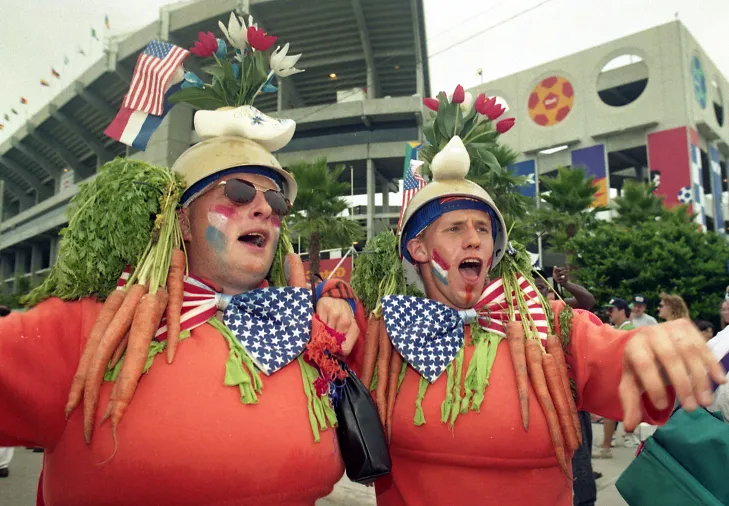 In the 1994 World Cup, Holland defeated Ireland 2-0 on July 4, 1994 at the Citrus Bowl in Orlando. (Orlando Sentinel file)
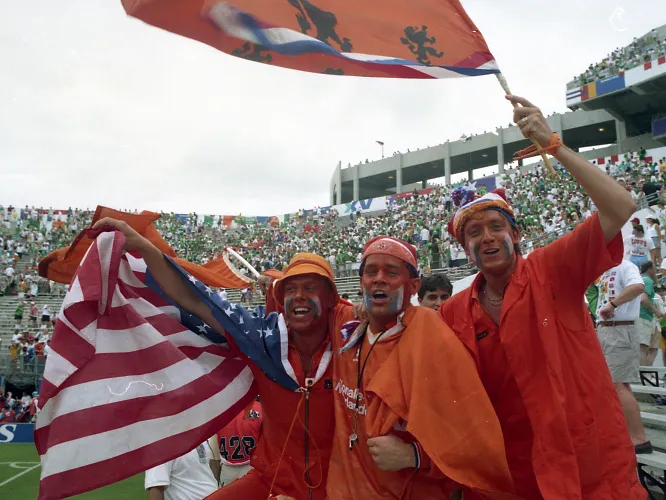 In the 1994 World Cup, Holland defeated Ireland 2-0 on July 4, 1994 at the Citrus Bowl in Orlando. (Joe Burbank/Orlando Sentinel file)
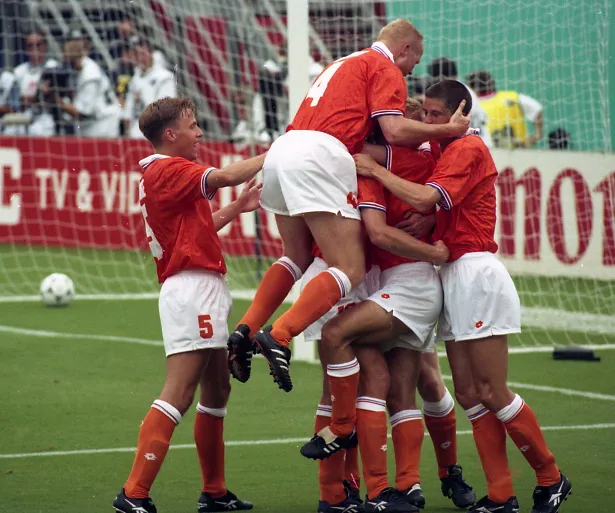 In the 1994 World Cup, Holland defeated Ireland 2-0 on July 4, 1994 at the Citrus Bowl in Orlando. (Joe Burbank/Orlando Sentinel file)
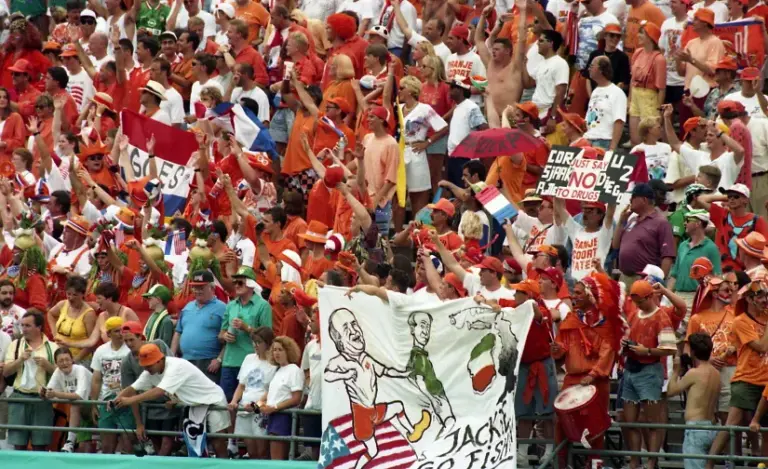 In the 1994 World Cup, Holland defeated Ireland 2-0 on July 4, 1994 at the Citrus Bowl in Orlando. (Orlando Sentinel file)
The stories from that summer have only grown richer with time.
Orlando Sentinel Sports Editor Kathy Laughlin remembers the World Cup through a particularly personal lens. Then a Cleveland resident, she happened to be in Orlando for her wedding. Her husband’s family lived in Central Florida, and the wedding guests were staying at a Winter Park hotel that suddenly found itself overrun by Dutch supporters.
Orange was everywhere.
The Dutch fans filled the hotel, filled the bars and filled the surrounding streets. The night before the wedding, they serenaded the future bride and groom with Dutch soccer songs in the hotel bar. What should have been a simple wedding weekend became a front-row seat to one of the most colorful moments in Orlando history.
“Everyone thinks their wedding is special and memorable, but having dozens of Dutch soccer fans — strangers of course — joyfully celebrating with the wedding party felt like a global hug,” Laughlin says. “It was unforgettable.”
Then came another challenge.
Months earlier, the wedding party had ordered a keg of Heineken for the reception. By the time the wedding arrived, Dutch supporters had apparently consumed nearly every keg available in Central Florida. The supplier couldn’t find one anywhere. Eventually, someone had to make the emergency drive to Tampa to secure the beer.
Former Orlando Sentinel sportswriter George Diaz reflects on the same theme that many others remember. Diaz, who is of Cuban descent, covered the World Cup for the Sentinel and was playfully called a “Mexican spy” by legendary Irish coach Jack Charlton.
Diaz says the World Cup wasn’t simply a sporting event; it was a cultural moment. It introduced Orlando residents to people, traditions and perspectives from around the globe. It allowed visitors to see Orlando as more than a tourist destination. For a few weeks, everybody belonged to the same giant community.
“It was just a fun, festive time where everybody came together,” Diaz recalls.
However, the lasting legacy of that summer extends far beyond nostalgia.
The World Cup not only gave Orlando cache; it gave us confidence.
It demonstrated that the community could successfully host a global event. That credibility helped Orlando secure Olympic soccer matches for the 1996 Atlanta Games. It accelerated youth soccer participation throughout Central Florida. It laid the foundation for Orlando City’s eventual arrival in Major League Soccer and the creation of the Orlando Pride in the National Women’s Soccer League. It helped establish Orlando as a destination for international sporting events rather than simply a destination for tourists.
It also was a harbinger of things to come at Florida Citrus Sports.
FCS, under late, great former CEO Chuck Rohe, was once largely a college-football organization, but Rohe threw his weight behind the World Cup effort. A young Steve Hogan partied on Church Street during that ’94 World Cup and saw the “epic passion” of international soccer firsthand and would start working at FCS a year later.
Hogan is now the CEO of Florida Citrus Sports, an organization that has gradually evolved into a major player in the burgeoning business of international soccer. Today, Florida Citrus Sports not only hosts some of the globe’s major brands — Chelsea, Arsenal, Real Madrid, Barcelona, etc. — for matches in Orlando but also helps manage soccer events throughout the United States and around the world.
“Back then, the World Cup showed us what was possible,” Hogan says today. “In the years since, I’m proud of the fact that we have fought for our share of the pie in a very competitive global soccer marketplace. Now, we’re getting our share of the pie, and we’re eating it in style.”
You see, the story of Orlando’s 1994 World Cup isn’t really about soccer.
It’s about vision.
It’s about a community willing to embrace something unfamiliar. It’s about volunteers who believed they could accomplish something extraordinary. It’s about a city discovering that it could compete on a global stage. And it’s about an unlikely leader named Joanie Schirm who saw possibility where others saw risk.
Today, as another World Cup begins in America, the circumstances may be different. The world certainly is. The headlines are louder. The politics are sharper. The costs are higher. The divisions often seem deeper.
But perhaps that’s why the memories of 1994 continue to resonate.
For three remarkable weeks, people from different countries, different religions, different cultures, different languages and different backgrounds came together in Orlando and found common ground.
The Irish sang.
The Dutch danced.
The Mexicans cheered.
The Moroccans celebrated.
The Belgians toasted new friends.
And Orlando opened its arms.
For a brief and glorious moment, the world came to town.
And when it left, Orlando would never be the same again, having discovered just how big and bright our future could be.
Email me at [email protected]. Hit me up on social media @BianchiWrites and listen to my radio show “Game On” every weekday from 3 to 6 p.m. on FM 96.9, AM 740 and 969TheGame.com/listen.
Read more SpaceX IPO: A glossary to help understand what happens in an initial public offering